Hilchos Shileyach Tzeeboor — The Law of a Prayer Leader
דִּין הַשְּׁלִיחַ צִבּוּר
Supplied source editions: Likutay Halachos, Volume 4. Additional supplied English paragraphs retain their nonexclusive reference spans and qualifications; no Hebrew counterpart is manufactured. Source qualifications and editorial learning aids remain separate from original teaching. Earlier personal annotations were not migrated.
Hilchos Shileyach Tzeeboor
The Law of a Prayer Leader
דִּין הַשְּׁלִיחַ צִבּוּר
Source basis
Based on the Torah-teaching “VaYoamehr Boaz el Ruth” – And Boaz said to Ruth [Likutay Moharan 65], see there.
For the essential tikun of tefillah is through the shileyach tzeeboor [the prayer leader] — for he is the choicest of the congregation. He must be fitting and worthy. He is the aspect of the bal hasadeh [the master of the field] — the head of the congregants. Therefore he is called "oavair lifnai hataivah" — "one who passes before the Ark" — for he has already reached the tachlis [the ultimate purpose] and makes the entire tefillah into one. Therefore he can "pass before the Ark" — moving to the Ark that is beyond it, as explained there. For even when he is at the second Ark, even at the end of tefillah, he is always passing before the first Ark — meaning he never departs from the first word, but constantly passes before it. And because of this very thing he can move to the second Ark.
Therefore the shileyach tzeeboor repeats the tefillah — showing that he grasps the tachlis, which is all one. Even though he has finished the tefillah, he is still at its beginning, at the word "Baruch" — demonstrating that it is all one, its end embedded in its beginning and its beginning in its end. Therefore the shileyach tzeeboor is called Chazan — from a term of vision and gazing, in the aspect of (Bamidbar 24): "Machazeh Shakai yechezeh" — "He beholds the vision of the Almighty" — for he beholds and sees the tachlis, through which he can pray properly.
This is what our Sages said (Rosh HaShanah 34b): "Why does the shileyach tzeeboor pass before the Ark? To fulfill the obligation of one who is not proficient." For one who is close to the tachlis and makes the entire tefillah into one — even when at the end of tefillah, he is still at its beginning, for he does not forget the first word — he is the aspect of baki [proficient], like one who is so expert in a matter that he can encompass it in a single statement and never forgets its beginning even when at its end. But one who cannot make the tefillah into one — when he is at the second word, he forgets the first, and cannot be swift in his tefillah to encompass it in oneness, due to his lack of proficiency — the shileyach tzeeboor, the chosen one who has reached the tachlis, fulfills his obligation and rectifies his tefillah by encompassing it in oneness.
Therefore every davar shebikdushah [matter of holiness requiring a minyan] — such as Kedushah, Burchoo, and Kadish — is said only through the shileyach tzeeboor. For the essential kedushah comes through him — since he is close to the tachlis, he is entirely one, entirely good, entirely holy. And every davar shebikdushah requires no fewer than ten — for speech is the final level of kedushah, the aspect of Malchus [Kingship], the tenth level. Its essential tikun is by raising it and encompassing it in the One — which is entirely good, entirely holy — the head of all the levels. Thus one needs from the lowest level to the highest — the aspect of ten levels. Therefore the essential tikun of tefillah is with ten, for then one can rectify the speech by raising it from below to Above, encompassing it in the One.
This is the aspect of YBK — Yichud Brachah Kedushah [Unification, Blessing, Holiness] — for kedushah and brachah come through yichud [unification], the aspect of "all is one." Its gematria [numerical value] equals the names Havayah Elokim — indicating that through bittul [beetool - nullification] to the tachlis, all suffering and all dinim [judgments] — the aspect of Elokim — are nullified: Havayah sweetens Elokim, for it is all good, all one, all holy. And this is accomplished by directing one's vision to gaze upon the tachlis — this is YBK, the aspect of the tlas givunin di'aina [three colors of the eye] from the Zohar HaKadosh (Mishputim 116a), which are right, left, and center. This is the aspect of baki — which is the aspect of YBK — the aspect of the tachlis. For the unification of Havayah and Elokim is the tachlis itself, in the aspect of (Zechariah 14): "Bayoam hahoo yih'yeh Hashem echad ooshmoa echad" — "On that day, Hashem will be One and His Name will be One."
Summary and study aids — Hilchos Shileyach Tzeeboor
The Law of a Prayer Leader
Translator’s editorial summary and study aid; not original teaching
Translator's Summary — Prayer Leader
Overview and study aid from the translator; not part of the original text of Likutay Halachos.
Core Message
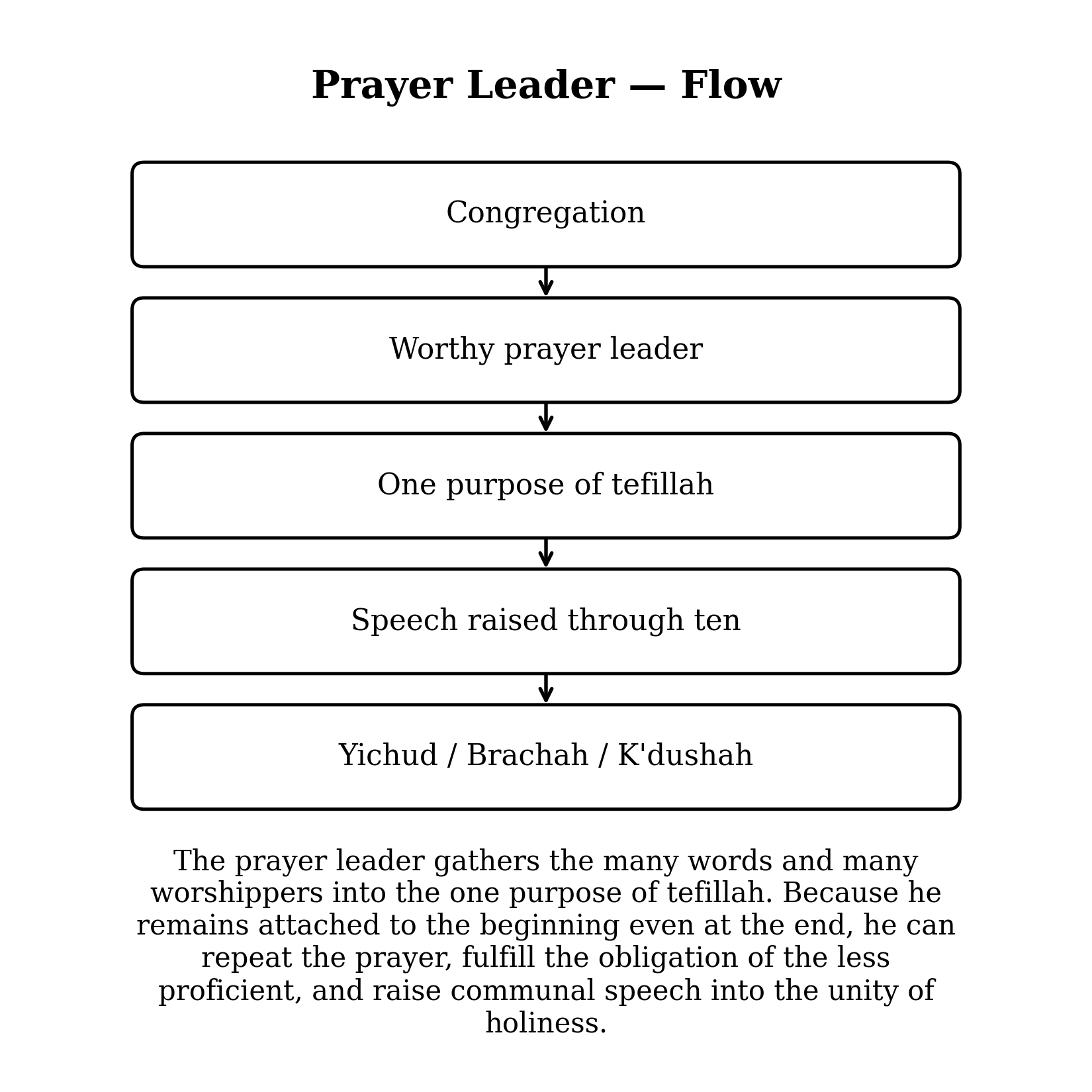
The prayer leader gathers the many words and many worshippers into the one purpose of tefillah. Because he remains attached to the beginning even at the end, he can repeat the prayer, fulfill the obligation of the less proficient, and raise communal speech into the unity of holiness.
Main Pillars
The worthy shileyach tzeeboor is the aspect of the master of the field and the head of the congregation.
Passing before the Ark means moving through the prayer without losing its first word or its final purpose.
Repetition reveals that the end is embedded in the beginning and the beginning in the end.
A minyan spans the ten levels from Malchus, the level of speech, to the One in Whom all levels are included.
Yichud, Brachah, and Kedushah unite Havayah and Elokim and sweeten judgment at the tachlis.
Practical Takeaways
Choose communal prayer and its leader with seriousness; the leader represents the unity of the congregation.
Keep the opening intention of tefillah alive through its final words.
When prayer feels fragmented, return the many words to their single purpose: attachment to Hashem.
— Translator's summary. Not part of the original text of Likutay Halachos. —
Expanded Study Aid — Prayer Leader
Key Terms and Concept Notes
Tachlis — the ultimate purpose in which the whole prayer becomes one.
Baki — proficiency that retains the beginning while reaching the end.
YBK — Yichud, Brachah, Kedushah; unity that sweetens judgment.
Reviewer / Series Continuity Note
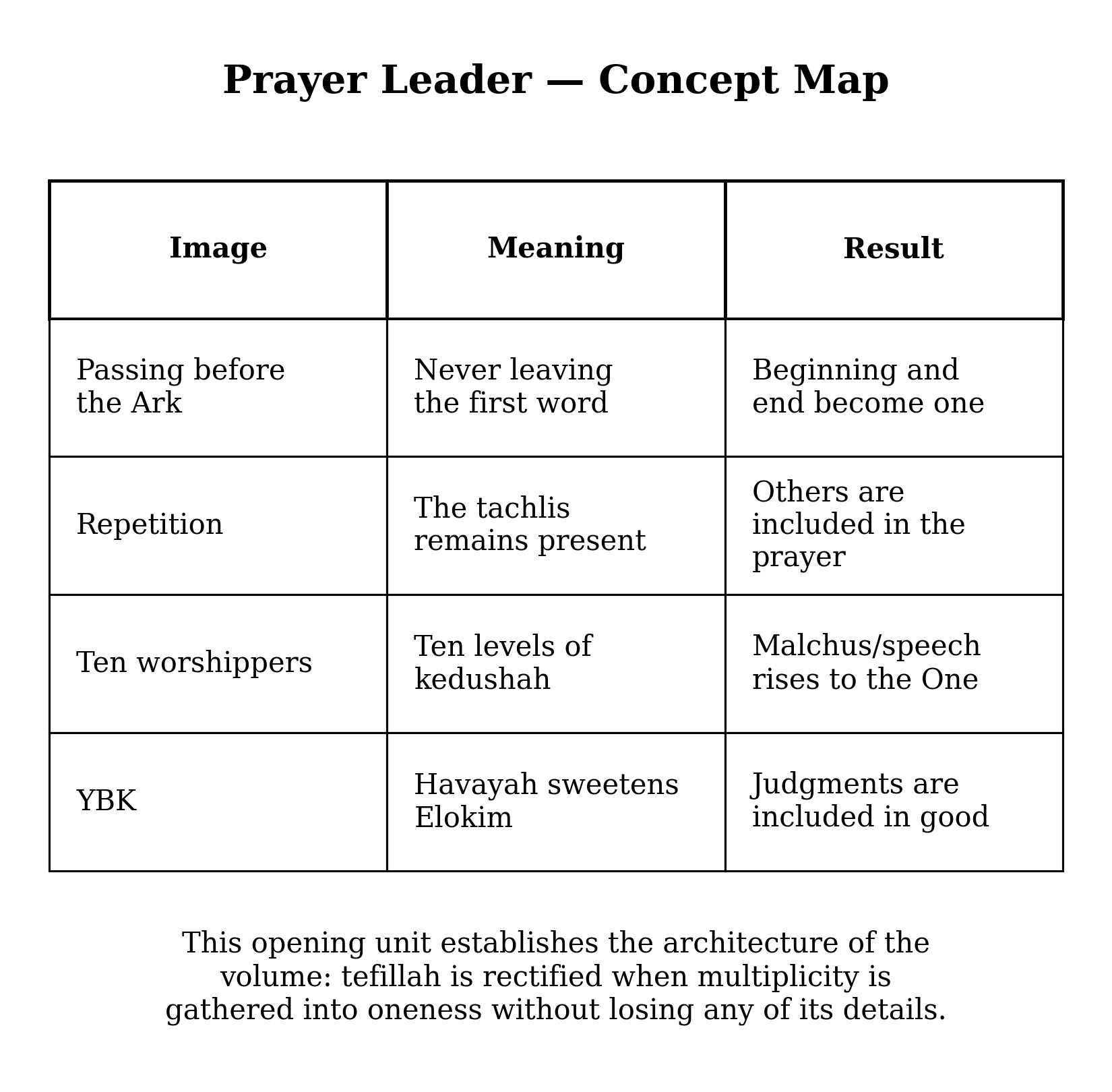
This opening unit establishes the architecture of the volume: tefillah is rectified when multiplicity is gathered into oneness without losing any of its details.
Diagram 1 — Prayer Leader Flow
Diagram 2 — Prayer Leader Concept Map
— End of translator study aid and diagrams. Not part of the original text of Likutay Halachos. —
Diagram 1 — Prayer Leader Flow — Translator’s editorial learning diagram; separate from original teachingDiagram 2 — Prayer Leader Concept Map — Translator’s editorial learning diagram; separate from original teaching