ניצבים Parashat Nitzavim
Deut. 29:9-30:20
14 Breslov teachings found
חומש עם ליקוטי הלכות
Chumash with Likutay Halachos - curated selections for this parsha
English Text (from Chumash with Likutey Halachos)
But for Torah shebichsav, which is the aspect of the perception of daray ma'alah, the aspect of "Ayay — where is the place of His glory" — it is permitted to receive payment. For there, in the upper aspect, the aspect of Ayay, the klipos and the sitra achra have no hold whatsoever. And one who merits this perception — the sitra achra cannot take hold there at all.
For it is brought in the words of Rabbeinu of blessed memory that the sustenance and vitality of the sitra achra is from the aspect of Ayay, which is the aspect of ma'amar sasum — that is, from the greatness of the concealment and hiddenness. Because this aspect is hidden and concealed in the utmost concealment, therefore from there is their vitality. But one who merits this perception of the aspect of Ayay — who knows of this concealment and merits attaining this perception of the aspect of Ayay, which is the ultimate of knowledge (tachlis hayedi'ah) — then the sitra achra and the klipos are nullified in the utmost nullification. For their primary sustenance is from the hiddenness and concealment of this aspect — because we do not have the power to attain this perception. Therefore they draw sustenance from there, G-d forbid, and intensify in k'firos [denials/heresies], G-d forbid, through the concealment and hiddenness of this aspect.
ֶ ּאַתֶם נִצָבִים הַיוֹם כֻּלְּכם ֹ ֵּוְזֶהו שֶׁקִבֵּץ מֹשֶׁה כָּל הַמַדְרֵגוֹת שֶׁבְּיִשְׂרָאֵל קֹדֶם מוֹתו ּּוְהִזְהִיר אוֹתָם שֶׁכֻּלָם צְרִיכִין לְקַיּם אֶת כָּל דִבְרֵי ּּהַתוֹרָה הַזֹאת,ּכְּמו ֹ שֶׁכָּתוב:ּאַתֶם נִצָבִים הַיוֹם כֻּלְכֶם ּוְכו'ּרָאשֵׁיכֶם שִׁבְטֵיכֶם זִקְנֵיכֶם וְשֹׁטְרֵיכֶם וְכו'ּוְכו' ָָמֵחֹטֵב עֵצֶיך עַד שֹׁאֵב מֵימֶיך.ּּרְאֵה מִמִי הִתְחִיל ובְמִי ּסִיֵםֵׁ:שֶׁהִתְחִיל מֵרָאשי בְּנֵי יִשְׂרָאֵל,שֶׁהֵם בְּחִינַת מְאֹד מְאֹד בְּמַעֲלָה הַגְּדוֹלִים,כָּל וְחוֹשֵׁב ְוְהוֹלֵך ּהַמַדְרֵגוֹת שֶׁבָּעוֹלָם שֶׁכְּלולִים בְּאֵלו הָעֲשָׂרָה שֶׁחוֹשֵׁב, מֵימֶיך שֹׁאֵב עַד עֵצֶיך מֵ
But for Torah shebichsav, which is the aspect of the perception of daray ma'alah, the aspect of "Ayay — where is the place of His glory" — it is permitted to receive payment. For there, in the upper aspect, the aspect of Ayay, the klipos and the sitra achra have no hold whatsoever. And one who merits this perception — the sitra achra cannot take hold there at all.
For it is brought in the words of Rabbeinu of blessed memory that the sustenance and vitality of the sitra achra is from the aspect of Ayay, which is the aspect of ma'amar sasum — that is, from the greatness of the concealment and hiddenness. Because this aspect is hidden and concealed in the utmost concealment, therefore from there is their vitality. But one who merits this perception of the aspect of Ayay — who knows of this concealment and merits attaining this perception of the aspect of Ayay, which is the ultimate of knowledge (tachlis hayedi'ah) — then the sitra achra and the klipos are nullified in the utmost nullification. For their primary sustenance is from the hiddenness and concealment of this aspect — because we do not have the power to attain this perception. Therefore they draw sustenance from there, G-d forbid, and intensify in k'firos [denials/heresies], G-d forbid, through the concealment and hiddenness of this aspect.
חֹטֵב שֶׁסִּיֵם ָָּעַד,ִשֶׁהֵם ּהַגִּבְעוֹנִים שֶׁנּתְגַּיְרו שֶׁלֹא לִשְׁמָה,רַק מֵחֲמַת אֵימָה ַ)ּּכְּמו ֹ שֶׁאָמְרו רַבּוֹתֵינו ז"ל:ּמְלַמֵד,ּשֶׁבָּאו גִּבְעוֹנִים ּבִּימֵי מֹשֶׁה וְכו'.(ּוְהֵם מְרַמְזִים עַל תַכְלִית דְיוֹטָא ּּהַתַחְתוֹנָה,ֹ וְאָמַר הִסְתַלְקותו קֹדֶם כֻּלָם ּוְקִבֵּץְ, ּשֶׁלּכֻלָם הוא מוֹסֵר אֶת הַתוֹרָה,ּכְּמו ֹ שֶׁכָּתוב שָׁם: ָלְעָבְרְך בִּבְרִית ה'ּוְכו'.ּּוְכֵן הִזְהִיר שָׁם שֶׁלְכָל הַדוֹרוֹת ּּעַד הַסּוֹף הוא מוֹסֵר אֶת הַתוֹרָה,ּכְּמו ֹ שֶׁכָּתוב:וְלֹא ּאִתְכֶם לְבַדְכֶם וְכוִ'ּכִּי אֶת אֲשֶׁר יֶשְׁנו ֹ פֹה עּּמָנו לִפְנֵי ה'ּאֱלֹקֵינו וְאֵת אֲשֶׁר אֵינֶנו פֹה וְ
But for Torah shebichsav, which is the aspect of the perception of daray ma'alah, the aspect of "Ayay — where is the place of His glory" — it is permitted to receive payment. For there, in the upper aspect, the aspect of Ayay, the klipos and the sitra achra have no hold whatsoever. And one who merits this perception — the sitra achra cannot take hold there at all.
For it is brought in the words of Rabbeinu of blessed memory that the sustenance and vitality of the sitra achra is from the aspect of Ayay, which is the aspect of ma'amar sasum — that is, from the greatness of the concealment and hiddenness. Because this aspect is hidden and concealed in the utmost concealment, therefore from there is their vitality. But one who merits this perception of the aspect of Ayay — who knows of this concealment and merits attaining this perception of the aspect of Ayay, which is the ultimate of knowledge (tachlis hayedi'ah) — then the sitra achra and the klipos are nullified in the utmost nullification. For their primary sustenance is from the hiddenness and concealment of this aspect — because we do not have the power to attain this perception. Therefore they draw sustenance from there, G-d forbid, and intensify in k'firos [denials/heresies], G-d forbid, through the concealment and hiddenness of this aspect.
כו'ּּלְהוֹרוֹת שֶׁלְכֻלָם ּּנִמְסְרָה לְכָל הַמַדְרֵגוֹת שֶׁבְּכָל הַדוֹרוֹת עַד הַסּוֹף,כִּי ּכֻּלָם יַצְלִיחו לָנֶצַח עַל־יְדֵי הַתוֹרָה יִהְיֶה מִי שֶׁיִהְיֶה ּמֵאֵיזֶה מַדְרֵגָה שֶׁהואִּ,כְֹּּּי דֶרֶך הַתוֹרָה הוא מָגֵן לְכָל
.sl{text-align:center;margin-bottom:25px;padding:10px 20px;font-size:16.5px;color:var(--source-color);font-style:italic;line-height:1.7;border-left:3px solid var(--divider);border-right:3px solid var(--divider);background:rgba(201,168,76,.03)}
ֶ ּאַתֶם נִצָבִים הַיוֹם כֻּלְּכם ּּקֹדֶם רֹאשׁ־הַשָׁנָה קוֹרִין פָרָשַׁת"ּאַתֶם נִצָבִים הַיוֹם ּכֻּלְכֶם"ּוְכוָּ',ַ שֶׁכ לְהוֹדִיעיִשְׂרָאֵל בֵּית נַפְשׁוֹת ל, ּּגְּדוֹלִים וקְטַנִים,ּכֻּלָם צְרִיכִים לְהִתְקַבֵּץ יַחַד וְלִכְלֹל ְּּיַחַד בְּאַהֲבָה בְּתוֹך הַקְדֻשָׁה הָעֶלְיוֹנָה,ְבְּתוֹך בְּחִינַת קָדָשִׁים קָדְשֵׁי,שְׁתִיָה ּאֶבֶן,הַכּוֹלֵל שֵׂכֶל,ּשֶׁהוא בְּחִינַת מֹשֶׁהְּ,בּּחִינַת הַצַדִיק הָאֱמֶתַ ,ּשֶׁצְרִיכִין לִנְסֹע רֹאשׁ־הַשָׁנָה עַל ּאֵלָיו.יַחַד שֶׁנִכְלָלִין ּוְעַל־יְדֵי־זֶה ְּבְּתוֹך אֶבֶן שְׁתִיָה,שֵׂכֶל הַכּוֹלֵל,ֹעַל־יְדֵי־זֶה זוֹכִין כָּל אֶחָד וְאֶחָד לְהַחֲיוֹת שִׂכְלו,
But in truth, Hashem, blessed be He, constricts Himself from the Infinite to the endless, all the way to the central point of this physical world where a person stands in his place on that day and at that hour specifically. And He arranges for him a thought, a word, and a deed each and every day, according to the day, according to the place, and according to the person. And He hints to him through them specifically, hints to draw close to His service.
ִּעַד שֶׁיוכַל לְהַמְתִיק כָּל מּינֵי דִינִים וְצִמְצומִים,ְֹּּּומִשָׁם נִמְשָׁך הַמְתָקָה לְכָל אֶחָד וְאֶחָד בִּמְקוֹמוֹ,ּבְּיוֹמו ֹ ושְׁעָתו,ּשֶׁיֵדַע כָּל אֶחָד ּּכְּפִי מַה שֶׁהואֹ,בִּמְקוֹמו ֹ בְּבֵיתו,ְּאו ֹ בַּדֶרֶך בְּאֵיזֶה ּמָקוֹם שֶׁהואֹ,ֹ ּוכְפִי מַה שֶׁהוא בְּאוֹתו ֹ הַיוּם ובְאוֹתו ּהַשָׁעָה וְהָרֶגַע,ּּשֶׁיֵדַע הֵיטֵב שֶׁבְּאוֹתו ֹ הַשָׁעָה וְהָרֶגַע ְּּיוכַל לְדַבֵּק עַצְמו ֹ לְהַשֵׁם יִתְבָּרַך מִמְקוֹמו ֹ שֶׁהוא שָׁם, שֶׁבַּלֵב וְהָעַקְמומִיות וְהַבִּלְבּולִים הַפְגָמִים ּומִכָּל שֶׁעוֹבֵר עָלָיו אָזָ,כְּפִי הּּאָדָם וְהַמָקוֹם וְהַזְמָן,ַכִּי הַכֹּל ּנִמְתָק וְנִתְבַּטֵל עַ
But in truth, Hashem, blessed be He, constricts Himself from the Infinite to the endless, all the way to the central point of this physical world where a person stands in his place on that day and at that hour specifically. And He arranges for him a thought, a word, and a deed each and every day, according to the day, according to the place, and according to the person. And He hints to him through them specifically, hints to draw close to His service.
ל־יְדֵי הַשֵׂכֶל הָעֶלְיוֹן הַכּוֹלֵל הַנ"ל. וְזֶה" :ּאַתֶם נִצָבִים הַיוֹם"ּּזֶה בְּחִינוֹת אָדָם ומָקוֹם וזְמָן; "ּאַתֶם"ּהַיְנו אָדָם,ּּבְּחִינַת כְּלָלִיות נַפְשׁוֹת יִשְׂרָאֵל; "ּנִצָבִים"ּּבְּחִינַת מָקוֹם שֶׁנִצָבִים עָלָיו;"ּהַיוֹם"בְּחִינַת זְמָן.וְזֶה" :ּכֻּלְכֶם לִפְנֵי ה'אֱלֹקֵיכֶם",ּּשֶׁאַתֶם כֻּלְכֶם,ֹכָּל ּאֶחָד כְּפִי מְקוֹמו ֹ ושְׁעָתו,ּּכֻּלְכֶם צְרִיכִים לֵידַע שֶׁאַתֶם ּּנִצָבִים וְעוֹמְדִים הַיוֹם לִפְנֵיה'אֱלֹקֵיכֶם,וְזֶה זוֹכִין ּּעַל־יְדֵי הַכְּלָלִיות)ּהַהִכָּלְלות(ּּ בְּהַצַדִיק הָאֱמֶת,ּשֶׁהוא קָדָשִׁים קָדְשֵׁי בְּחִינַת,שְׁתִיָה ּאֶבֶן.וְזֶה" :ָלְעָבְרְך ּבִּבְרִית
But in truth, Hashem, blessed be He, constricts Himself from the Infinite to the endless, all the way to the central point of this physical world where a person stands in his place on that day and at that hour specifically. And He arranges for him a thought, a word, and a deed each and every day, according to the day, according to the place, and according to the person. And He hints to him through them specifically, hints to draw close to His service.
וְכו'ָּּאֲשֶׁר אָנֹכִי כֹּרֵת עִמְך הַיוֹם"בְּחִינַת"ֹ ּהַיוֹם אִם בְּקֹלוּתִשְׁמָעו",ֹּלְהִתְגַּבֵּר לְהַתְחִיל בַּעֲבוֹדַת הַשֵׁם ּּבְּכָל עֵת ובְכָל שָׁעָה ובְכָל רֶגַע שֶׁעוֹמֵד בּו,וְלֹא ּלִדְחוֹת מִיוֹם לַחֲבֵרו ֹ כְּלָל,כִּי צְרִיכִין לֵידַע שֶׁאֵין ּּלָאָדָם בְּעוֹלָמו ֹ אֶלָא אוֹתו ֹ הַיוֹם וְאוֹתו ֹ רֶגַע לְבַדֹ ,כְּמו ּשֶׁכָּתוב"ּוַתִפְקְדֶנו לִבְקָרִים לִרְגָעִים תִבְחָנֶנו".)הִלְכוֹת ּּפִקָדוֹן וְאַרְבָּעָה שׁוֹמְרִים–הֲלָכָהה,אוֹת לולְפִי אוֹצַר
But in truth, Hashem, blessed be He, constricts Himself from the Infinite to the endless, all the way to the central point of this physical world where a person stands in his place on that day and at that hour specifically. And He arranges for him a thought, a word, and a deed each and every day, according to the day, according to the place, and according to the person. And He hints to him through them specifically, hints to draw close to His service.
ּאַתֶם נִצָבִים הַיוֹם כֻּלְּכֶם לִפְנֵי הֹ'אֱלקֵיכֶם,ָרָאשֵׁיכֶם שִׁבְטֵיכֶם זִקְנֵיכֶם וְשֹׁטְרֵיכֶם כֹּל אִיש ׁ יִשְׂראֵל מַהּּשֶׁמַכִּיןכַּףאֶלכַּףבִּשְׁעַתּּהַתְפִלָה–כִּיּאָמְרו ּחֲכָמֵינוזִכְרוֹנָםלִבְרָכָה)בראשיתרבהפ"א:(לָמָה הִתְחִילָהּהַתוֹרָהמִבְּרֵאשִׁית?כִּיּהָעַכּו"ֹ םיּאמְרוּלָנו: גַּזְלָנִיםּאַתֶם,ּשֶׁכְּבַשְׁתֶםאֶרֶץשִׁבְעָהעֲמָמִין;בִּשְׁבִיל זֶהַ:כֹּחמַעֲשָׂיוֹ הִגִּידּלְעַמו–שֶׁהִגִּיד,שֶׁכָּלהָעוֹלָמוֹת הַכֹּלמַעֲשֵׂייָדָיו,ׁ ּולְמִיּשֶׁהַקָדוֹש־ְּבָּרוך־ּהוארוֹצֶהּהוא נוֹתֵן.וְזֶה:לָתֵתלָהֶםנַחֲלַתגּוֹיִם;ֹ כִּיבְּיָדוהַכֹּל.וְכָל ּהַדְבָרִיםַ נִקְרָאִיםכֹּחמַעֲשָׂיו,כְּנ
Hilchos Apitropos [Laws of Guardianship]
ֶגֶדכ"חאַתְוָןּּדְעֻבְדָא ּדִבְרֵאשִׁית,כְּנֶגֶדכ"חּפִרְקִיןּדְיָדַיִם.ַ וְזֶהּיָדוע,כִּי אֲוִירָאּדְאֶרֶץעֲמָמִיןהִיאטְמֵאָה,וַאֲוִירָא ּדְאֶרֶץָ־יִשְׂראֵלׁ ּהואקָדוֹשוְטָהוֹר,כִּיׁ הוֹצִיא ּהַקָדוֹש־ְּבָּרוך־ּהואּמִתַחַתיַדּהָעַכּו"םוְנָתַןּלָנו;אֲבָל אֶרֶץּעַמִים,שֶׁהִיאּחוץ־לָאָרֶץ,שָׁםאֲוִירטָמֵא.
Hilchos Apitropos [Laws of Guardianship]
ּּוכְשֶׁאָנומָחְאָןכַּףאֶלכַּף,בָּזֶהנִתְעוֹרֵרכ"חאַתְוָן ּדִבְרֵאשִׁיתַ,ַ כֹּחמעֲשָׂיו,ֹ וְנִמְצָאשֶׁבְּיָדולָתֵתּלָנונַחֲלַת גּוֹיִם,כִּיהַכֹּלׁ שֶׁלּהַקָדוֹש־ְּבָּרוך־ּהוא,ׁ ּובָזֶהַ יֵשכֹּח ּבְּיָדֵינולְטַהֵראֲוִיראֶרֶץּהָעַמִים,כִּינֶחֱזַראֶרֶץּהָעַמִים ּתַחַתׁ מֶמְשֶׁלֶתּהַקָדוֹש־ְּבָּרוך־ּהואֹ,ּובְיָדוְ לָתֵתלכָל מִיּשֶׁיִרְצֶהֹ,כְּמוּשֶׁכָּתוב:לָתֵתלָהֶםנַחֲלַתגּוֹיִם.וְאָז נִטְהָראֲוִירׁ ּהַמָקוֹםשֶׁאִישּהַיִשְׂרְאֵלִיּּמִתְפַלֵל,וְשׁוֹאֵב ׁ אֲוִירֹ ּהַקָדוֹשכְּמובְּאֶרֶץ־יִשְׂרָאֵל.
§ 45 — The Goblet in Binyamin's Sack: Hidden Mercy in Bitter Sorrow
This is the great bitterness when the goblet was found in Binyamin's sack — yet through this specifically, Yosef revealed himself and they were gathered together: "Yosef could not restrain himself" — and joy increased, as above. This is a hint: when a person is in great, bitter distress that twists his heart — let him know and believe that this too is for good. Certainly wondrous mercy is hidden within the bitterness. He must only cry out and pray to Hashem and wait for His mercy. Gavi'a [goblet] in gematria equals yud-gimmel ayin-bais [13 × 72] — the thirteen Mechilin d'Rachamay, the totality of all mercy and great kindness. Specifically through the goblet in Binyamin's sack (which caused such bitter distress), they were gathered together and it was revealed that the goblet is wondrous mercy — thirteen times seventy-two: the thirteen Mechilin d'Rachamay, the totality of all mercy, as above.
§ 46 — "I Rejoiced When They Said: Let Us Go to the House of Hashem"
"I rejoiced when they said to me: let us go to the house of Hashem." The essential joy is in the house of Hashem — the Bais HaMikdash, deriving from "the Place of the world": "blessed is the glory of Hashem from His place," as above. "Our feet were standing in your gates, Yerushalayim" — there is the essential standing and sustenance of the feet. The essential thing is to sort the feet, as above — but their complete sorting is when one comes on foot to the Bais HaMikdash (and likewise to the true tzadikim, who are in the aspect of the Bais HaMikdash), where the essential completeness of joy resides.
"Yerushalayim, built as a city joined together; there the tribes ascended, the tribes of G-d, a testimony to Israel, to thank the Name of Hashem." Yerushalayim below corresponds to Yerushalayim above — the above supernal Place ("he encountered the place"). There the tribes ascended — to thank [l'hodos]: all the ascents through the above tikunim are to ascend to the supernal Place, where the essential todah and thanksgiving in joy resides — "to thank the Name of Hashem."
"Pray for the peace of Yerushalayim... peace within your walls... for the sake of my brothers and friends, I shall speak of peace within you." The essential thing depends on peace, as above. Dispute is hatred and anger — sadness from the Chambers of Exchange, which exchange and reverse everything, implanting false reasoning in the heart to hate one's fellow for nothing — even among tzadikim and the upright, multiplying dispute through their reversed reasoning. This is the dispute of the tribes against Yosef the tzadik, selling him as a slave. But in the end, everything is transformed for good through the great tzadikim who know how to draw joy even in the bitterness of exile, extracting from the exile and the Chambers of Exchange, as above.
§ 47 — Yehudah and Yosef: Mashiach ben David and Mashiach ben Yosef
This is: "Yehudah approached him" — the essential tikun through Yehudah and Yosef uniting — the essence of Mashiach ben David (from Yehudah) and Mashiach ben Yosef. David is the aspect of Tehillim, composed with the ten types of melody (= joy) — the sweet singer of Israel. The inflaming of joy in the heart (= Yosef, "the house of Yosef a flame") — its essential revelation is through words of thanksgiving and praise (= David, who satiated the Holy One with songs and praises). Speech has great power — through it the essential revelation of joy: "a man has joy in the answer of his mouth"; "worry in a man's heart — let him quash it; a good word gladdens it." This is: "lips of song shall my mouth praise" specifically — the aspect of David from Yehudah, named for thanksgiving: "this time I shall thank Hashem."
Yehudah said to Yosef: "let your servant speak a word in the ears of my lord." Ears are the instrument of hearing; "hearing depends on the heart" — where the root of joy resides: "You placed joy in my heart." This joy is aroused by Yosef, who inflames the heart by blowing away the dust. But the essential revelation and sustaining of joy is through speech (= David from Yehudah). Therefore Yehudah said to Yosef: "let your servant speak a word" — specifically a word: holy words of the joy of holy emunah, as we proclaim daily: "fortunate are we — how good is our portion!" etc. "In the ears of my lord" — "hearing depends on the heart." Rashi: "let my words enter your ears." Through the speech, the words enter his ears and heart until joy shines in completeness and sadness (= anger and judgment) is nullified. "Let not your anger burn against your servant" — anger nullified through the intensity of joy shining through speech, as above.
§ 48 — Yaakov's Care That Binyamin Be Born in Eretz Yisrael
Therefore Yaakov was extremely careful that the holy bed not be completed outside Eretz Yisrael, as stated in the holy Zohar — when Yosef was born he said: "send me away." Had Binyamin been born outside Eretz Yisrael, Yaakov could not have left, as the Zohar states. Binyamin — the completion of the holy bed, the ultimate completeness of joy — through him joy is drawn from "the Place of the world" to the place of this world. The essential holy Place is the awesome place of the Bais HaMikdash. Had he been born, chas v'shalom, in the impure place of Lavan's house outside Eretz Yisrael, joy would have been drawn to the Sitra Achra, chas v'shalom — whose entire overpowering is through drawing joy to themselves: all the joys of worldly vanities (= the laughter of the fool): "of joy — what does it accomplish?" We plead: "let not my enemies rejoice over me."
This is the great bitterness when the goblet was found in Binyamin's sack — yet through this specifically, Yosef revealed himself and they were gathered together: "Yosef could not restrain himself" — and joy increased, as above. This is a hint: when a person is in great, bitter distress that twists his heart — let him know and believe that this too is for good. Certainly wondrous mercy is hidden within the bitterness. He must only cry out and pray to Hashem and wait for His mercy. Gavi'a [goblet] in gematria equals yud-gimmel ayin-bais [13 × 72] — the thirteen Mechilin d'Rachamay, the totality of all mercy and great kindness. Specifically through the goblet in Binyamin's sack (which caused such bitter distress), they were gathered together and it was revealed that the goblet is wondrous mercy — thirteen times seventy-two: the thirteen Mechilin d'Rachamay, the totality of all mercy, as above.
§ 46 — "I Rejoiced When They Said: Let Us Go to the House of Hashem"
"I rejoiced when they said to me: let us go to the house of Hashem." The essential joy is in the house of Hashem — the Bais HaMikdash, deriving from "the Place of the world": "blessed is the glory of Hashem from His place," as above. "Our feet were standing in your gates, Yerushalayim" — there is the essential standing and sustenance of the feet. The essential thing is to sort the feet, as above — but their complete sorting is when one comes on foot to the Bais HaMikdash (and likewise to the true tzadikim, who are in the aspect of the Bais HaMikdash), where the essential completeness of joy resides.
"Yerushalayim, built as a city joined together; there the tribes ascended, the tribes of G-d, a testimony to Israel, to thank the Name of Hashem." Yerushalayim below corresponds to Yerushalayim above — the above supernal Place ("he encountered the place"). There the tribes ascended — to thank [l'hodos]: all the ascents through the above tikunim are to ascend to the supernal Place, where the essential todah and thanksgiving in joy resides — "to thank the Name of Hashem."
"Pray for the peace of Yerushalayim... peace within your walls... for the sake of my brothers and friends, I shall speak of peace within you." The essential thing depends on peace, as above. Dispute is hatred and anger — sadness from the Chambers of Exchange, which exchange and reverse everything, implanting false reasoning in the heart to hate one's fellow for nothing — even among tzadikim and the upright, multiplying dispute through their reversed reasoning. This is the dispute of the tribes against Yosef the tzadik, selling him as a slave. But in the end, everything is transformed for good through the great tzadikim who know how to draw joy even in the bitterness of exile, extracting from the exile and the Chambers of Exchange, as above.
§ 47 — Yehudah and Yosef: Mashiach ben David and Mashiach ben Yosef
This is: "Yehudah approached him" — the essential tikun through Yehudah and Yosef uniting — the essence of Mashiach ben David (from Yehudah) and Mashiach ben Yosef. David is the aspect of Tehillim, composed with the ten types of melody (= joy) — the sweet singer of Israel. The inflaming of joy in the heart (= Yosef, "the house of Yosef a flame") — its essential revelation is through words of thanksgiving and praise (= David, who satiated the Holy One with songs and praises). Speech has great power — through it the essential revelation of joy: "a man has joy in the answer of his mouth"; "worry in a man's heart — let him quash it; a good word gladdens it." This is: "lips of song shall my mouth praise" specifically — the aspect of David from Yehudah, named for thanksgiving: "this time I shall thank Hashem."
Yehudah said to Yosef: "let your servant speak a word in the ears of my lord." Ears are the instrument of hearing; "hearing depends on the heart" — where the root of joy resides: "You placed joy in my heart." This joy is aroused by Yosef, who inflames the heart by blowing away the dust. But the essential revelation and sustaining of joy is through speech (= David from Yehudah). Therefore Yehudah said to Yosef: "let your servant speak a word" — specifically a word: holy words of the joy of holy emunah, as we proclaim daily: "fortunate are we — how good is our portion!" etc. "In the ears of my lord" — "hearing depends on the heart." Rashi: "let my words enter your ears." Through the speech, the words enter his ears and heart until joy shines in completeness and sadness (= anger and judgment) is nullified. "Let not your anger burn against your servant" — anger nullified through the intensity of joy shining through speech, as above.
§ 48 — Yaakov's Care That Binyamin Be Born in Eretz Yisrael
Therefore Yaakov was extremely careful that the holy bed not be completed outside Eretz Yisrael, as stated in the holy Zohar — when Yosef was born he said: "send me away." Had Binyamin been born outside Eretz Yisrael, Yaakov could not have left, as the Zohar states. Binyamin — the completion of the holy bed, the ultimate completeness of joy — through him joy is drawn from "the Place of the world" to the place of this world. The essential holy Place is the awesome place of the Bais HaMikdash. Had he been born, chas v'shalom, in the impure place of Lavan's house outside Eretz Yisrael, joy would have been drawn to the Sitra Achra, chas v'shalom — whose entire overpowering is through drawing joy to themselves: all the joys of worldly vanities (= the laughter of the fool): "of joy — what does it accomplish?" We plead: "let not my enemies rejoice over me."
וְזֶה:ּאַתֶםּנִצָבִיםּהַיוֹם)דבריםכט(–אֵיןֶ עֲמִידָהאּלָא ּּתְפִלָה)ברכותו.(:לִפְנֵיה'אֱלֹקֵיכֶם–זֶהבְּחִינוֹת אֶרֶץ־יִשְׂרָאֵלֹ,כְּמוּשֶׁאָמְרוּחֲכָמֵינוזִכְרוֹנָםלִבְרָכָה )כתובותקי:(:כָּלּהַדָרבְּאֶרֶץ־יִשְׂרָאֵל,ׁ כְּמִיֹ ּשֶׁיֵשלו אֱלוֹקַי.ּהַיְנו:עַל־יְדֵימָהּּתִזְכּוְ ּשֶׁתְהֵאּתּפִלַתְכֶם בַּאֲוִירָאּדְאֶרֶץ־יִשְׂרָאֵל?–רָאשֵׁיכֶםשִׁבְטֵיכֶםּוְכו'. ּומוֹנֶהעֶשֶׂרבְּחִינוֹת,ּהַיְנובְּחִינוֹתמֶחָאַתכַּף;עַל־יְדֵי מְחִיאַתּכַּפַיִם,ּּהַתְפִלָההִיאבַּאֲוִירָאּדְאֶרֶץ־ַ יִשְׂרָאֵל
And therefore his tikkun is through his brother, who is adjacent to him in the permutations of the letters. For the six hundred thousand souls of Israel are the aspect of the six hundred thousand letters of the Torah, and every individual of Israel has a letter in the Torah, and every letter is comprised of all the letters. And likewise, every soul is comprised of all the souls — only that its essence is grasped in this letter. And just as in the Torah there are parashiyos and p’sukim and words and letters, so too among the souls there are tribes and families and ancestral houses, etc. And each person together with his brother is like a single word in the Torah that has several letters — so too in his father’s house there are several souls of his brothers. It follows that his brother is adjacent to him in the aforementioned permutations of the letters. Therefore he has the power to redeem him through the secret of yibum.
And the essential tikkun of yibum is through the aspect of hahu rucha d’shadei b’gavah (that spirit which he casts into her) — that is, the aspect of the spirit of prophecy mentioned above, which is drawn at its root from the tzadik, from which comes begetting, as mentioned above. And therefore through hahu rucha (that spirit) he can rectify him, for he is reformed and refashioned through hahu rucha — through which faith is clarified and one merits the aspect of the renewal of the world, from which comes the tikkun.
And therefore, when he does not wish to perform yibum, then: “She shall remove his shoe from upon his foot” (Devarim 25:9) — to show him that he has blemished in the aspect of the akeiv (heel), as mentioned above. For all the blemish is drawn from the sin of Adam HaRishon, in that he did not merit to rectify it according to his portion. And the essential sin and blemish of Adam HaRishon was in the aspect of the akeiv — through the serpent who was cunning, from which come all the damages, as is explained in the aforementioned Torah. For through this he caused: “And you shall bruise him on the heel” (Bereishis 3:15) — from which comes the power of the heel of Esav, which is the contamination of the serpent.
And the tikkun is through the voice of the melody explained there, which is drawn through the clarification of faith, etc., which is the aspect of: “I heard Your voice in the garden, and I was afraid” (Bereishis 3:10), as is explained there. And then, after the tikkun began, it is written: “And Hashem Elokim made for Adam and for his wife garments of skin, and He clothed them” (Bereishis 3:21) — the secret of the shoes, as is brought.
And therefore this yavam (levir) who does not wish to perform yibum, and this indicates that he does not have the power to draw all the aforementioned tikkunim — therefore: “She shall remove his shoe from upon his foot,” etc., and she shall answer and say: “So shall it be done to the man who will not build up his brother’s house,” etc. (Devarim 25:9). For there is the blemish in the aspect of the shoes, which are the aspect of the garments of skin, which are the aspect of the tikkun of the heel, as mentioned above.
And this is: “And she shall spit in his face” (Devarim 25:9) — which is the aspect of disgrace, the opposite of kavod (honor). For the spirit of prophecy mentioned above is drawn from kavod, as is explained there. And therefore this one who has blemished in this has blemished in kavod. And therefore: “she shall spit in his face” — which is the opposite of kavod.
May it be His will that He save us and all His people Israel, that they should not come to chalitzah and yibum. And may it speedily be fulfilled: “The smallest shall become a thousand, and the youngest a mighty nation; I am Hashem — in its time I will hasten it” (Yeshayah 60:22). Blessed is Hashem forever, Amein and Amein. “Hashem shall reign forever; your G-d, O Tziyon, from generation to generation, Halleluyah!” (Tehillim 146:10)
And the essential tikkun of yibum is through the aspect of hahu rucha d’shadei b’gavah (that spirit which he casts into her) — that is, the aspect of the spirit of prophecy mentioned above, which is drawn at its root from the tzadik, from which comes begetting, as mentioned above. And therefore through hahu rucha (that spirit) he can rectify him, for he is reformed and refashioned through hahu rucha — through which faith is clarified and one merits the aspect of the renewal of the world, from which comes the tikkun.
And therefore, when he does not wish to perform yibum, then: “She shall remove his shoe from upon his foot” (Devarim 25:9) — to show him that he has blemished in the aspect of the akeiv (heel), as mentioned above. For all the blemish is drawn from the sin of Adam HaRishon, in that he did not merit to rectify it according to his portion. And the essential sin and blemish of Adam HaRishon was in the aspect of the akeiv — through the serpent who was cunning, from which come all the damages, as is explained in the aforementioned Torah. For through this he caused: “And you shall bruise him on the heel” (Bereishis 3:15) — from which comes the power of the heel of Esav, which is the contamination of the serpent.
And the tikkun is through the voice of the melody explained there, which is drawn through the clarification of faith, etc., which is the aspect of: “I heard Your voice in the garden, and I was afraid” (Bereishis 3:10), as is explained there. And then, after the tikkun began, it is written: “And Hashem Elokim made for Adam and for his wife garments of skin, and He clothed them” (Bereishis 3:21) — the secret of the shoes, as is brought.
And therefore this yavam (levir) who does not wish to perform yibum, and this indicates that he does not have the power to draw all the aforementioned tikkunim — therefore: “She shall remove his shoe from upon his foot,” etc., and she shall answer and say: “So shall it be done to the man who will not build up his brother’s house,” etc. (Devarim 25:9). For there is the blemish in the aspect of the shoes, which are the aspect of the garments of skin, which are the aspect of the tikkun of the heel, as mentioned above.
And this is: “And she shall spit in his face” (Devarim 25:9) — which is the aspect of disgrace, the opposite of kavod (honor). For the spirit of prophecy mentioned above is drawn from kavod, as is explained there. And therefore this one who has blemished in this has blemished in kavod. And therefore: “she shall spit in his face” — which is the opposite of kavod.
May it be His will that He save us and all His people Israel, that they should not come to chalitzah and yibum. And may it speedily be fulfilled: “The smallest shall become a thousand, and the youngest a mighty nation; I am Hashem — in its time I will hasten it” (Yeshayah 60:22). Blessed is Hashem forever, Amein and Amein. “Hashem shall reign forever; your G-d, O Tziyon, from generation to generation, Halleluyah!” (Tehillim 146:10)
ּּכִּי אֶת אֲשֶׁר יֶשְׁנו ֹ פֹה וכוֹ' ּּוְאֵת אֲשֶׁר אֵינֶנּו פה ּכָּל יְמֵי חַיֵי הַצַדִיק הוא בְּחִינַת יוֹם,ּוְאָז עִקַר הַמְשָׁכַת אֵלֵינו שֶׁמַמְשִׁיך הַקְדוֹשָׁה וְהַתוֹרָה ְּּהַדַעַת,וְאַחַר ּּהִסְתַלְקוּתו ֹ שֶׁהּוא בְּחִינַת לַיְלָה,ּוְאָז נִסְתְמו תַרְעֵין ּדְגַן עֵדֶן וְנִסְתַלֵק הַדַעַת,ֹּּוְאָז צְרִיכִין לְחַיוֹת עַצְמֵנו ְּּבְּהַתוֹרָה שֶׁהִמְשִׁיך עָלֵינו בַּיוֹם דְהַיְנו בַּחַיִים חִיותו,כִּי מֹשֶׁה בְּחִינַת שֶׁהֵם הַגְּדוֹלִים ּּהַצַדִיקִים,מַמְשִׁיכִים ּהַתוֹרָה מִמָקוֹם עֶלְיוֹן וְנוֹרָא וְנִשְׂגָּב כָּזֶה ובְשֵׂכֶל נִפְלָא כָּזֶה,ּּעַד שֶׁיֵש ׁ כֹּח ַ בְּתוֹרָתָם לְהָשִׁיב
Oas Chof-Daled
And likewise regarding divorce — he must divorce her and separate her from her root in him, and it is impossible to separate her except according to the law of Moshe and Israel. That is, through the Torah, which is the aspect of the generality of the spirit of prophecy that clarifies faith, from which comes the union, as mentioned above. And therefore one must ascend there in order to effect the separation from there. For she is not his destined match, since they have come to the point of separation such that he divorces her. For when she is not his destined match and there are many quarrels between them until they cannot reconcile their minds — and all the more so when he has found in her actual ervas davar (a matter of immorality) — then it is impossible to effect through them the unification of nature and Providence, etc., as mentioned above.
For sometimes the investigators of nature become clever against the truth of Providence, which is the aspect of: “The adulteress — under her husband she takes strangers” (Yechezkel 16:32) — who turn away from the truth of faith and go after foreign opinions, etc. And from there is drawn all the damage even in the physical realm between the couples, until he is compelled to divorce her. And then he must separate her from her root, as mentioned above.
For every man and woman are the aspect of particular intellects who need to receive from each other specifically — just as it is at the root, in the knowledge of the Torah and its secrets, where each one needs to receive from the intellect that pertains to him specifically. And if he receives from another intellect that does not pertain to him, he can cause great damage. And therefore one truly needs a very great and distinguished Rabbi who can illuminate each and every person according to his intellect, according to the time and the level that is his. And from there is the root of husband and wife, giver and receiver, as mentioned above — that the soul of this wife needs to receive from this husband specifically. And when she does not pertain to him, from there come the divorces.
And therefore the get must be in writing, and must mention therein the faith of the renewal of the world, as mentioned above, and according to the law of Moshe and Israel — to indicate that he separates her only from himself, for she does not pertain to him. But she is still bound according to the law of the holy Torah, and she has permission to marry whomever she wishes and to be rectified through him. And therefore the get is called a seifer (book/scroll), for it receives from the aspect of Seifer HaTorah (the Torah scroll). And the get serves her as proof and as witness that she has not been separated, G-d forbid, from the Torah entirely — only from this particular man. But she is still bound to the Torah, for she has been released from him according to the law of Moshe and Israel, etc., as mentioned above.
Hilchos Yibum Va’Chalitzah, Halacha 5
And likewise regarding divorce — he must divorce her and separate her from her root in him, and it is impossible to separate her except according to the law of Moshe and Israel. That is, through the Torah, which is the aspect of the generality of the spirit of prophecy that clarifies faith, from which comes the union, as mentioned above. And therefore one must ascend there in order to effect the separation from there. For she is not his destined match, since they have come to the point of separation such that he divorces her. For when she is not his destined match and there are many quarrels between them until they cannot reconcile their minds — and all the more so when he has found in her actual ervas davar (a matter of immorality) — then it is impossible to effect through them the unification of nature and Providence, etc., as mentioned above.
For sometimes the investigators of nature become clever against the truth of Providence, which is the aspect of: “The adulteress — under her husband she takes strangers” (Yechezkel 16:32) — who turn away from the truth of faith and go after foreign opinions, etc. And from there is drawn all the damage even in the physical realm between the couples, until he is compelled to divorce her. And then he must separate her from her root, as mentioned above.
For every man and woman are the aspect of particular intellects who need to receive from each other specifically — just as it is at the root, in the knowledge of the Torah and its secrets, where each one needs to receive from the intellect that pertains to him specifically. And if he receives from another intellect that does not pertain to him, he can cause great damage. And therefore one truly needs a very great and distinguished Rabbi who can illuminate each and every person according to his intellect, according to the time and the level that is his. And from there is the root of husband and wife, giver and receiver, as mentioned above — that the soul of this wife needs to receive from this husband specifically. And when she does not pertain to him, from there come the divorces.
And therefore the get must be in writing, and must mention therein the faith of the renewal of the world, as mentioned above, and according to the law of Moshe and Israel — to indicate that he separates her only from himself, for she does not pertain to him. But she is still bound according to the law of the holy Torah, and she has permission to marry whomever she wishes and to be rectified through him. And therefore the get is called a seifer (book/scroll), for it receives from the aspect of Seifer HaTorah (the Torah scroll). And the get serves her as proof and as witness that she has not been separated, G-d forbid, from the Torah entirely — only from this particular man. But she is still bound to the Torah, for she has been released from him according to the law of Moshe and Israel, etc., as mentioned above.
Hilchos Yibum Va’Chalitzah, Halacha 5
ולְהַחֲיוֹת כָּל ּהַנְפָשׁוֹת שֶׁיַעַסְקו בְּתוֹרָתָם לָנֶצַח.ֱּכִּי הִתְגַּלות תוֹרָתָם שֶׁהֶע עַל־יְדֵי הָיָהוְכו עִבּור בִּבְחִינַת הַנְפָשׁוֹת ּלו' בִּפְנִים ּכַּמְבֹאָר,הַנְפָשׁוֹת גַּם הֶעֱלו כֹּחָם ּובְגֹדֶל הָעֲתִידִין לָבוֹא,ּּבִּבְחִינַת וְלֹא אִתְכֶם לְבַד וְכו'כִּי אֶת ּאֲשֶׁר יֶשְׁנו ֹ פֹה וְאֶת אֲשֶׁר אֵינֶנו פֹה וְכו,'ֹּוְהִמְשִׁיכו ּהַתוֹּּרָה בִּקְדֻשָׁה כָּזֹאת עַד שֶׁכָּל מִי שֶׁיַעֲסֹק בְּתוֹרָתָם ּּתָאִיר לו ֹ הַתוֹרָה לָצֵאת מֵחֶשְׁכַת אֲפֵלָתו,בִּבְחִינַת נֵר לִנְתִיבָתִי וְאוֹר דְבָרֶיך ָּלְרַגְלִיֹ .עוֹסְקו יְדֵי עַל ִּכִּי ּבְּהַתוֹרָה חוֹזֵר וְנִתְחַדֵש ׁ נַפְשׁו ֹ
Oas Chof-Daled
And likewise regarding divorce — he must divorce her and separate her from her root in him, and it is impossible to separate her except according to the law of Moshe and Israel. That is, through the Torah, which is the aspect of the generality of the spirit of prophecy that clarifies faith, from which comes the union, as mentioned above. And therefore one must ascend there in order to effect the separation from there. For she is not his destined match, since they have come to the point of separation such that he divorces her. For when she is not his destined match and there are many quarrels between them until they cannot reconcile their minds — and all the more so when he has found in her actual ervas davar (a matter of immorality) — then it is impossible to effect through them the unification of nature and Providence, etc., as mentioned above.
For sometimes the investigators of nature become clever against the truth of Providence, which is the aspect of: “The adulteress — under her husband she takes strangers” (Yechezkel 16:32) — who turn away from the truth of faith and go after foreign opinions, etc. And from there is drawn all the damage even in the physical realm between the couples, until he is compelled to divorce her. And then he must separate her from her root, as mentioned above.
For every man and woman are the aspect of particular intellects who need to receive from each other specifically — just as it is at the root, in the knowledge of the Torah and its secrets, where each one needs to receive from the intellect that pertains to him specifically. And if he receives from another intellect that does not pertain to him, he can cause great damage. And therefore one truly needs a very great and distinguished Rabbi who can illuminate each and every person according to his intellect, according to the time and the level that is his. And from there is the root of husband and wife, giver and receiver, as mentioned above — that the soul of this wife needs to receive from this husband specifically. And when she does not pertain to him, from there come the divorces.
And therefore the get must be in writing, and must mention therein the faith of the renewal of the world, as mentioned above, and according to the law of Moshe and Israel — to indicate that he separates her only from himself, for she does not pertain to him. But she is still bound according to the law of the holy Torah, and she has permission to marry whomever she wishes and to be rectified through him. And therefore the get is called a seifer (book/scroll), for it receives from the aspect of Seifer HaTorah (the Torah scroll). And the get serves her as proof and as witness that she has not been separated, G-d forbid, from the Torah entirely — only from this particular man. But she is still bound to the Torah, for she has been released from him according to the law of Moshe and Israel, etc., as mentioned above.
Hilchos Yibum Va’Chalitzah, Halacha 5
And likewise regarding divorce — he must divorce her and separate her from her root in him, and it is impossible to separate her except according to the law of Moshe and Israel. That is, through the Torah, which is the aspect of the generality of the spirit of prophecy that clarifies faith, from which comes the union, as mentioned above. And therefore one must ascend there in order to effect the separation from there. For she is not his destined match, since they have come to the point of separation such that he divorces her. For when she is not his destined match and there are many quarrels between them until they cannot reconcile their minds — and all the more so when he has found in her actual ervas davar (a matter of immorality) — then it is impossible to effect through them the unification of nature and Providence, etc., as mentioned above.
For sometimes the investigators of nature become clever against the truth of Providence, which is the aspect of: “The adulteress — under her husband she takes strangers” (Yechezkel 16:32) — who turn away from the truth of faith and go after foreign opinions, etc. And from there is drawn all the damage even in the physical realm between the couples, until he is compelled to divorce her. And then he must separate her from her root, as mentioned above.
For every man and woman are the aspect of particular intellects who need to receive from each other specifically — just as it is at the root, in the knowledge of the Torah and its secrets, where each one needs to receive from the intellect that pertains to him specifically. And if he receives from another intellect that does not pertain to him, he can cause great damage. And therefore one truly needs a very great and distinguished Rabbi who can illuminate each and every person according to his intellect, according to the time and the level that is his. And from there is the root of husband and wife, giver and receiver, as mentioned above — that the soul of this wife needs to receive from this husband specifically. And when she does not pertain to him, from there come the divorces.
And therefore the get must be in writing, and must mention therein the faith of the renewal of the world, as mentioned above, and according to the law of Moshe and Israel — to indicate that he separates her only from himself, for she does not pertain to him. But she is still bound according to the law of the holy Torah, and she has permission to marry whomever she wishes and to be rectified through him. And therefore the get is called a seifer (book/scroll), for it receives from the aspect of Seifer HaTorah (the Torah scroll). And the get serves her as proof and as witness that she has not been separated, G-d forbid, from the Torah entirely — only from this particular man. But she is still bound to the Torah, for she has been released from him according to the law of Moshe and Israel, etc., as mentioned above.
Hilchos Yibum Va’Chalitzah, Halacha 5
גַּם עַתָה בּבְחִינַת עִבּור, מֵעֲלִיוֹת נִמְשְׁכו תוֹרָה הַחִדושֵׁי שֶׁאֵלו ּמֵחֲמַת ּוְהִתְחַדְשׁות הַנְפָשׁוֹת אֲשֶׁר יֶשְׁנו ֹ פֹה וַאֲשֶׁר אֵינֶנו פֹה ּוְכו'.ּוְזֶה בְּחִינַת טָעֲמָה כִּי טוֹב סַחְרָה לֹא יִכְבֶּה ּּבַּלַיְלָה נֵרָהִ,ּּדְהַיְנו שֶׁאֲפּלו בַּלַיְלָה אַחַר הִסְתַלְקות ּּהַצַדִיק,ּּלֹא יִכְבֶּה נֵר תוֹרָתו ֹ הַקְדוֹשָׁה לְעוֹלָם וָעֶד.
Oas Chof-Daled
And likewise regarding divorce — he must divorce her and separate her from her root in him, and it is impossible to separate her except according to the law of Moshe and Israel. That is, through the Torah, which is the aspect of the generality of the spirit of prophecy that clarifies faith, from which comes the union, as mentioned above. And therefore one must ascend there in order to effect the separation from there. For she is not his destined match, since they have come to the point of separation such that he divorces her. For when she is not his destined match and there are many quarrels between them until they cannot reconcile their minds — and all the more so when he has found in her actual ervas davar (a matter of immorality) — then it is impossible to effect through them the unification of nature and Providence, etc., as mentioned above.
For sometimes the investigators of nature become clever against the truth of Providence, which is the aspect of: “The adulteress — under her husband she takes strangers” (Yechezkel 16:32) — who turn away from the truth of faith and go after foreign opinions, etc. And from there is drawn all the damage even in the physical realm between the couples, until he is compelled to divorce her. And then he must separate her from her root, as mentioned above.
For every man and woman are the aspect of particular intellects who need to receive from each other specifically — just as it is at the root, in the knowledge of the Torah and its secrets, where each one needs to receive from the intellect that pertains to him specifically. And if he receives from another intellect that does not pertain to him, he can cause great damage. And therefore one truly needs a very great and distinguished Rabbi who can illuminate each and every person according to his intellect, according to the time and the level that is his. And from there is the root of husband and wife, giver and receiver, as mentioned above — that the soul of this wife needs to receive from this husband specifically. And when she does not pertain to him, from there come the divorces.
And therefore the get must be in writing, and must mention therein the faith of the renewal of the world, as mentioned above, and according to the law of Moshe and Israel — to indicate that he separates her only from himself, for she does not pertain to him. But she is still bound according to the law of the holy Torah, and she has permission to marry whomever she wishes and to be rectified through him. And therefore the get is called a seifer (book/scroll), for it receives from the aspect of Seifer HaTorah (the Torah scroll). And the get serves her as proof and as witness that she has not been separated, G-d forbid, from the Torah entirely — only from this particular man. But she is still bound to the Torah, for she has been released from him according to the law of Moshe and Israel, etc., as mentioned above.
Hilchos Yibum Va’Chalitzah, Halacha 5
And likewise regarding divorce — he must divorce her and separate her from her root in him, and it is impossible to separate her except according to the law of Moshe and Israel. That is, through the Torah, which is the aspect of the generality of the spirit of prophecy that clarifies faith, from which comes the union, as mentioned above. And therefore one must ascend there in order to effect the separation from there. For she is not his destined match, since they have come to the point of separation such that he divorces her. For when she is not his destined match and there are many quarrels between them until they cannot reconcile their minds — and all the more so when he has found in her actual ervas davar (a matter of immorality) — then it is impossible to effect through them the unification of nature and Providence, etc., as mentioned above.
For sometimes the investigators of nature become clever against the truth of Providence, which is the aspect of: “The adulteress — under her husband she takes strangers” (Yechezkel 16:32) — who turn away from the truth of faith and go after foreign opinions, etc. And from there is drawn all the damage even in the physical realm between the couples, until he is compelled to divorce her. And then he must separate her from her root, as mentioned above.
For every man and woman are the aspect of particular intellects who need to receive from each other specifically — just as it is at the root, in the knowledge of the Torah and its secrets, where each one needs to receive from the intellect that pertains to him specifically. And if he receives from another intellect that does not pertain to him, he can cause great damage. And therefore one truly needs a very great and distinguished Rabbi who can illuminate each and every person according to his intellect, according to the time and the level that is his. And from there is the root of husband and wife, giver and receiver, as mentioned above — that the soul of this wife needs to receive from this husband specifically. And when she does not pertain to him, from there come the divorces.
And therefore the get must be in writing, and must mention therein the faith of the renewal of the world, as mentioned above, and according to the law of Moshe and Israel — to indicate that he separates her only from himself, for she does not pertain to him. But she is still bound according to the law of the holy Torah, and she has permission to marry whomever she wishes and to be rectified through him. And therefore the get is called a seifer (book/scroll), for it receives from the aspect of Seifer HaTorah (the Torah scroll). And the get serves her as proof and as witness that she has not been separated, G-d forbid, from the Torah entirely — only from this particular man. But she is still bound to the Torah, for she has been released from him according to the law of Moshe and Israel, etc., as mentioned above.
Hilchos Yibum Va’Chalitzah, Halacha 5
ַ*ְּּהַצַדִיק שֶׁמַמְשִׁיך תוֹרָה עַל יְדֵי עֲלִיַת הַנְפָשׁוֹת כַּנ"ל, ּהוא מַמְשִׁיכָה בִּקְדֻשָׁה נִפְלָאָה כָּזֹאת,ּּעַד שֶׁאֲפִלו ֹאַחַרְּ כָּך בְּשָׁעָה שֶׁלֹא יִהְיו הַנְפָשׁוֹת הָאֵלו אֶצְלו,ֹרַק ּיִהְיו כָּל אֶחָד בְּבֵיתו,ַּאַף עַל פִי כֵן יִהְיֶה לו ֹ כֹּח ַ לְכָל ְּאֶחָד לְהַמְשִׁיך עַל עַצְמו ֹ אוֹר קְדֻשַׁת הַתוֹרָה הַנ"ל,עַד ּשֶׁתָאִיר לו ֹ כְּמו ֹ אוֹר וְנֵר לָצֵאת מֵאֲפֵלָהלְאוֹר גָּדוֹל. )ּהִלְכוֹת אֲבֵדָה ומְצִיאָה-הֲלָכָה ג,ּ אוֹתִיוֹתהזלְפִי
§ 8 — Nadav and Avihu; the Necessity of Marriage for the Kohen
And Nadav and Avihu — who were awesome tzadikim — nonetheless they damaged in the opposite direction: they wanted only to ascend higher and higher with no restrainer whatsoever, and therefore they offered ketores at a time that was not their own, and entered without permission. Their entire damage was that they did not rectify the restrainer — the arranger and settler. This is the aspect of "b'karvasam lifnay Hashem vayamusu" — "in their drawing near before Hashem they died" [Vayikra 16:1] — they drew too close, more than was fitting, since they did not rectify the arranger and settler. Therefore Aharon was warned: "v'al yavo b'chol eis el hakodesh" — "and he shall not come at all times into the sanctuary" [Vayikra 16:2].
And therefore their damage was because they had not married — as is stated in the holy Zohar — for the woman flows from the aspect of the arranger and settler, as above. Therefore a Kohen must be married, as is stated in the Zohar — and in particular the Kohen Gadol [High Priest] on Yom Kippur, who was forbidden to conduct the service if he was not married. For it is impossible to rectify the arranger and settler except when one is married to a woman — who flows from there, as above.
§ 9 — "Who Is Rich? One Who Is Happy with His Portion" — Hilchos Kesuvos
And this is the aspect of "Ezehu ashir? Hassamayach b'chelko" — "Who is rich? One who is happy with his portion" [Avos 4:1] — for the essential rectification of wealth in holiness is through joy specifically. For specifically through joy one elevates holiness from the klippos until one merits to ascend and make all the rectifications mentioned above, until attaining the lights mentioned above through the aspect of pursuit and restraint — from which flows the descent of divine bounty, which is the aspect of wealth, as above.
Hilchos Kesuvos [Laws of the Marriage Document]
§ 10 — The Obligation of Kesuvah; Elevating the Wife; Ratzo vaShov
And Nadav and Avihu — who were awesome tzadikim — nonetheless they damaged in the opposite direction: they wanted only to ascend higher and higher with no restrainer whatsoever, and therefore they offered ketores at a time that was not their own, and entered without permission. Their entire damage was that they did not rectify the restrainer — the arranger and settler. This is the aspect of "b'karvasam lifnay Hashem vayamusu" — "in their drawing near before Hashem they died" [Vayikra 16:1] — they drew too close, more than was fitting, since they did not rectify the arranger and settler. Therefore Aharon was warned: "v'al yavo b'chol eis el hakodesh" — "and he shall not come at all times into the sanctuary" [Vayikra 16:2].
And therefore their damage was because they had not married — as is stated in the holy Zohar — for the woman flows from the aspect of the arranger and settler, as above. Therefore a Kohen must be married, as is stated in the Zohar — and in particular the Kohen Gadol [High Priest] on Yom Kippur, who was forbidden to conduct the service if he was not married. For it is impossible to rectify the arranger and settler except when one is married to a woman — who flows from there, as above.
§ 9 — "Who Is Rich? One Who Is Happy with His Portion" — Hilchos Kesuvos
And this is the aspect of "Ezehu ashir? Hassamayach b'chelko" — "Who is rich? One who is happy with his portion" [Avos 4:1] — for the essential rectification of wealth in holiness is through joy specifically. For specifically through joy one elevates holiness from the klippos until one merits to ascend and make all the rectifications mentioned above, until attaining the lights mentioned above through the aspect of pursuit and restraint — from which flows the descent of divine bounty, which is the aspect of wealth, as above.
Hilchos Kesuvos [Laws of the Marriage Document]
§ 10 — The Obligation of Kesuvah; Elevating the Wife; Ratzo vaShov
ּהַנִּסְתָרֹת לַה'ָּּאֱלֹקֵינו וְהַנִּגְלֹת לָנו ּּולְבָנֵינו עַד עוֹלם ִׁ ּשֶׁפֵרְשׁו ֹ רַשַ"י ז"ל עַל עִנְיַןּ הָעַרְבות,ִּׁכְּמו ֹ שֶׁכָּתוב שָׁם ּבְּפֵרוש ׁ רַש"י:ּּוְאִם תֹאמַר אַתָה מַעֲנִיש ׁ אֶת הָרַבִּים ּעַל הִרְהורֵי הַיָחִיד וְכו,'ֹּהֲלֹא אֵין אָדָם יוֹדֵע ַ טְמונוֹתָיו שֶׁל חֲבֵרו?אֵין אֲנִי מַעֲנִיש ׁ אֶתְכֶם עַל'ּּהַנִסְתָרוֹת'ּוְכו,' אֲבָלִ'ּהַנגְלֹת'ּוְכו,'ּעַיֵן שָׁם.ּהַיְנו שֶׁהַכָּתוב מְיַשֵׁב ּדַעְתֵנו וְאוֹמֵר לָנו שֶׁלֹא נִפְחַד מִזֶה,כִּי אֵינו ֹ בָּא חַס ֹּוְשָׁלוֹם בִּטְרונְיָא עִמָנו לְהַעֲמִיס עָלֵינו עֹל שֶׁלֹא נוכַל ּלְקַיְמוַ,ּכִּי אֵין אָנו צְרִיכִים לַעֲשׂוֹת ר
And therefore his tikkun is through his brother, who is adjacent to him in the permutations of the letters. For the six hundred thousand souls of Israel are the aspect of the six hundred thousand letters of the Torah, and every individual of Israel has a letter in the Torah, and every letter is comprised of all the letters. And likewise, every soul is comprised of all the souls — only that its essence is grasped in this letter. And just as in the Torah there are parashiyos and p’sukim and words and letters, so too among the souls there are tribes and families and ancestral houses, etc. And each person together with his brother is like a single word in the Torah that has several letters — so too in his father’s house there are several souls of his brothers. It follows that his brother is adjacent to him in the aforementioned permutations of the letters. Therefore he has the power to redeem him through the secret of yibum.
And the essential tikkun of yibum is through the aspect of hahu rucha d’shadei b’gavah (that spirit which he casts into her) — that is, the aspect of the spirit of prophecy mentioned above, which is drawn at its root from the tzadik, from which comes begetting, as mentioned above. And therefore through hahu rucha (that spirit) he can rectify him, for he is reformed and refashioned through hahu rucha — through which faith is clarified and one merits the aspect of the renewal of the world, from which comes the tikkun.
And therefore, when he does not wish to perform yibum, then: “She shall remove his shoe from upon his foot” (Devarim 25:9) — to show him that he has blemished in the aspect of the akeiv (heel), as mentioned above. For all the blemish is drawn from the sin of Adam HaRishon, in that he did not merit to rectify it according to his portion. And the essential sin and blemish of Adam HaRishon was in the aspect of the akeiv — through the serpent who was cunning, from which come all the damages, as is explained in the aforementioned Torah. For through this he caused: “And you shall bruise him on the heel” (Bereishis 3:15) — from which comes the power of the heel of Esav, which is the contamination of the serpent.
And the tikkun is through the voice of the melody explained there, which is drawn through the clarification of faith, etc., which is the aspect of: “I heard Your voice in the garden, and I was afraid” (Bereishis 3:10), as is explained there. And then, after the tikkun began, it is written: “And Hashem Elokim made for Adam and for his wife garments of skin, and He clothed them” (Bereishis 3:21) — the secret of the shoes, as is brought.
And therefore this yavam (levir) who does not wish to perform yibum, and this indicates that he does not have the power to draw all the aforementioned tikkunim — therefore: “She shall remove his shoe from upon his foot,” etc., and she shall answer and say: “So shall it be done to the man who will not build up his brother’s house,” etc. (Devarim 25:9). For there is the blemish in the aspect of the shoes, which are the aspect of the garments of skin, which are the aspect of the tikkun of the heel, as mentioned above.
And this is: “And she shall spit in his face” (Devarim 25:9) — which is the aspect of disgrace, the opposite of kavod (honor). For the spirit of prophecy mentioned above is drawn from kavod, as is explained there. And therefore this one who has blemished in this has blemished in kavod. And therefore: “she shall spit in his face” — which is the opposite of kavod.
May it be His will that He save us and all His people Israel, that they should not come to chalitzah and yibum. And may it speedily be fulfilled: “The smallest shall become a thousand, and the youngest a mighty nation; I am Hashem — in its time I will hasten it” (Yeshayah 60:22). Blessed is Hashem forever, Amein and Amein. “Hashem shall reign forever; your G-d, O Tziyon, from generation to generation, Halleluyah!” (Tehillim 146:10)
And the essential tikkun of yibum is through the aspect of hahu rucha d’shadei b’gavah (that spirit which he casts into her) — that is, the aspect of the spirit of prophecy mentioned above, which is drawn at its root from the tzadik, from which comes begetting, as mentioned above. And therefore through hahu rucha (that spirit) he can rectify him, for he is reformed and refashioned through hahu rucha — through which faith is clarified and one merits the aspect of the renewal of the world, from which comes the tikkun.
And therefore, when he does not wish to perform yibum, then: “She shall remove his shoe from upon his foot” (Devarim 25:9) — to show him that he has blemished in the aspect of the akeiv (heel), as mentioned above. For all the blemish is drawn from the sin of Adam HaRishon, in that he did not merit to rectify it according to his portion. And the essential sin and blemish of Adam HaRishon was in the aspect of the akeiv — through the serpent who was cunning, from which come all the damages, as is explained in the aforementioned Torah. For through this he caused: “And you shall bruise him on the heel” (Bereishis 3:15) — from which comes the power of the heel of Esav, which is the contamination of the serpent.
And the tikkun is through the voice of the melody explained there, which is drawn through the clarification of faith, etc., which is the aspect of: “I heard Your voice in the garden, and I was afraid” (Bereishis 3:10), as is explained there. And then, after the tikkun began, it is written: “And Hashem Elokim made for Adam and for his wife garments of skin, and He clothed them” (Bereishis 3:21) — the secret of the shoes, as is brought.
And therefore this yavam (levir) who does not wish to perform yibum, and this indicates that he does not have the power to draw all the aforementioned tikkunim — therefore: “She shall remove his shoe from upon his foot,” etc., and she shall answer and say: “So shall it be done to the man who will not build up his brother’s house,” etc. (Devarim 25:9). For there is the blemish in the aspect of the shoes, which are the aspect of the garments of skin, which are the aspect of the tikkun of the heel, as mentioned above.
And this is: “And she shall spit in his face” (Devarim 25:9) — which is the aspect of disgrace, the opposite of kavod (honor). For the spirit of prophecy mentioned above is drawn from kavod, as is explained there. And therefore this one who has blemished in this has blemished in kavod. And therefore: “she shall spit in his face” — which is the opposite of kavod.
May it be His will that He save us and all His people Israel, that they should not come to chalitzah and yibum. And may it speedily be fulfilled: “The smallest shall become a thousand, and the youngest a mighty nation; I am Hashem — in its time I will hasten it” (Yeshayah 60:22). Blessed is Hashem forever, Amein and Amein. “Hashem shall reign forever; your G-d, O Tziyon, from generation to generation, Halleluyah!” (Tehillim 146:10)
ַק מּּה שֶׁבְּיָדֵינוׁ , הַקֹדֶש בְּדֶרֶך וְתַלְמִידֵינו בָּנֵינו לְחַנֵך ְְּּּּׁלִרְאוֹת ּוְשֶׁיִתְוַסְּפו אֶל הַקִבּוץ הַקָדוֹש,ּוְעַל־יְדֵי זֶה מִמֵילָא ּנֵצֵא יְדֵי הָעַרְבות עַל־יְדֵי רִבּוי הַבָּתִים שֶׁיִתְוַסְּפוִּ.כֵ י ּּעַל־פִי חֶשְׁבּוֹן הַצּרופִים וְרִבּוי הַבָּתִים שֶׁנִבְנִין עַל יְדֵי אֲבָנִים עוֹד ּשֶׁנִתְוַסְּפִין,ג יְצִירָה בְּסֵפֶר ּכַּמְבֹאָר' ּּאֲבָנִים בּוֹנוֹת שִׁשָׁה בָּתִים,ד'אֲבָנִים כ"ּד בָּתִים,ה' אֲבָנִים בּוֹנוֹת ק"ּך בָּתִים,וׂ'אֲבָנִים תש"ּּך בָּתִים וְכו,' עַדּּשֶׁאֵין הַפֶה יָכוֹל לְדַבֵּר וְהַלֵב לַחֲשֹׁב.וְנַפְשׁוֹת יִשְׂרָאֵל נִקְרָאִין גַּם כֵּן אֲבָנִים,ׁ
And therefore his tikkun is through his brother, who is adjacent to him in the permutations of the letters. For the six hundred thousand souls of Israel are the aspect of the six hundred thousand letters of the Torah, and every individual of Israel has a letter in the Torah, and every letter is comprised of all the letters. And likewise, every soul is comprised of all the souls — only that its essence is grasped in this letter. And just as in the Torah there are parashiyos and p’sukim and words and letters, so too among the souls there are tribes and families and ancestral houses, etc. And each person together with his brother is like a single word in the Torah that has several letters — so too in his father’s house there are several souls of his brothers. It follows that his brother is adjacent to him in the aforementioned permutations of the letters. Therefore he has the power to redeem him through the secret of yibum.
And the essential tikkun of yibum is through the aspect of hahu rucha d’shadei b’gavah (that spirit which he casts into her) — that is, the aspect of the spirit of prophecy mentioned above, which is drawn at its root from the tzadik, from which comes begetting, as mentioned above. And therefore through hahu rucha (that spirit) he can rectify him, for he is reformed and refashioned through hahu rucha — through which faith is clarified and one merits the aspect of the renewal of the world, from which comes the tikkun.
And therefore, when he does not wish to perform yibum, then: “She shall remove his shoe from upon his foot” (Devarim 25:9) — to show him that he has blemished in the aspect of the akeiv (heel), as mentioned above. For all the blemish is drawn from the sin of Adam HaRishon, in that he did not merit to rectify it according to his portion. And the essential sin and blemish of Adam HaRishon was in the aspect of the akeiv — through the serpent who was cunning, from which come all the damages, as is explained in the aforementioned Torah. For through this he caused: “And you shall bruise him on the heel” (Bereishis 3:15) — from which comes the power of the heel of Esav, which is the contamination of the serpent.
And the tikkun is through the voice of the melody explained there, which is drawn through the clarification of faith, etc., which is the aspect of: “I heard Your voice in the garden, and I was afraid” (Bereishis 3:10), as is explained there. And then, after the tikkun began, it is written: “And Hashem Elokim made for Adam and for his wife garments of skin, and He clothed them” (Bereishis 3:21) — the secret of the shoes, as is brought.
And therefore this yavam (levir) who does not wish to perform yibum, and this indicates that he does not have the power to draw all the aforementioned tikkunim — therefore: “She shall remove his shoe from upon his foot,” etc., and she shall answer and say: “So shall it be done to the man who will not build up his brother’s house,” etc. (Devarim 25:9). For there is the blemish in the aspect of the shoes, which are the aspect of the garments of skin, which are the aspect of the tikkun of the heel, as mentioned above.
And this is: “And she shall spit in his face” (Devarim 25:9) — which is the aspect of disgrace, the opposite of kavod (honor). For the spirit of prophecy mentioned above is drawn from kavod, as is explained there. And therefore this one who has blemished in this has blemished in kavod. And therefore: “she shall spit in his face” — which is the opposite of kavod.
May it be His will that He save us and all His people Israel, that they should not come to chalitzah and yibum. And may it speedily be fulfilled: “The smallest shall become a thousand, and the youngest a mighty nation; I am Hashem — in its time I will hasten it” (Yeshayah 60:22). Blessed is Hashem forever, Amein and Amein. “Hashem shall reign forever; your G-d, O Tziyon, from generation to generation, Halleluyah!” (Tehillim 146:10)
And the essential tikkun of yibum is through the aspect of hahu rucha d’shadei b’gavah (that spirit which he casts into her) — that is, the aspect of the spirit of prophecy mentioned above, which is drawn at its root from the tzadik, from which comes begetting, as mentioned above. And therefore through hahu rucha (that spirit) he can rectify him, for he is reformed and refashioned through hahu rucha — through which faith is clarified and one merits the aspect of the renewal of the world, from which comes the tikkun.
And therefore, when he does not wish to perform yibum, then: “She shall remove his shoe from upon his foot” (Devarim 25:9) — to show him that he has blemished in the aspect of the akeiv (heel), as mentioned above. For all the blemish is drawn from the sin of Adam HaRishon, in that he did not merit to rectify it according to his portion. And the essential sin and blemish of Adam HaRishon was in the aspect of the akeiv — through the serpent who was cunning, from which come all the damages, as is explained in the aforementioned Torah. For through this he caused: “And you shall bruise him on the heel” (Bereishis 3:15) — from which comes the power of the heel of Esav, which is the contamination of the serpent.
And the tikkun is through the voice of the melody explained there, which is drawn through the clarification of faith, etc., which is the aspect of: “I heard Your voice in the garden, and I was afraid” (Bereishis 3:10), as is explained there. And then, after the tikkun began, it is written: “And Hashem Elokim made for Adam and for his wife garments of skin, and He clothed them” (Bereishis 3:21) — the secret of the shoes, as is brought.
And therefore this yavam (levir) who does not wish to perform yibum, and this indicates that he does not have the power to draw all the aforementioned tikkunim — therefore: “She shall remove his shoe from upon his foot,” etc., and she shall answer and say: “So shall it be done to the man who will not build up his brother’s house,” etc. (Devarim 25:9). For there is the blemish in the aspect of the shoes, which are the aspect of the garments of skin, which are the aspect of the tikkun of the heel, as mentioned above.
And this is: “And she shall spit in his face” (Devarim 25:9) — which is the aspect of disgrace, the opposite of kavod (honor). For the spirit of prophecy mentioned above is drawn from kavod, as is explained there. And therefore this one who has blemished in this has blemished in kavod. And therefore: “she shall spit in his face” — which is the opposite of kavod.
May it be His will that He save us and all His people Israel, that they should not come to chalitzah and yibum. And may it speedily be fulfilled: “The smallest shall become a thousand, and the youngest a mighty nation; I am Hashem — in its time I will hasten it” (Yeshayah 60:22). Blessed is Hashem forever, Amein and Amein. “Hashem shall reign forever; your G-d, O Tziyon, from generation to generation, Halleluyah!” (Tehillim 146:10)
ּבְּחִינַת תִשְׁתַפֵכְנָה אַבְנֵי קֹדֶש.ְּּּוְעַל כֵּן כְּשֶׁנִתְוַסֵּף נֶפֶש ׁ אֶחָד מִיִשְׂרָאֵל עַל ּאֵיזֶה קִבּוץ קָטָן מִיִשְׂרָאֵל שֶׁנִתְקַבּּצו לְדָבָר שֶׁבִּקְדֻשָׁה, ּובִפְרָט אִם זוֹכִין לְהִתְקַבֵּץ אֶל הַצַדִיק הָאֱמֶת הָעוֹסֵק ּּבְּתִקון נַפְשׁוֹת יִשְׂרָאֵל,ּּולְהָבִיאָם לְתַכְלִית שְׁלֵמות ּקְדֻשָׁתָם,ּׁאֲזַי עַל יְדֵי הַנֶפֶש ׁ הַזֶה שֶׁנִתְוַסֵּף עֲלֵיהֶם מֵחָדָשַ,נִתְרַבִּין הּבָּתִים דִקְדֻשָׁה עַד אֵין קֵץ וְאֵין חֵקֶר, ּכְּגוֹן לְמָשָׁל כְּשֶׁנִתְוַסֵּף נֶפֶש ׁ אֶחָד עַל קִבּוץ דִקְדֻשָׁה יִשְׂרָאֵל נַפְשׁוֹת עָשָׂר תִשְׁעָה ּשֶׁל,ֹ נַעֲשָׂה יָדו וְעַל ּמִסְפָר עֶשְׂרִים,
§ 33 — "A Son of Old Age": Yosef Conquers the Old Age of the Sitra Achra
ַּאֲזַי נִתְרַבִּין הַבָּתִים לְפִי הַחֶשְׁבּוֹןּהַנ"ל ּּעוֹד יוֹתֵר מִשְׁנֵי אֲלָפִים מִילְיוֹן פְעָמִים מִילֵי מִילְיוֹן. ּוכְבָר יָדַעְת ָ מִסְפַר הַמִילְיוֹן,ּּשֶׁהוא אֶלֶף פְעָמִים אֶלֶף, ּומִילֵי מִילְיוֹן הוא אֶלֶף פְעָמִים אֶלֶף מִילְיוֹן,ֲנִמְצָא ּכְּשֶׁנִתְוַסֵּף עוֹד נֶפֶש ׁ אֶחָד וְנַעּׁשָׂה קִבּוץ דִקְדֻשָׁה שֶׁל אֶחָד וְעֶשְׂרִים נֶפֶש,ַּּאֲזַי יִהְיֶה הַמִסְפָר עֶשְׂרִים וְאֶחָד ּפְעָמִים בְּמִסְפַר כָּל הַנ"ל,ּוְכֵן לְהַלָן עַד שֶׁבֶּאֱמֶת אֵין ּּהַפֶה יָכוֹל לְדַבֵּר וְהַלֵב לַחֲשֹׁב.ּוְעַל יְדֵי עֹצֶם רִבּוי ּהַבָּתִים עַלּּיְדֵי זֶה גַּם הַנְפָשׁוֹת שֶׁהֵם בַּחוץ לְגַמְרֵי ע
§ 33 — "A Son of Old Age": Yosef Conquers the Old Age of the Sitra Achra
ֲדַיִן,ְַּּכּוֹנְסִים אוֹתָם גַּם כֵּן לִפְנִים לְתוֹך רִבּוי הַבָּתִים ּהַנ"ל,ּשֶׁנִבְנִים מִמֵילָא גַּם סְבִיבָם מֵעֹצֶם רִבּויָם,וְעַל ּיְדֵי זֶה יָכוֹל כָּל אָדָם לֵיצֵא יְדֵי חוֹבַת הָעַרְבות,שֶׁכָּל ּּאֶחָד מִיִשְׂרָאֵל עָרֵב בְּעַד חֲבֵרו ֹ ובְעַד כָּל יִשְׂרָאֵל, ַּוְנִכְרְתו עַל זֶה אַלְפֵי אֲלָפִים וְרִבֵּי רְבָבוֹת בְּרִיתוֹת עַל ּכָּל מִצְוָה ומִצְוָה כַּמְבֹאָר בְּדִבְרֵי רַבּוֹתֵינו ז"ל,ִּוְאָמְרו ּשָׁם עַרְבָא וְעַרְבָא דְעַרְבָא אּיכָּא בֵּינַיְיהו.ַוְלִכְאוֹרָה ּּמִי יָכוֹל לָצֵאת יְדֵי חוֹבַת כָּל הָעַרְבות הַנ"ל בִּפְרָט ּבַּדוֹרוֹת הַלָלו וְכוַ',ְּאַך כְּפִי הַנ"ל אֲזַי הָר
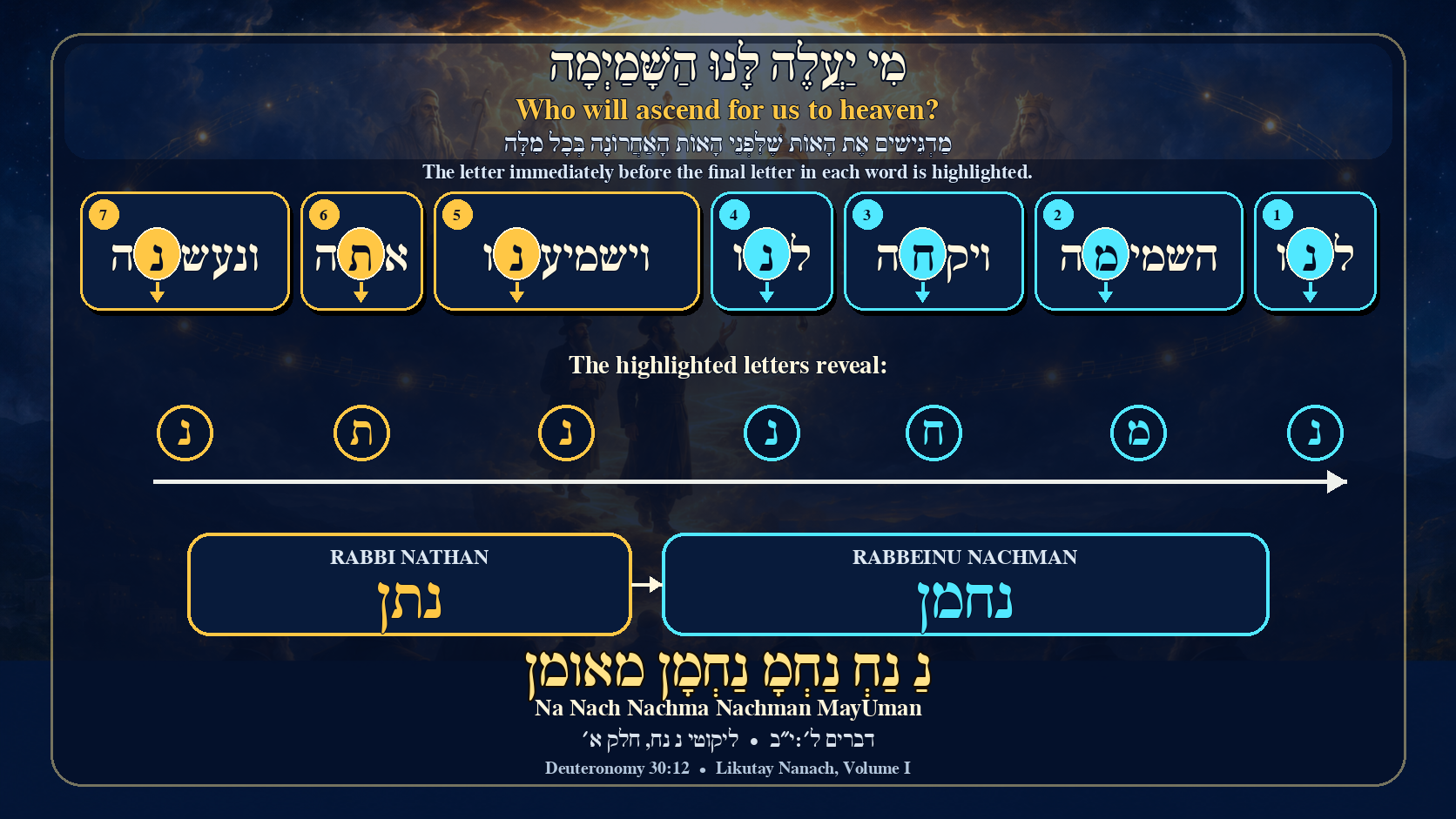
Na Nach Nachma Nachman May'Uman
וֹצֶה לָצֵאת ּיְדֵי חוֹבַת הָעַרְבות וְעֹצֶם רִבּוי הַבְּרִיתוֹת שֶׁנִכְרְתו עַל זֶהַ,ּאֲזַי יִשְׁתְּּדֵל לְקָרֵב נַפְשׁוֹת יִשְׂרָאֵל לְהַשֵׁם יִתְבָּרַך, ּּׁוַאֲזַי אֲפִלו כְּשֶׁאֵינו ֹ זוֹכֶה רַק לְהוֹסִיף נֶפֶש ׁ אַחַת עַל ּהַקִבּוץ הַקָדוֹש,ֹּהֲרֵי כַּמָה אַלְפֵי אֲלָפִים וְרִבֵּי רְבָבוֹת ּמִילֵי מִלְיוֹן בָּתִים נִתְוַסְּפִים עַל יָדו,מִכָּלּשֶׁכֵּן כְּשֶׁזוֹכֶה ּלְקָרֵב כַּמָה נְפָשׁוֹת,ּשֶׁעַל יְדֵי כָּל זֶה נִתְרַבִּים הַבָּתִים כָּך ְכָּל,הַנִשְׁפָכִים לְגַמְרֵי הָרְחוֹקִים כָּל שֶׁגַּם ּּעַד ְּּּבְּרֹאש ׁ כָּל חֻצוֹת נִכְנָסִין גַּם כֵּן מִמֵילָא לְתוֹך הַבָּתִים ּּדִקְדֻשָׁה,ּובָז
For all things — before one eats them or derives pleasure from them — one must raise and elevate them upward to holiness, in order to draw down for them a life-force from holiness. And then the food is fit for the eating of Israel. For previously it drew its life-force from the aspect of the Tree of Knowledge (Etz HaDa'as), through which all things fell among the klippos [husks]. And therefore one must recite a blessing before every item from which one wishes to derive pleasure. For through the blessing — through which one blesses and gives thanks to Hashem blessed-be-He Who created that thing — through this one raises and lifts that thing upward to its root in holiness, and draws down for it a life-force from there. For through the speech of the blessing — in which one says, for example, “boray pri ha'eitz” [Who creates the fruit of the tree] — through this it is as though the thing is created anew. For it is now rectified, and a life-force is drawn down for it from holiness. And it turns out that one is now creating it anew literally. As is brought above in Hilchos Nedarim (Halacha 1).
And this is the aspect of Terumah and Ma'aser. And ma'aser min hama'aser [a tithe of the tithe] which is also a Terumah. And on the face of it the matter is puzzling: since there is a commandment to separate yet another Terumah — that is, ma'aser min hama'aser — it would have seemed appropriate to separate it all at once. For there is no difference at all between the first and the last Terumah: both go to the Kohen, both are holy with a single holiness according to the law of Terumah.
ֶה יּּוֹצֵא יְדֵי חוֹבַת הָעַרְבות בִּשְׁלֵמות גָּדוֹל.ּוְכָל אָדָם יָכוֹל לְקַיֵם זֹאת עַל יְדֵי שֶׁמִשְׁתַדֵל ְּּלְקָרֵב בָּנָיו עַל כָּל פָנִים לַעֲבוֹדָתו ֹ ולְתוֹרָתו ֹ יִתְבָּרַך, ּולְהַקִבּוץ הַקָדוֹש ׁ הַנִלְוִים אֶל הַצַדִיק הָאֱמֶת הַמַנְהִיג ּהָאֲמִתִי,הָאֲמִתִי ׁ בַּדֶרֶך הַקֹדֶש בְּדֶרֶך ְְּּהַמַדְרִיכָם ּדִקְדֻשָׁה אֲשֶׁר דָרְכו בּו ֹ אֲבוֹתֵינו מֵעוֹלָם,בִּפְרָט מִי ּּשֶׁזוֹכֶה לְהַעֲמִיד גַּם תַלְמִידִים אֲחֵרִים.
Since emunah is in the aspect of "this is Yerushalayim — in the midst of the nations I have placed her" and the chitzonim [external forces] draw sustenance from her — one must be very careful. One needs caution and exertion not to remain submerged there, chas v'shalom — not to let them overpower, since they draw sustenance from there. This is: "one should always be careful with Tefilas HaMinchah" — then extra caution is needed. Therefore the Sages decreed that specifically close to Minchah one should not begin any work or eating — lest he forget to pray. Specifically then they were concerned, since then judgments prevail — the chitzonim drawing from emunah. Therefore they decreed these decrees — lest he forget, for then extra caution is needed lest they overpower him.
ּוְזֶהו" :ּּהַנִסְתָרֹת לַה'ּאֱלֹקֵינו",ְּכִּי רַק הוא יִתְבָּרַךלְבַד ּיוֹדֵע ַ נִסְתָרוֹת,ּובְוַדַאי לֹא יַעֲנִיש ׁ אוֹתָנו עַל הַנִסְתָרוֹת ּמִמֶנוִׁ,ֹ שֶׁפֵרֵש ׁ רַש ּּוכְמוֹ"עִנְיָנו ֹ וְשִׁיטָתו לְפִי י,רַק "ּוְהַנִגְלֹת לָנו ולְבָנֵינו"ּדַיְקָא,ּּשֶׁאָנו צְרִיכִין הָעִקָר ּלְהִשְׁתַדֵל לְקָרֵב בָּנֵינוּּ וְתַלְמִידֵינו שֶׁנִקְרָאִים גַּם־כֵּן בָּנִים,ְַּּּּלְקָרֵב מַה שֶׁנוכַל לַעֲבוֹדָתו ֹ יִתְבָּרַך ולְצָרְפָם ׁ כַּנ הַקָדוֹש הַקִבּוץ אֶל ּולְהוֹסִיפָם"ל,זֶה וְעַל־יְדֵי ּיִתְרַבּו הַבָּתִים מְאֹד עַד שֶׁיִתְקָרְבו מִמֵילָא כֻּלָם לִפְנִים וְכּו'.ּוְזֶהו"ּּעַד עוֹלָם לַעֲשׂוֹת אֶת כָּ
And this is the aspect of the mikveh, which is the aspect of the waters of da’as that come through the aforementioned tikkun. For the mikveh is made through rainwater, which is the aspect of g’vuros g’shamim, or from a well and a spring, which are the aspect of the wells of Yitzchak. For specifically through the aspect of the might of Yitzchak are the waters of da’as and compassion revealed, the aspect of the mikveh, as mentioned above. And this is the essential tikkun, for it is the aspect of tefillah in the aspect of din of the man of great power, as mentioned above in the aforementioned teaching. And therefore through this specifically they are purified from the contamination of the serpent, etc., as mentioned above. And this is the aspect of the immersion in the mikveh, whether of the niddah or of the gentiles when they convert. For through this they emerge from the aspect of din, which is the contamination of the serpent, the blemish of the desire of adultery, and they are included in the totality of compassion and da’as, upon which the essential holiness of the union depends, as mentioned above.
Oas Ches
And therefore the Kohein, who is the aspect of the ultimate compassion and da’as — as is brought, that the Kohein is the aspect of great chesed (kindness), for the Kohein is the first of the three aforementioned brains, of the three aforementioned kinds of compassion — therefore the Kohein is warned even more regarding the holiness of the union, and must distance himself from the aspect of din more and more. And even among Israelites themselves, wherever there is any hold of din whatsoever, she is forbidden to him.
Oas Ches
And therefore the Kohein, who is the aspect of the ultimate compassion and da’as — as is brought, that the Kohein is the aspect of great chesed (kindness), for the Kohein is the first of the three aforementioned brains, of the three aforementioned kinds of compassion — therefore the Kohein is warned even more regarding the holiness of the union, and must distance himself from the aspect of din more and more. And even among Israelites themselves, wherever there is any hold of din whatsoever, she is forbidden to him.
ל דִבְרֵי הַתוֹרָה ּהַזֹאת",ַּהַיְנו שֶׁעַל־יְדֵי זֶה לְבַד שֶׁנְקָרֵב אֶת בָּנֵינו ּוְתַלְמִידֵינו הַמועָטִים אֶל הַקִבּוץ כַּנ"ל,ְעַל־יְדֵי זֶה ּבְּוַדַאי יִתְקַיֵם עַד עוֹלָם קִיום הַתוֹרָה וְהַתּפִלָה לַעֲשׂוֹת ּאֶת כָּל דִבְרֵי הַתוֹרָה הַזֹאת,כִּי עַל־יְדֵי זֶה סוֹף כָּל ְּסוֹף יִתְקָרְבו כֻּלָם לְהַשֵׁם יִתְבָּרַך בֶּאֱמֶת) .הִלְכוֹת ּפְרִיָה ורְבִיָה וְהִלְכוֹת אִישׁות-הֲלָכָהה,אוֹתיג לְפִי
font-size: 1.05em;
ּומָל ה'ָָאֱלֹקֶיך אֶת לְבָבְך וְאֶת לְבַב ָזַרְעֶך... ּאִם יִזְכֶּה שֶׁיַרְגִּיש ׁ בֶּאֱמֶת כְּאֵב חֲטָאָיו,ֹ ּהַיְנו כְּשֶׁיָמול אֶת עָרְלַת לְבָבו–ּּ כִּי כָּל זְמַן שֶׁלִבּו ֹ עָרֵל וְאָטום,אִי אֶפְשָׁר לו ֹ לְהַרְגִּיש ׁ בֶּאֱמֶתֶׁ,רַק כְּשֹּּיָמול אֶת עָרְלַת לְבָבו,ּוְיִהְיֶה לו ֹ חָלָל בַּלֵב,ֹוַאֲזַי יַרְגִּיש ׁ לְבָבו ֹ בֶּאֱמֶת כְּאֵבו גֹּדֶל,בֶּאֱמֶת וְיִתְחָרֵט וְיִצְטַעֵר,מִגֹּדֶל וַאֲזַי הַטִפוֹת כָּל שֶׁל הַלְבָבוֹת כָּל גַּם יַרְגִּישׁו ּהַחֲרָטָה ּשֶׁנִמְשְׁכו מִמֶנו,ּולְכָל מָקוֹם שֶׁנִמְשְׁכו,ּיַרְגִּישׁו שָׁם ּבַּמָקוֹם שֶׁהֵם,ּהֵן אוֹתָם שֶׁנִמְשְׁכו מִמֶנו וְנִתְהַוו מֵה
margin-bottom: 8px;
ֶם ּבָּנָיו מִמִין בְּנֵי־אָדָם,ּוְהֵן אוֹתָם שֶׁנִמְשְׁכו מִמֶנו לְמָקוֹם אַחֵר,חַס וְשָׁלוֹם,ּוְגַם שָׁם יֵש ׁ לָהֶם לֵב ושְׁאָראֵיבָרִים. וַאֲזַיֹ,ּּכְּשֶׁיָמול אֶת לְבָבו ֹ וְיַרְגִּיש ׁ לְבָבו ֹ גֹּדֶל כְּאֵבו, ּוְיַתְחִיל לְהִצְטַעֵר ולְהִתְחָרֵט בֶּאֱמֶת,ּאֲזַי יַרְגִּישׁו שָׁם ּכָּל הַלְבָבוֹת שֶׁל הַטִפוֹת,ְּוְיִתְוַדַע לָהֶם הָאֱמֶת הֵיאַך טִנוֹפ בִּמְקוֹם מֻטָלִים ּּהֵםתַחְתִית בִּשְׁאוֹל ּּוֹת.כִּי ּמִתְחִלָה נִדְמֶה לָהֶם שֶׁטוֹב לָהֶם,ּכִּי הֵן מַזִיקֵי עָלְמָא, רַק אַחַר־ְכָּך,ּּכְּשֶׁנִמוֹל לְבָבָם עַל־ּּיְדֵי שֶׁנִמוֹל לְבַב אֲבִיהֶם,הֵם הֵיכָן מַרְגִּישִׁין אֲזַי,לְקוֹנֵן ּומ
Sefirah: purifying the Moach, day by day
Lag BaOmer: the gal — partition against evil thoughts
ַתְחִילִין ּולְהִצְטַעֵרֲ,וְנַעבֵּינֵיהֶם ׁ גָּדוֹל רַעַש שָׁם שֶׂה.ּוְזֶהו )דברים ל:(ּומָל ה'ָָָאֱלֹקֶיך אֶת לְבָבְך וְאֶת לְבַב זַרְעֶך; ּהַיְנו כְּשֶׁיָמול הֹ'אֶת לְבָבוֹ,ּיִמוֹל גַּם לְבַב זַרְעו.ּולְהֵיכָן ְּּשֶׁנִמְשָׁך הַזֶרַע,הֵן לְמִין בְּנֵי־אָדָםָּ,ּאֲזַי מְחֻיָבִים בנָיו, ּּשֶׁיַרְגִּישׁו גַּם־ּכֵּן הִרְהור תְשׁובָה עַל־ּּיְדֵי שֶׁנִמוֹל לְבַב אֲבִיהֶם,ְוְכֵן אִם נִמְשָׁך לְמָקוֹם אַחֵר,חַס וְשָׁלוֹם,ַאֲזַי ּיִמוֹלו שָׁם הַלְבָבוֹת וְיַרְגִּישׁו כַּנ"ל.ּוְהַזְמַן הַמְסֻגָּל לָזֶה ּּהוא חֹדֶש ׁ אֱלולֱ,כִּי אּלול רָאשֵׁי־תֵבוֹת:ָאֶת לְבָבְך וְאֶת לְבַב;ּהַיְנו שֶׁיָמול ה'אֶת לְבָבו ֹ
And therefore in truth one requires great [spiritual] study [limud] for this — to cleave to the dust of the feet of the wholehearted and upright of heart, and to strive all his days to be included in the aspect of the yeshiva [Torah academy] of the true tzaddik who engages in the true study of the fulfillment of the Torah. For this is the essential purpose: to bring faith into the world and to draw every person out from the disgraceful places into which he has fallen. For there are many deep halachos in this, and all of it is hinted at in the aforementioned Torah, which writes there that this is the aspect of “a teacher with students” — which is called a yeshiva — see there carefully.
וְאֶת לֵבָב סְתָםֹ, ּּהַתָלוי בּוַ,ְּּלְהֵיכָן שֶׁנִמְשָׁך כַּנ"ל.ּהַיְנו הַלֵב שֶׁל הַטִפוֹת ּּלְאֵיזֶה מָקוֹם שֶׁנִמְשְׁכו,ּאִם שֶׁנִמְשְׁכו וְנִתְהַוו מֵהֶם בָּנָיו מִין בְּנֵי־אָדָם,ּּוְהֵן שֶׁנִמְשְׁכו,חַס וְשָׁלוֹם,לְמָקוֹם אַחֵרֹ, ּּוְגַם הֵם בָּנָיו וְהֵם תְלויִים בּו.וְעַל־ּכֵּן כְּשֶׁנִפְטָר הָאָדָם, ּהֵם הוֹלְכִים אַחַר הַמִטָה ומְקוֹנְנִים עָלָיו,כְּמו ֹ בָּנָיו ּּמַמָש ׁ מִמִין אָדָםֶׁ,ְּאַך שֶׁזֶה שּהֵם הוֹלְכִים ומְקוֹנְנִים ּאַחֲרָיו הוא לו ֹ לְבִזָיוֹן ולְחֶרְפָה גְּדוֹלָה,רַחֲמָנָא לִצְלַן. ּּרַחֲמָנָא לִצְלַן מֵעֳנָשִׁים הַלָלוַ,ּּכַּיָדועַ. )ּּלִקוטֵי מוֹהֲר"ן
And therefore in truth one requires great [spiritual] study [limud] for this — to cleave to the dust of the feet of the wholehearted and upright of heart, and to strive all his days to be included in the aspect of the yeshiva [Torah academy] of the true tzaddik who engages in the true study of the fulfillment of the Torah. For this is the essential purpose: to bring faith into the world and to draw every person out from the disgraceful places into which he has fallen. For there are many deep halachos in this, and all of it is hinted at in the aforementioned Torah, which writes there that this is the aspect of “a teacher with students” — which is called a yeshiva — see there carefully.
ּלֹא בַשָׁמַיִם הִוא ּבְּוַדַאי אֲפִלו אִםּּ לֹא הָיָה אֶפְשָׁר לְקַיֵם אֶת הַתוֹרָה כִּי ּאִם עַל־יְדֵי שֶׁיַעֲלו לַשָׁמַיִם,ּּהַיְנו לַעֲשׂוֹת תֵכֶף עֲבוֹדוֹת מְאֹד גְּבוֹהוֹת,הָיִינו בְּוַדַאי שָׁמַיִם בְּחִינַת ָּּשֶׁהֵם אַחֲרֶיה לַעֲלוֹת צְרִיכִים,לְהָאָדָם רָאוי בְּוַדַאי ֲּּכִּי ּשֶׁיַעְּּבֹד הַשֵׁם יִתְבָּרַך בְּתַכְלִית תַכְלִית מַדְרֵגָה עֶלְיוֹנָה ּאֲשֶׁר הוא בְּחִינַת שָׁמָיִם.
And therefore in truth one requires great [spiritual] study [limud] for this — to cleave to the dust of the feet of the wholehearted and upright of heart, and to strive all his days to be included in the aspect of the yeshiva [Torah academy] of the true tzaddik who engages in the true study of the fulfillment of the Torah. For this is the essential purpose: to bring faith into the world and to draw every person out from the disgraceful places into which he has fallen. For there are many deep halachos in this, and all of it is hinted at in the aforementioned Torah, which writes there that this is the aspect of “a teacher with students” — which is called a yeshiva — see there carefully.
ְְּּאַך הַשֵׁם יִתְבָּרַך חָפֵץ חֶסֶד הוא,ּּוְהוא יָדַע יִצְרֵנו ּּזָכור כִּי עָפָר אֲנָחְנו,ּוְיֵצֶר לֵב הָאָדָם רַע מִנְעֻרָיו,ָוְאִי אֶפְשָׁר לְכָל אָדּם לְהַתְחִיל תֵכֶף בַּעֲבוֹדוֹת גְּבוֹהוֹת עַד ּלַשָׁמַיִם,ּּוַאֲפִלו לְאַחַר הַהַתְחָלָה,לָאו כָּל אָדָם זוֹכֶה גְּבוֹהוֹת לַעֲבוֹדוֹת יָמָיו בְּסוֹף ּּאֲפִלו.וְאִם־כֵּן,חַס וְשָׁלוֹם,ְּאִם לֹא יִרְצֶה הַשֵׁם יִתְבָּרַך לְקַבֵּל הָעֲבוֹדוֹת ּּפְשׁוטוֹת שֶׁל סְתַם בְּנֵי־אָדָם הַכְּשֵׁרִים,אִם־כֵּן אָבְדָה ּהַתִקְוָה,חַס וְשָׁלוֹם,שֶׁל רֹב הָעוֹלָם!עַל־כֵּן הִזְהִירָה ּהַתוֹרָה עַל זֶה כִּי"ּּלֹא בַשָׁמַיִם הִוא וְכו'",ּוְסִיֵם" :כִּי ָּקָר
Afterward he mentioned above time: "Yamim yutzaru v'lo echad bahem" (Tehillim 139:16) — all days before Him are one. "V'lo echad bahem" — this is Yom HaKippurim (Tanna D'vei Eliyahu Rabbah 81). The day a person does teshuvah is above time; Yom HaKippurim is above time (Alef-Beis HeChadash, letter Tav, Teshuvah 1).
Teshuvah is above place — the Kisei HaKavod — and above time. After waving the omer (elevating "place" to "above place"), one begins counting the days. Above time, counting is not applicable.34 When Hashem created the world — space and time — He counted the days: "And there was evening and there was morning, one day" (Bereishis 1:5). Creation requires time and space — the aspect of counting. Above time and space, everything is one. Therefore one counts the days of the omer to elevate time to "above time." The judgment is only sweetened "at its root." Through the omer of barley (all tzimtzumim, "place") one elevates "place"; through the counting (essential aspect of time) one elevates time. The essential thing is to purify "place," binding it to the "Place of the world." Through this, the days also ascend.
This is alluded to in the teaching mentioned above, on: "L'veischa na'avah kodesh, Hashem l'orech yamim" — Hashem is the Place of the world.37 He constricted His Shechinah in the Beis HaMikdash only because there were beautiful things there — the form of the Temple was like the form of Creation and Gan Eiden (Hakdamas HaTikkunim).38 But He Himself is the Place of the world. Through this: "Hashem l'orech yamim" — He can judge the world with mercy. He can make Rosh Hashanah, which is yoma arichta.
Teshuvah is above place — the Kisei HaKavod — and above time. After waving the omer (elevating "place" to "above place"), one begins counting the days. Above time, counting is not applicable.34 When Hashem created the world — space and time — He counted the days: "And there was evening and there was morning, one day" (Bereishis 1:5). Creation requires time and space — the aspect of counting. Above time and space, everything is one. Therefore one counts the days of the omer to elevate time to "above time." The judgment is only sweetened "at its root." Through the omer of barley (all tzimtzumim, "place") one elevates "place"; through the counting (essential aspect of time) one elevates time. The essential thing is to purify "place," binding it to the "Place of the world." Through this, the days also ascend.
This is alluded to in the teaching mentioned above, on: "L'veischa na'avah kodesh, Hashem l'orech yamim" — Hashem is the Place of the world.37 He constricted His Shechinah in the Beis HaMikdash only because there were beautiful things there — the form of the Temple was like the form of Creation and Gan Eiden (Hakdamas HaTikkunim).38 But He Himself is the Place of the world. Through this: "Hashem l'orech yamim" — He can judge the world with mercy. He can make Rosh Hashanah, which is yoma arichta.
וֹב אֵלֶיך הַדָבָר מְאֹד,ָָֹּבְּפִיך ובִלְבָבְך לַעֲשׂתו", ּהַיְנו,עִם בִּטְרונְיָא בָּא הַקָדוֹשׁ־בָּרוך־הוא ְּּשֶׁאֵין ּבְּרִיוֹתָיו,ּּוְאֵינו ֹ חָפֵץ מֵהָאָדָם שֶׁיַעֲלֶה לַשָׁמַיִם,ֹ ּּדְהַיְנו בְּכֹחו שֶׁאֵין מַה דַוְקָא גְּבוֹהוֹת עֲבוֹדוֹת ּשֶׁיַעֲשֶׂה לַעֲשׂוֹת עֲדַיִןָ,ְּרַק הַשֵׁם יִתְבָּרַך חֹּפֵץ מֵהָאָדָם שֶׁיַעֲשֶׂה ּמַה שֶׁאֶפְשָׁר לו ֹ לְפִי מַדְרֵגָתו,בִּבְחִינַת"ּּסֻלָם מֻצָב ּאַרְצָה וְרֹאשׁו ֹ מַגִּיע ַ הַשָׁמָיְמָה"ֹ ,ְּדְהַיְנו שֶׁיַמְשִׁיך עַצְמו ְּּמְעַט מְעַט לְמַעְלָה לְמַעְלָה בְּכָל פַעַם וְיֵלֵך מִמַדְרֵגָה לְמַדְרֵגָה,כְּמּו ֹ שֶׁאָנו מְבַקְשִׁין בְּכָל יוֹם" :ּּש
And it is explained there that the rest of the world certainly needs to be in a state of constant teshuvah, for even when one says "I have sinned" etc., one cannot say it without some ulterior motive. Therefore one must constantly return over one's previous teshuvah etc. And see what is written there — that one needs to be expert in the halachah if one wants to return: the aspect of expert in entering, expert in exiting — the aspect of "If I ascend to the heavens, there You are; and if I make my bed in She'ol, behold You are there" etc. (Tehillim 139:8). That even in all the descents in the world, even in the lowest depths of She'ol, one should strengthen oneself to find Hashem and return to Him — in the aspect of "If I make my bed in She'ol, behold You are there" etc.
ֶׁתַרְגִּילֵנו ָבְּתוֹרָתֶך",ּּשֶׁתַרְגִּילֵנו דַיְקָא,ּכְּמו ֹ הַהֶרְגֵּל שֶׁמַרְגִּיל אָדָם אֶת עַצְמו ֹ בְּאֵיזֶה דָבָר מְעַט מְעַטֹ. ְֶּּנִמְצָא שֶׁאֵין הָאָדָם צָרִיך לְהִסְתַכֵּל בִּתְחִלַת עֲבוֹדָתו ַּשֶׁיַעֲלגָבוֹה לְמַדְרֵגָה מִיָד ּּה,בְּחִינַת ּשֶׁזֶה'לֹא כִּי ּבַשָׁמַיִם הִוא,'ְּּּשֶׁאֵין אַתָה צָרִיך לַעֲלוֹת מִיָד לַשָׁמַיִם, ְּּּרַק הוא צָרִיך לְהִתְחַזֵק לְהִתְקָרֵב וְלַעֲלוֹת לַמַדְרֵגָה ּּהַקְרוֹבָה אֵלָיו מִיָד.
And the essential thing is through the aspect of aidus Hashem ne'emanah, as above — the aspect of two trustworthy witnesses, which are the aspect of the two aforementioned points, the aspect of "If I ascend to the heavens" and "if I make my bed in the abyss" — which is the essential truth that shines from beginning to end. One must take to heart the point of truth always, every day and at every time and every hour, in every place where he is, as above.
Os 12
Os 12
וְזֶהָ: "ָּכִּי קָרוֹב אֵלֶיך הַדּבָר מְאֹד וְכו'",ֹ כִּי בֶּאֱמֶת ְּהַתוֹרָה וְהָעֲבוֹדָה שֶׁאַתָה צָרִיך לְקַיֵם עַתָה כְּפִי רְצוֹנו ְָּיִתְבָּרַך הוא קָרוֹב אֵלֶיך מְאֹד,ְּכִּי אֵין אַתָה צָרִיך רַק ָּלְהִתְגַּבֵּר לַעֲלוֹת מִמַדְרֵגָתְך לַמַדְרֵגָה הַסְּמוכָה שֶׁהִיא קְרוֹבָהמְאֹד ָאֵלֶיך,מֻזְהָר אַתָה זֶה ּוְעַל" :ָֹבְּפִיך לַעֲשׂוֹתו ָּובִלְבָבְך",מְאֹד לְהִתְגַּבֵּר שֶׁצָרִיך ְּדְהַיְנו ּעַל־יְדֵי דִבּורֵי־תוֹרָה ותְפִלָה,שֶׁעַל־יְדֵי־זֶה מְקָרְרִין ּחֲמִימות הַלֵב דְסִטְרָא־אָחֳרָא,ּּשֶׁלֹא יִבְעַר הַלֵב,ְחַס ושָׁלוֹם,לְתַאֲווֹת רָעוֹת;ּּוְגַם מְקָרְרִין אֶת חֲמִימות הַלֵב ּּדִקְדֻשׁ
And the essential thing is through the aspect of aidus Hashem ne'emanah, as above — the aspect of two trustworthy witnesses, which are the aspect of the two aforementioned points, the aspect of "If I ascend to the heavens" and "if I make my bed in the abyss" — which is the essential truth that shines from beginning to end. One must take to heart the point of truth always, every day and at every time and every hour, in every place where he is, as above.
Os 12
Os 12
ָה,ּשֶׁלֹא יִבְעַר חוץ מֵהַמִדָה,ּשֶׁלֹא יִרְצֶה לַעֲלוֹת ּתֵכֶף בַּמֻפְלָא מִמֶנו,ַּוְעַל־יְדֵי־זֶה זוֹכִין לַעֲלוֹת מִדַרְגָּא ּלְדַרְגָּא וְלַעֲשׂוֹת אֶת כָּל דִבְרֵי הּּתוֹרָה הַזֹאת.)הִלְכוֹת ּתְרומוֹת ומַעַשְׂרוֹת–הֲלָכָהג,אוֹת ילְפִי אוֹצַר ּהַיִרְאָה-יִרְאָה וַעֲבוֹדָה,אוֹת קיא;ּוְעַיֵןּתַלְמוד תוֹרָה,
The entire drush revolves around the Blind Beggar's gift of arichas chayim. The L'shem Yichud before Tefillin: "May long life be drawn upon me." Addendum: Shmuel, Reish Lakish, and R' Yochanan's memories (Yerushalmi Kesubos) parallel the elders' boasts — but only from after birth. The story speaks of ancient Tzaddikim whose level is beyond measure.
ֹ ָּכִּי קָרוֹב אֵלֶיך הַדָבָר מְאד ֹ ּאִי־אֶפְשָׁר לְקַבֵּל אֶת הַתוּרָה בְּכָל אָדָם ובְכָל זְמַן, ּדְהַיְנו שֶׁיִזְכֶּה לְקַיֵם אֶת הַתוֹרָה ולְהָבִין דַרְכֵּי הַתוֹרָה עַל מְכוֹנָם,ּשֶׁזֶה עִקַר בְּחִינַת קַבָּלַת הַתוֹרָה שֶׁבְּכָל זְמַן ּבִּכְלָלִיות ובִפְרָטִיות בְּכָל אָדָםִּ,וְכָל זֶה אִי אֶפְשָׁר כי אִם עַל־יְדֵי יְגִיעוֹת גְּדוֹלוֹת,ּשֶׁצְרִיכִין לִשְׁבֹּר מְנִיעוֹת ּעֲצומוֹת קֹדֶם שֶׁזוֹכֶה כָּל אֶחָד לִבְחִינַת קַבָּלַת הַתוֹרָהַ, ּכְּמַאֲמַר רַבּוֹתֵינו ז"ל:ּיָגַעְתִי ומָצָאתִי תַאֲמִין מָצָאתִי ּוְלֹא יָגַעְתִי אַל תַאֲמִין וְכו,'כִּיּצְרִיכִין לִהְיוֹת מְרֻצֶה ְְּּׁלִמְסֹר נַפְ
.ts-card.c5 { border-color: #3e4e8b; } .ts-card.c5 .ts-section-num { color: #3e4e8b; }
שׁו ֹ מַמָש ׁ וְלֵירֵד לְתוֹך הַיָם ולְתוֹך הַתְהוֹם ּמַמָש,ּבִּשְׁבִיל לְחַפֵש ׂ אַחַר דַרְכֵי הַתוֹרָה הַקְדוֹשָׁה, ֹ יָם ׁ כְּמו מַמָש שֶׁהֵם עֲצומוֹת מְנִיעוֹת לִשְׁבֹּר ּהַיְנו ּותְהוֹם.ּוְאָז כְּשֶׁהואּ מְרֻצֶה לָזֶהׁ ,ּוְהָרָצוֹן וְהַחֵשֶׁק שֶׁיֵש ְּּלו ֹ לְהַתוֹרָה הַקְדוֹשָׁה חָזָק אֶצְלו ֹ כָּל כָּךֹ ,אֲזַי עוֹזֵר לו ְּּּהַשֵׁם יִתְבָּרַך שֶׁזוֹכֶה לִשְׁבֹּר כָּל הַמְנִיעוֹת,וְהַמְנִיעוֹת ּמִתְבַּטְלִין מֵאֲלֵיהֶן,ְּּּכִּי אֵין הַקָדוֹש ׁ בָּרוך הואבָּא ּּבִּטְרונְיָא עִם בְּרִיוֹתָיוַ ,ְּּּוְאֵין הַקָדוֹש ׁ בָּרוך הוא שׁוֹלֵח ּּמְנִיעוֹת לְהָאָדָם שֶׁלֹא יוכַל לְשַׁבְּרָם אִם יִרְצֶ
The Tefillah l'Ani is the most precious of all, as the Zohar HaKadosh elaborates there at great length, praising the prayer of the poor one: "Broken vessels of HaKadosh Baruch Hu — he constantly quarrels with HaKadosh Baruch Hu, and HaKadosh Baruch Hu listens and hears his words. When he prays his prayer, all the windows of heaven are opened. All other prayers ascending on high are pushed aside by this poor, broken-hearted one. HaKadosh Baruch Hu says: Let all the prayers of the world be wrapped aside, and let this prayer come before Me. I do not want any court to judge between us. Let his complaints be before Me — he and I alone." HaKadosh Baruch Hu secures Himself alone with those complaints, with that prayer: "V'lifnei Hashem yishpoch sicho" — "Before Hashem he pours out his prayer" — "Lifnei Hashem" indeed. All the hosts of heaven ask one another: "With what is HaKadosh Baruch Hu occupied?" They say: "He has secluded Himself in longing with His vessels." None of them know what becomes of this prayer of the poor one and all his complaints — for the poor one's desire is only to pour his tears in complaint before the holy King, and the desire of HaKadosh Baruch Hu is only to receive them.
All this was said even about a poor person who prays about physical needs and poverty. How much more so when a person begins to have mercy on himself, senses his poverty in good deeds, argues with Hashem, quarrels with Him, protests that He does not draw him close, and pours his prayer and heart before Him until he is stirred to tears — how exceedingly precious this prayer is before Hashem! It is the most precious of all prayers.
ה.ּוְהָעִקָר ּּהוא עַל־יְדֵי תקֶף הָרָצוֹן,כִּי כָּל הַמְנִיעוֹת אֵינָם בָּאִים ּעַל הָאָדָם רַק בִּשְׁבִיל נִסָּיוֹן ובְחִירָה,וְגַם נִמְשָׁכִין ּמֵהַקִטְרוג שֶׁמְקַטְרֵג הַשָׂטָן עַל בְּחִינַת קַבָּלַת הַתוֹרָה בִּכְלָל,ּוְכֵן בַּפְרָט.ּּאֲבָל תֵכֶף כְּשֶׁהוא חָזָק בְּהָרָצוֹן ְּהַקְדוֹשָׁה כָּל־כָּךׁ ,ּעַד שֶׁהוא מְרֻצֶה לִמְסֹר נַפְשׁו ֹ מַמָש כָּל וְלִשְׁבֹּרּהַמְנִיעוֹת,כָּל נִתְבַּטְלִין מִמֵילָא ּּאֲזַי ּּהַקִטְרוגִים,ּכִּי מֵאַחַר שֶׁמְרֻצֶה לִשְׁבֹּר מְנִיעוֹת כָּאֵלו, ּּבְּוַדַאי מַגִּיע ַ לו ֹ זֶה לִזְכּוֹת לְקַבָּלַת הַתוֹרָה בִּשְׁבִיל זֶה, ּוְאָז עַל־יְדֵי זֶה מִמֵילָא נִתְבַּטְ
And then specifically all will merit to know and recognize Him, blessed be He, in truth — as it is said: "for they will all know Me, from the smallest of them to the greatest" (Yirmiyahu 31:33). For the essential revelation of emes is to reveal the knowledge of His true being in the world — for He, blessed be He, is the very substance of emes, as it is said: "and the emes of the Lord endures forever" (Tehillim 117:2), and as it is written: "And the Lord God is emes" (Yirmiyahu 10:10). And every person, in proportion to his distance from emes, is likewise distant from the Blessed Lord. And conversely, the closer one is to emes, the closer one is to the Blessed Lord. But the truth of the emes is impossible to attain except through free choice in many and powerful trials — as we find with all the great tzaddikim, who merited to attain emes only through many trials. The first was Avraham Avinu, who had exceedingly powerful trials against the entire world which was filled with falsehood and claimed that truth was with them — to the point that they declared Avraham a heretic and a denier and cast him into the fiery furnace and pursued him greatly. And he stood through all the trials and through this revealed emes in the world, and made known that there is a true God who rules and governs and supervises and so on. And likewise all the tzaddikim who came after him.
And the essential revelation of emes in its completeness will be through Moshiach Tzidkeynu, who will come at the end in the final days of these times — when the world has already multiplied greatly. And the essential multiplicity is in the minds — for there are many differences of mind, which is the essential multiplicity, the aspect of "greatly multiplied in minds." And Moshiach, through the power of his righteousness, will merit to attain the emes in its truth and to reveal emes in the world. And then there will be the complete redemption, and then the intent of creation will be fulfilled in the ultimate completeness. For this is the essential intent of creation: that creation emerge from potentiality into actuality — then the multiplicity began, from which the grip of falsehood is drawn — and the world should multiply, multiplicity upon multiplicity, greatly. So that through this falsehood should intensify further. And therefore in truth, whatever happened — all the destructions and deteriorations and so on — happened. Only the tzaddikim in each generation who merit to emes sustain the world in each and every generation, until at the end when the minds multiply exceedingly, for this is the essential multiplicity — and falsehood intensifies greatly — then specifically the righteous redeemer will merit to clarify the emes through the force of his toil. And then specifically His Name, blessed be He, will be glorified and sanctified through the revelation of emes in its truth from within the multiplicity specifically, as above.
But this emes that will then be revealed — no angel or seraph is capable of attaining it. Only the genuinely true tzaddikim who stood in the trial until they merited to reveal emes from within the multiplicity — from within this physical world, where the multiplicity is at the utmost distance from the One — and when they reveal the emes here, they draw close to the Blessed Lord with the utmost closeness, for which everything was created, as above. And therefore even the angels called "emes" — whose attribute is emes — they too could not understand and attain the depths of the Blessed Lord's mind. Therefore they brought accusations against the creation of man, and the one called emes said: let him not be created. For even though his attribute is emes, even so he could not attain the depth of the Blessed Lord's mind — to attain the true emes which the tzaddikim will merit in the end through standing in the trial in the very world of falsehood (alma d'shikra). And therefore emes said: let him not be created — for emes saw that the moment man would be created, falsehood would intensify. And therefore emes could not bear that man be created, for emes cannot endure falsehood. But in truth even the angels called emes erred in this — for even though their intention was in truth, they could not stand upon the true emes. For the emes in its truth is impossible to attain except specifically in this world, through standing in the trial, as above.
Therefore the Blessed Lord decreed to cast emes to the earth — for this itself is the tikun and clarification of emes: that through emes being cast down to the earth in the aspect of "and it cast emes to the ground," through this very thing emes will be clarified and refined through the true tzaddikim. And then specifically the clarified emes will be revealed — that they will merit to attain the knowledge of His true being, blessed be He — which in no way would have been possible to attain when emes was above in the supernal worlds where there is no falsehood at all. For even the attribute of emes itself cannot attain Him, blessed be He, except through emes descending into this world and being clarified through the tzaddikim, as above. And therefore the moment the ministering angels said: "Why do You dishonor Your takhsis? Let emes rise from the earth!" — the Holy One, blessed be He, agreed with them, as is understood from the Midrash cited above. For the intention of the Blessed Lord from the outset was also this: that emes should be cast to the earth — to the place that is very far from emes, for there is the multiplicity, far from the One in the extreme, where the grip of falsehood is very strong — and there specifically emes will be clarified through the tzaddikim. And through this emes will rise from the earth in the ultimate completeness, in the aspect of "emes will sprout from the earth" — where emes will grow and increase further. And then emes will be completed and all will attain the true emes, as is cited above.
And this is the meaning of: "Behold, You desire emes in the hidden places (ba-tuchot), and in the concealed place You will make wisdom known to me" (Tehillim 51:8) — for regarding this matter that we have written concerning the Midrash cited above: whoever truly desires emes and wishes to be careful for his eternal purpose in truth and not to mislead himself — he can derive from this genuine counsel and immensely powerful encouragement beyond all limit and measure, in such a way that he will remain standing on his position, remaining steadfast at the point of emes rooted within him — and nothing in the world will be able to distract or confuse him or hold him back, through any impediment or incitement or rejection whatsoever. Even if he passes through whatever he passes through. Even if he knows within himself that his deeds are very much deteriorated and that he is as distant as he is distant from the Blessed Lord and His Torah. And in addition to this, they oppress and torment him with various oppressions and afflictions and rejections — to prevent him and distance him from the true point of emes, God forbid. And even so he will not listen to this at all, but will look each time at the point of emes and will say in his heart: even so — what is the true emes? And through this he will constantly strengthen himself and remain steadfast at the point of emes.
And the essential thing is that emes should not prevent him from the true emes — for the essential distancing of each person from the very substance of the true emes is through emes itself. As one sees tangibly that all strife is through emes — for the opponents say that they have the emes. And so it is in every generation. And in particular in the generations that immediately preceded us — when the strife between the scholars (lomdim) and the chassidim was exceedingly powerful and cut to the very soul. And how many and how many souls were sunk through this. And how many separations were made between husband and wife through this. And how many were lost from both worlds through this — as is well known to those who are versed in the events that occurred in the generations that immediately preceded us, which our fathers and teachers told us. And the essential cause of all the strife was through emes itself — for now we know that the great scholars who disputed the great leaders of the chassidim were also, for the most part, genuinely great righteous men. And all their dispute with the great leaders of the chassidim — who were exceedingly holy and awesome tzaddikim — was only because of emes: for the great scholars said that emes was with them, and that the great leaders of the chassidim were far from emes because they transgressed the Torah of emes. As I myself heard in my own ears a great many of their arguments — particularly from the mouth of my father-in-law, the gaon and tzaddik, our rebbe Rav Dovid Tzvi, of blessed memory, who was a great tzaddik as is widely known, and who disputed greatly with the great leaders of the chassidim — and all of it was because of his emes. And likewise it is in every generation and generation.
And all this descended from the accusation of the angels cited above, who brought accusations against the creation of man — from which is drawn the entire power of the evil inclination, whose essential power is through strife, which is drawn through the accusation of the angels enclothing itself in those who dispute and oppose. And the essential power of their accusation was drawn from the aspect cited above: that even the attribute of emes itself, when it descended among the angels, brought an accusation — emes itself brought accusations against the creation of man, as above. And from there descended all the accusations and conflicts in the world below — particularly among Torah scholars, whose essential strife is through emes, as above — that is, through the aspect cited above: that even emes itself cannot attain the true substance of His being, blessed be He. And just as it cannot attain His very being, so it cannot attain the depth of His mind — for He and His mind are one, and there is the essential true emes. But the moment emes descends from Him, blessed be He — the moment the attribute of emes had already descended from Him — immediately the depth of the truth of His holy mind became concealed. For the attainment of the depth of His mind in true emes is hidden and concealed from all created and emanated beings, and so on. It is impossible to fathom the depths of His mind, blessed be He — and not any angel or seraph, and so on — except the souls of the genuinely great tzaddikim who are very elevated in stature, who merit through their deeds and service to the attainment of His mind, blessed be He, in truth. And this will be the essential reward for them as is known.
And the essential revelation of emes in its completeness will be through Moshiach Tzidkeynu, who will come at the end in the final days of these times — when the world has already multiplied greatly. And the essential multiplicity is in the minds — for there are many differences of mind, which is the essential multiplicity, the aspect of "greatly multiplied in minds." And Moshiach, through the power of his righteousness, will merit to attain the emes in its truth and to reveal emes in the world. And then there will be the complete redemption, and then the intent of creation will be fulfilled in the ultimate completeness. For this is the essential intent of creation: that creation emerge from potentiality into actuality — then the multiplicity began, from which the grip of falsehood is drawn — and the world should multiply, multiplicity upon multiplicity, greatly. So that through this falsehood should intensify further. And therefore in truth, whatever happened — all the destructions and deteriorations and so on — happened. Only the tzaddikim in each generation who merit to emes sustain the world in each and every generation, until at the end when the minds multiply exceedingly, for this is the essential multiplicity — and falsehood intensifies greatly — then specifically the righteous redeemer will merit to clarify the emes through the force of his toil. And then specifically His Name, blessed be He, will be glorified and sanctified through the revelation of emes in its truth from within the multiplicity specifically, as above.
But this emes that will then be revealed — no angel or seraph is capable of attaining it. Only the genuinely true tzaddikim who stood in the trial until they merited to reveal emes from within the multiplicity — from within this physical world, where the multiplicity is at the utmost distance from the One — and when they reveal the emes here, they draw close to the Blessed Lord with the utmost closeness, for which everything was created, as above. And therefore even the angels called "emes" — whose attribute is emes — they too could not understand and attain the depths of the Blessed Lord's mind. Therefore they brought accusations against the creation of man, and the one called emes said: let him not be created. For even though his attribute is emes, even so he could not attain the depth of the Blessed Lord's mind — to attain the true emes which the tzaddikim will merit in the end through standing in the trial in the very world of falsehood (alma d'shikra). And therefore emes said: let him not be created — for emes saw that the moment man would be created, falsehood would intensify. And therefore emes could not bear that man be created, for emes cannot endure falsehood. But in truth even the angels called emes erred in this — for even though their intention was in truth, they could not stand upon the true emes. For the emes in its truth is impossible to attain except specifically in this world, through standing in the trial, as above.
Therefore the Blessed Lord decreed to cast emes to the earth — for this itself is the tikun and clarification of emes: that through emes being cast down to the earth in the aspect of "and it cast emes to the ground," through this very thing emes will be clarified and refined through the true tzaddikim. And then specifically the clarified emes will be revealed — that they will merit to attain the knowledge of His true being, blessed be He — which in no way would have been possible to attain when emes was above in the supernal worlds where there is no falsehood at all. For even the attribute of emes itself cannot attain Him, blessed be He, except through emes descending into this world and being clarified through the tzaddikim, as above. And therefore the moment the ministering angels said: "Why do You dishonor Your takhsis? Let emes rise from the earth!" — the Holy One, blessed be He, agreed with them, as is understood from the Midrash cited above. For the intention of the Blessed Lord from the outset was also this: that emes should be cast to the earth — to the place that is very far from emes, for there is the multiplicity, far from the One in the extreme, where the grip of falsehood is very strong — and there specifically emes will be clarified through the tzaddikim. And through this emes will rise from the earth in the ultimate completeness, in the aspect of "emes will sprout from the earth" — where emes will grow and increase further. And then emes will be completed and all will attain the true emes, as is cited above.
And this is the meaning of: "Behold, You desire emes in the hidden places (ba-tuchot), and in the concealed place You will make wisdom known to me" (Tehillim 51:8) — for regarding this matter that we have written concerning the Midrash cited above: whoever truly desires emes and wishes to be careful for his eternal purpose in truth and not to mislead himself — he can derive from this genuine counsel and immensely powerful encouragement beyond all limit and measure, in such a way that he will remain standing on his position, remaining steadfast at the point of emes rooted within him — and nothing in the world will be able to distract or confuse him or hold him back, through any impediment or incitement or rejection whatsoever. Even if he passes through whatever he passes through. Even if he knows within himself that his deeds are very much deteriorated and that he is as distant as he is distant from the Blessed Lord and His Torah. And in addition to this, they oppress and torment him with various oppressions and afflictions and rejections — to prevent him and distance him from the true point of emes, God forbid. And even so he will not listen to this at all, but will look each time at the point of emes and will say in his heart: even so — what is the true emes? And through this he will constantly strengthen himself and remain steadfast at the point of emes.
And the essential thing is that emes should not prevent him from the true emes — for the essential distancing of each person from the very substance of the true emes is through emes itself. As one sees tangibly that all strife is through emes — for the opponents say that they have the emes. And so it is in every generation. And in particular in the generations that immediately preceded us — when the strife between the scholars (lomdim) and the chassidim was exceedingly powerful and cut to the very soul. And how many and how many souls were sunk through this. And how many separations were made between husband and wife through this. And how many were lost from both worlds through this — as is well known to those who are versed in the events that occurred in the generations that immediately preceded us, which our fathers and teachers told us. And the essential cause of all the strife was through emes itself — for now we know that the great scholars who disputed the great leaders of the chassidim were also, for the most part, genuinely great righteous men. And all their dispute with the great leaders of the chassidim — who were exceedingly holy and awesome tzaddikim — was only because of emes: for the great scholars said that emes was with them, and that the great leaders of the chassidim were far from emes because they transgressed the Torah of emes. As I myself heard in my own ears a great many of their arguments — particularly from the mouth of my father-in-law, the gaon and tzaddik, our rebbe Rav Dovid Tzvi, of blessed memory, who was a great tzaddik as is widely known, and who disputed greatly with the great leaders of the chassidim — and all of it was because of his emes. And likewise it is in every generation and generation.
And all this descended from the accusation of the angels cited above, who brought accusations against the creation of man — from which is drawn the entire power of the evil inclination, whose essential power is through strife, which is drawn through the accusation of the angels enclothing itself in those who dispute and oppose. And the essential power of their accusation was drawn from the aspect cited above: that even the attribute of emes itself, when it descended among the angels, brought an accusation — emes itself brought accusations against the creation of man, as above. And from there descended all the accusations and conflicts in the world below — particularly among Torah scholars, whose essential strife is through emes, as above — that is, through the aspect cited above: that even emes itself cannot attain the true substance of His being, blessed be He. And just as it cannot attain His very being, so it cannot attain the depth of His mind — for He and His mind are one, and there is the essential true emes. But the moment emes descends from Him, blessed be He — the moment the attribute of emes had already descended from Him — immediately the depth of the truth of His holy mind became concealed. For the attainment of the depth of His mind in true emes is hidden and concealed from all created and emanated beings, and so on. It is impossible to fathom the depths of His mind, blessed be He — and not any angel or seraph, and so on — except the souls of the genuinely great tzaddikim who are very elevated in stature, who merit through their deeds and service to the attainment of His mind, blessed be He, in truth. And this will be the essential reward for them as is known.
לִין כָּל הַמְנִיעוֹת,וְזוֹכֶה ּּלְקַבָּלַת הַתוֹרָה בִּשְׁלֵמות.ּוְזֶה בְּחִינַת לֹא בַּשָׁמַיִם ּהִיא וְכו'ָּּכִּי קָרוֹב אֵלֶיך הַדָבָר מְאֹד וְכו,'ּכִּי תֵכֶף ּכְּשֶׁהוא חָזָק בְּהָרָצוֹן דִקְדֻשָׁה עַד שֶׁהָיָה מְרֻצֶה לַעֲלוֹת ּלַשָׁמַיִם בִּשְׁבִיל זֶה,וְכֵןִּׁלַעֲבֹר מֵעֵבֶר לַיָם בִּשְׁבִיל זֶה ּּכְּעֵין שֶׁפֵרֵש ׁ רַש"י שָׁם,ָּאֲזַי תֵכֶף כִּי קָרוֹב אֵלֶיך כִּי מִמֵילָא הַמְנִיעוֹת כָּל ּנִתְבַּטְלִין,הַדְבָרִים כָּל ַּוְאָז ּשֶׁבַּקְדֻשָׁה קְרוֹבִים אֵלָיו כַּנ"ל.)הִלְכוֹת הֶכְשֵׁר כֵּלִיםָ - הֲלָכה ד,אוֹת כדּ לְפִי אוֹצַר הַיִרְאָה-ּתַלְמוד תוֹרָה
The Rebbe (LM I:192): the true speech of the Tzaddik = his face, mind, and neshamah. The Megillah = the radiance of Mordechai and Esther's faces. All suspend their service to hear it — because the Tzaddik's face is the source of everything.
§ 28–30 — Purim Joy, Feast & Mishloach Manos
ֹ ָּּאֲשֶׁר אָנֹכִי מְצַוְך הַיום ּעִקַר אֲרִיכַת יָמָיו שֶׁל הָאָדָם הוא מַה שֶׁצְרִיכִין לִזָהֵר ְּּלְהַאֲרִיך ולְהַרְחִיב הַיוֹם בְּכָל יוֹם וָיוֹם,כִּי כָל יוֹם וָיוֹם ּּבִּתְחִלָתו ֹ הוא קָצָר מְאֹד,ּובָא לְהָאָדָם,ֹלְכָל אֶחָד בְחִינָתו כְּפִי וְאֶחָד,גָּדוֹל בְּמֵצַרׁ,בְּחוש ּּוְכַנִרְאֶה, ּשֶׁבְּכָל יוֹם וָיוֹם בִּתְחִלָתו ֹ קָשָׁה עַל הָאָדָם מְאֹד מְאֹד ְּהָעֲבוֹדָה שֶׁהוא צָרִיך לַעֲשׂוֹתּבְּזֶה הַיוֹם.ּומֵחֲמַת זֶה ְּרַבִּים נִמְנָעִין מֵעֲבוֹדָתו ֹ יִתְבָּרַך וְדוֹחִין ומַטְעִין אֶת וָיוֹם יוֹם בְּכָל עַצְמָם,שֶׁאוֹמְרִים:לִי קָשֶׁה ּהַיוֹם ּּלְהִתְפַלֵל!אָטום לִבִּי ּּהַיוֹם!מְנִ
Therefore on Rosh HaShanah we pray much for the sprouting of the horn of Mashi'ach: "Simchah l'artzecha v'sason l'irecha utz'michas keren l'David avdecha" — "Joy to Your land, gladness to Your city, and the sprouting of a horn for David Your servant." Our essential hope to return through Mashi'ach Tzidkainu = through kedushas Rosh HaShanah (when the world was created in His gratuitous chesed). Each year on Rosh HaShanah → the k'lipos and the dominion of the nations over Eretz Yisrael are subdued → kedushas Eretz Yisrael is revealed and drawn to us → until Hashem will have mercy, subdue them completely, and return the land to us speedily.
Therefore Rosh HaShanah is the first day of the Aseres Y'mai T'shuvah [Ten Days of Repentance]. The essential t'shuvah is through the Chesed Chinam that sustained the world before Mattan Torah. Those who already transgressed the Torah's commandments have no sustenance through Torah (since they violated it). They could not return — for according to revealed Torah law given to the court below, t'shuvah does not help: one who transgressed a prohibition carrying lashes or one of the four death penalties — even if he wants to return with all forms of t'shuvah — it does not exempt him from the din of lashes or death. The essential t'shuvah that works = through the Chesed Chinam that sustained the world before Mattan Torah. Just as it sustained the world for 26 generations before Mattan Torah until Yisrael would receive the Torah — so it sustains the wicked despite their transgressing the Torah, until they return and fulfill it. Since on Rosh HaShanah (when the world was created) this Chesed is drawn (= the path to Eretz Yisrael) → then is the essential beginning of t'shuvah → therefore the Aseres Y'mai T'shuvah begin then.
יעוֹת ׁ לִי יֶש ּהַיוֹם ּובִלְבּולִים אֵלוִ!וְכֵן מּּזְדַמֵן לו ֹ כִּמְעַט בְּכָל יוֹם וָיוֹם,ֹ עַד ּּשֶׁמֵחֲמַת זֶה רַבִּים מְזַלְזְלִין בִּדְבָרִים הָעוֹמְדִים בְּרומו שֶׁל עוֹלָםֹ,ּומַאי נִיהו?ּּתְפִלָה,ַּּכְּמו ֹ שֶׁאָמְרו רַבּוֹתֵינו ז"ל,ּוְהַתְפִלָה דוֹמָה עֲלֵיהֶם לְמַשָׂא,ַוַחֲפֵצִים לִפְטֹר המֵעֲלֵיהֶם ּּתְפִלָה,מְבִינִים שֶׁאֵינָם מֵחֲמַת וְכָל זֶה וְאֵינָם מְשִׂימִים אֶל לִבָּם לִרְאוֹת הֵיטֵב שֶׁבְּכָל יוֹם וָיוֹם ְּהוא כָּך,ּכִּי כָל יוֹם בִּתְחִלָתו ֹ הוא קָצָר ובָא לְהָאָדָם גָּדוֹל ובְצִמְצום ּּבְּמֵצַר,וְהָעֲבוֹדָה ּּוְהַקְדֻשָׁהּשֶׁהוא ְּצָרִיך לַעֲשׂוֹת בְּזֶה הַיוֹם עֲדַיִן
And the main time is only because of the forgetfulness — because days and years pass, and over time, the earlier days are forgotten. And because of the forgetfulness, it seems as if it has already been a long and drawn-out time. But when one remembers well what happened from the beginning until now, and the day that passed many years ago is as if it stands now — through this one sees that there is no time at all. Although with our intellect we certainly cannot understand this matter in completeness — only some flash, in passing, as it were.
הִיא נֶעְלֶמֶת בְּמֵצַר גָּדוֹל ּּובְקַטְנות גָּדוֹל מְאֹד.ְאֲבָל הָאָדָם צָרִיך בְּכָל יוֹם ּלִהְיוֹת גִּבּוֹר כַּאֲרִי וְכו,'ְַּלְהִתְגַּבֵּר לְהַאֲרִיך ולְהַרְחִיב ְּּאֶת הַיוֹם וְלֵילֵך בְּכָל שָׁעָה מִקּּטְנות לְגַדְלות,ּּדְהַיְנו קְדֻשָׁה בְּתוֹסֶפֶת מֵהַיוֹם וְשָׁעָה שָׁעָה כָּל ּלְהַגְדִיל יְתֵרָה,ּּשֶׁזֶה עִקַר הָעֲבוֹדָה,ּּמַה שֶׁצְרִיכִין בְּכָל עֵת דְגַדְלות לְמֹחִין דְקַטְנות מִמֹחִין ּלָצֵאת.עִקַר ְּוְזֶה ּיְצִיאַת מִצְרַיִם שֶׁאָנו צרִיכִין לִזְכֹּר בְּכָל יוֹם וָיוֹם,כִּי ּבְּכָל יוֹם אָנו צְרִיכִין לְהִשְׁתַדֵל לָצֵאת מִמֵצַר לַמֶרְחָב, ּּשֶׁזֶהו בְּחִינַתָ: "ּּמִן הַמֵצַר קָ
Returning to the matter of Shabbos Nachamu — the Shabbos after Tisha B'Av, the consolation for the destruction of the Bais HaMikdash.
רָאתִי י"ּה,ּעָנָנִי בַמֶרְחָב"ַ, ּשֶׁזֶה עִקַר אֲרִיכַת יָמָיו שֶׁל הָאָדָם כַּנ"ל.ֵ)הִלְכוֹת גְּנבָה -הֲלָכָה ג,אוֹת יּ לְפִי אוֹצַר הַיִרְאָה-יִרְאָה וַעֲבוֹדָה,
§7
And this is the aspect of: "Go for yourself [lech l'cha] from your land", etc. And the word "l'cha" [for yourself] is not understood at all, as Rashi struggled with this and explained: "l'cha" — for your benefit, etc. And according to the above it can be well understood, with Hashem's help. For it has already been explained above that Hashem, blessed be He, commanded him in this passage to draw himself to all the holinesses mentioned above — that is, to Eretz Yisra'ail and t'filah and emunah and nisim — all of which one merits only through truth, as above. And this is "lech l'cha" — "l'cha" specifically — that all your going and traveling should be "l'cha," to you and to yourself alone. That is, to the essential point of truth, which is your essence and your vitality. For the essential aspect of a person is the holy neshamah within him, which is the entire person, as it is written in the sefarim and brought in his [Rabbainu's] words of blessed memory in siman 22 — that what is called "I" [ani] by a person is only the essence of the neshamah. For a person's flesh is called "the flesh of a person," and the essential person is the neshamah. And the neshamah is a portion of G-d from Above, which is the essence of truth. And this is the aspect of the souls of Yisra'ail, which began from Avraham, about whom it is said: "entirely the seed of truth" (Yirmiyahu 2:21).
ֶּּהַעִדֹתִי בָכֶם הַיוֹם אֶת הַשָׁמַיִם וְאֶת הָאָרץ ְֶּכִּי צְרִיכִים שְׁנֵי עֵדִים דַיְקָא לְגַלוֹת הָאֱמֶת מִתוֹך ּהַשֶׁקֶר שֶׁהֵם בְּחִינַת שָׁמַיִם וָאָרץ,ּשֶׁהוא בְּחִינַת מַעְלָה ּּומַטָה,ָּּבְּחִינַת אִם אֶסַּק שָׁמַיִם שָׁם אָתָה וְאַצִיעָה ּשְׁאוֹל הִנֶך,ּכִּי כְּלַל הַתוֹרָה הוא אֱמונָה,ּכְּמו ֹ שֶׁכָּתוב: "ָּכָּל מִצְוֹתֶיך אֱמונָהַ".ּוכְמו ֹ שֶׁאָמְרו רַבּוֹתֵינו ז"ל:בָּא וְהֶעֱ ּּחֲבַקוקאֱמונָה שֶׁהוא אַחַת עַל ּּמִידָן.ּוְעִקַר ּהָאֱמונָה שֶׁתְלויָה בָּאֱמֶת,ַּכְּמו ֹ שֶׁכָּתוב בְּמָקוֹם אַחֵר ּהוא בִּשְׁתֵי בְּחִינוֹת הַנ"ל,ּדְהַיְנו שֶׁצְרִיכִין לְהַאֲמִין בַּהֹ'ְּּיִתְבָּרַך
And this is the aspect of Ma'aser corresponding to the ten fingers of the two hands, which correspond to the ten commandments in the bread etc., as is brought.
Hilchos Terumos uMa'asros · Halacha Four · Likutay Halachos, Yoreh De'ah II
Na Nach Nachma Nachman MeUman ✦
Hilchos Terumos uMa'asros · Halacha Four · Likutay Halachos, Yoreh De'ah II
Na Nach Nachma Nachman MeUman ✦
שֶׁהוא יָחִיד קַדְמוֹן הָיָה הוֹוֶה וְיִהְיֶה וכְמו צְרִיכִין כֵּן ֹ יִתְבָּרַך בִּמְצִיאותו לְהַאֲמִין ְּּשֶׁצְרִיכִין ּלְהַאֲמִין שֶׁהוא הַבּוֹרֵא,ּּהוא הַיוֹצֵר,ְּּהוא הַמַנְהִיג מֶלֶך ּשַׁלִיט ומוֹשֵׁל ומַשְׁגִּיח ַ עַל כָּל דָבָר מֵרֹאש ׁ וְעַד סוֹף,כִּי ּכְּשֶׁאֵינו ֹ מַאֲמִין חַס וְשָׁלוֹם שֶׁהואְיִתְבָּרַך מוֹשֵׁל בַּכֹּל מָשָׁלָה ֹ בַּכֹּל ומַלְכותו ּתָמִיד,ומְקַצֵץ כּוֹפֵר ּהוא ּבַּנְטִיעוֹתָ .ּוְעַל־כֵּן עִקַר הָאֱמונָה הוא בִּבְחִינַת וְיָדַעְת ָּהַיוֹם וַהֲשֵׁבֹת ָ אֶל לְבָבֶך כִּי ה'ּּהוא הָאֱלֹקִים בַּשָׁמַיִם ּמִמַעַל וְעַל הָאָרֶץּ מִתָחַת אֵין עוֹדֹ ,כִּי צְרִיכִין לְהַמְלִי
And this is what is written there adjacent to it: "A little sleep, a little slumber, a little folding of the hands to lie down — and your poverty will come like a traveler, and your want like a man of shields" (Proverbs 6:10–11). That one must minimize sleep and slumber in order to seek the true Tzadik who is called a "traveler" [mehalech] and a "man of shields" [ish magen]. For the tzadikim are called "travelers" because they go from level to level constantly, as it is written: "And I will give you walkers [mehalchim] among these that stand" (Zechariah 3:7). And the tzadik is also called a "man of shields" — for he shields all who take refuge in him. And this is: "A little sleep, a little slumber," etc. — until you merit that there shall come "like a traveler" — "your head [roshcha]," and Rashi explains: "the things that you are lacking [rash] and your want shall be filled," etc. That is, all the things that you lack and everything that is missing for you — in the physical and the spiritual — everything will come to you swiftly, like a "traveler" and like a "man of shields." That is, according to the stature of the tzadik that you merit to find — who is called a "traveler" and a "man of shields" — correspondingly all your wants and your "head" — that is, the things you are lacking — will come to you. For all deficiencies are filled through the tzadik, for he draws down all abundance, in the physical and the spiritual, through implanting the knowledge of His G-dliness yisbarach in those who are attached to him — through which all deficiencies are filled, as it is written: "If you have acquired da'as, what do you lack?" (Nedarim 41a).
And therefore, one must break the sleep and rise at midnight to mourn and to lament and to weep and to cry out greatly over the destruction of the Beis HaMikdash and the intensity of the bitterness of the exile in body and soul. And all the more so to weep and cry out exceedingly over the passing of the tzadikim, which is twice as grievous as the destruction of the Beis HaMikdash, as our Sages, of blessed memory, said — for all the sufferings, may the Merciful One save us, that we endure come through this, as it is written: "The righteous one perishes, and no one takes it to heart; for on account of the evil, the righteous one is gathered in" (Isaiah 57:1). Therefore, everyone who has compassion for his own soul must cry out greatly that he should merit, even now, to find a true Rebbe and leader who can implant within him the knowledge of His G-dliness yisbarach — through which all deficiencies will be filled, all sufferings will be nullified, and everything will be rectified.
The Laws of Donning Garments
And therefore, one must break the sleep and rise at midnight to mourn and to lament and to weep and to cry out greatly over the destruction of the Beis HaMikdash and the intensity of the bitterness of the exile in body and soul. And all the more so to weep and cry out exceedingly over the passing of the tzadikim, which is twice as grievous as the destruction of the Beis HaMikdash, as our Sages, of blessed memory, said — for all the sufferings, may the Merciful One save us, that we endure come through this, as it is written: "The righteous one perishes, and no one takes it to heart; for on account of the evil, the righteous one is gathered in" (Isaiah 57:1). Therefore, everyone who has compassion for his own soul must cry out greatly that he should merit, even now, to find a true Rebbe and leader who can implant within him the knowledge of His G-dliness yisbarach — through which all deficiencies will be filled, all sufferings will be nullified, and everything will be rectified.
The Laws of Donning Garments
כו ּלְמַעְלָה ולְמַטָה בַּשָׁמַיִם מִמַעַל וְעַל הָאָרֶץ מִתַחַת מָשָׁלָה שֶׁמַלְכותו ֹ בַּכֹּל ּּלְהַאֲמִין) .ּהִלְכוֹת עֵדות-
False celebrities
Four Parshiyos = Four Letters of the Name
Shekalim (Temple) → Zachor (erase Amalek) → Parah (purify outside) → HaChodesh (fill the moon)
PURIM
Greatest light revealed • Mordechai goes out
Four Parshiyos = Four Letters of the Name
Shekalim (Temple) → Zachor (erase Amalek) → Parah (purify outside) → HaChodesh (fill the moon)
PURIM
Greatest light revealed • Mordechai goes out
בֶּןֹ־ּמֵאָה וְעֶשְׂרִים שָׁנָה אָנֹכִי הַיום 'ּהַיוֹם'ּּמָלְאו יָמַי ושְׁנוֹתַי,ְכִּי אֵינו ֹ יָכוֹל לֵילֵך יוֹתֵרַ, ּּכְּמו ֹ שֶׁאָמְרו רַבּוֹתֵינו ז"ל)סוֹטָה יג:(ּמְלַמֵד,ּשֶׁנִסְתְמו ּמִמֶנו וְכו'.ְְּּכִּי הוא צָרִיך לִחְיוֹת חַיִים אֲרֻכִּים לֵילֵך ּּבְּכָל פַעַם יוֹתֵר וְיוֹתֵר וְכְשֶׁאֵינו ֹ יָכוֹל לֵילֵך יוֹתֵר מֻכְרָח ּּלְהִסְתַלֵקַ,ּכַּמובָן בַּשִׂיחוֹת הַקְדוֹשׁוֹת שֶׁל רַבֵּנו ז"לֹ, וְזֶה לְשׁוֹנו:ּקֹדֶם הִסְתַלְקותו ֹ אָמַר שֶׁכְּבָר הוא עוֹמֵד ּּעַכְשָׁו עַל מַדְרֵגָה כָּזו ֹ שֶׁאִי אֶפְשָׁר לְהַשִׂיג יוֹתֵר בְּשׁום ֹּאֹפֶן כָּל זְמַן שֶׁמְלֻבָּשִׁין בְּהַגּוף וְאָמַר שֶׁמִתְגַּע
This is our essential occupation and crying on Rosh HaShanah — to clarify and sanctify the machshavah, upon which all kedushah and all the sweetening of dinim depends. For this we travel to Tzaddikim on RH. To the degree one sanctifies his machshavah → kedushas Eretz Yisrael is revealed (for when evil thoughts flood a person = the waters of the Mabul → kedushas EY is concealed). To the degree one pushes away confused thoughts and sanctifies his machshavah → kedushas EY is revealed. The essential kedushas EY = tikkun hab'ris, which depends on k'dushas hamachshavah: "Tzaddikim yirshu aretz" — "The righteous shall inherit the land."
ְגֵּע ַ מְאֹד גּופו לְהַפְשִׁיט ּמְאֹד.עַל ֹ לַעֲמֹד לו אֶפְשָׁר אִי כִּי ַּּמַדְרֵגָה אַחַת בְּשׁום אֹפֶן כִּי כָּל יְמֵי חַיָיו מֵעוֹלָם לֹא ּּעָמַד עַל מַדְרֵגָה אַחַת אֲפִלו כְּשֶׁהִגִּיעלְאֵיזֶה מַדְרֵגָה ּעֶלְיוֹנָה שֶׁיִהְיֶה אֲפִלו לְתַכְלִית הַמַעֲלָה אַף־עַל־ּפִי־כֵן ּהָיָה מְחַפֵש ׂ יוֹתֵר עַד שֶׁהִגִּיע ַ לְמַדְרֵגָה גְּבוֹהָה יוֹתֵר וְיוֹתֵר.ּּוְכֵן הָיָה תָמִיד כָּל יְמֵי חַיָיו כַּמְבֹאָר בְּמָקוֹם אַחֵרַ)שִׁבְחֵי הָר"ןִ –ָסִימנים לגלדַ (.ּולְבַסּוֹף הִגִּיע ְּּלְמַדְרֵגָה גְּבוֹהָה שֶׁאִי אֶפְשָׁר בְּתוֹך הַגּוף לְהַשִׂיג יוֹתֵר ּבְּשׁום אֹפֶן.וְעַלֹ ־ּּכֵּן הָיָה מֻכְרָח לְהִס
For through the Tzadik lowering himself and illuminating within us his great light below, in our place — which is the aspect of the lighting of the Chanukah lamp — through this we have the power afterward to ascend to the light of the Tzadik, to receive the light in his place — which is the aspect of the lighting of the Shabbos lamp, the aspect of going and ascending to the light of the Tzadik, as above. And this is the aspect of the special quality of Shabbos Chanukah, when one fulfills both holy lamplight commandments — the Chanukah lamp and the Shabbos lamp. And seemingly, the Shabbos lamp alone should suffice, since it is greater — for one ascends above, as mentioned above. But in truth, one must first light the Chanukah lamp, in order to draw the light of the Tzadik below to our place through various garments and strategies. This is the tikun that Mattisyahu and the Tzadikim of that generation drew into us for all generations, through the intensity of the miracle of Chanukah, as above. And afterward we are able to light the Shabbos lamp, for afterward we can ascend to the light of the Tzadik to receive the light in his place.
And so the true Tzadikim conduct themselves with us: when they see the weakness of the world to receive their great light, then they diminish themselves in many ways of diminishment and in many aspects, and they travel and go to the world in order to enliven them and arouse them. And afterward the world has the power to go and travel to them, to receive their light in their place. And this is the aspect of: "I shall go down with you to Egypt, and I shall also surely bring you up" (Genesis 46:4) — that at first Hashem, blessed be He, lowers Himself to Yisrael, as above, and afterward He raises them up through this with ascent after ascent, in the aspect of "bring you up, also ascending." And this is the aspect of what is written regarding Shmuel: "and he went about Beis El and Gilgal and Mitzpah, and his return was to Ramah, for there was his house" (I Samuel 7:16) — that at first he went around the land, Beis El and Gilgal etc., going and traveling and lowering himself to illuminate within Yisrael. And afterward, "his return was to Ramah, for there was his house" — he returned to his home, to his place, and the entire world went to him, for afterward they were able to ascend to him to receive the light in his place, as mentioned above.
And every person must know this: that all the hints and thoughts of teshuvah that come to him every day — all of this is drawn from the light of Hashem, blessed be He, and the true Tzadikim, who lower themselves to him to illuminate within him in his place. And if he will arouse himself with some awakening, he can afterward ascend to the light of the Tzadik, to his place. In the aspect of: "I shall go down with you to Egypt, and I shall also surely bring you up" — and this applies to every person and at every time. Understand this well. And this is the aspect of what is written in Yechezkel (6): "and your survivors shall remember Me" etc. "when I have broken their adulterous heart" — see Rashi's commentary there, whose meaning is that, as it were, Hashem, blessed be He, humbled Himself to arouse them to teshuvah, etc. — i.e. as above, that the prophet rebukes them in the Name of Hashem, blessed be He, who humbled and lowered Himself so much in order to arouse them and raise them to Himself — and they did not take it to heart, etc.
— 22 —
And so the true Tzadikim conduct themselves with us: when they see the weakness of the world to receive their great light, then they diminish themselves in many ways of diminishment and in many aspects, and they travel and go to the world in order to enliven them and arouse them. And afterward the world has the power to go and travel to them, to receive their light in their place. And this is the aspect of: "I shall go down with you to Egypt, and I shall also surely bring you up" (Genesis 46:4) — that at first Hashem, blessed be He, lowers Himself to Yisrael, as above, and afterward He raises them up through this with ascent after ascent, in the aspect of "bring you up, also ascending." And this is the aspect of what is written regarding Shmuel: "and he went about Beis El and Gilgal and Mitzpah, and his return was to Ramah, for there was his house" (I Samuel 7:16) — that at first he went around the land, Beis El and Gilgal etc., going and traveling and lowering himself to illuminate within Yisrael. And afterward, "his return was to Ramah, for there was his house" — he returned to his home, to his place, and the entire world went to him, for afterward they were able to ascend to him to receive the light in his place, as mentioned above.
And every person must know this: that all the hints and thoughts of teshuvah that come to him every day — all of this is drawn from the light of Hashem, blessed be He, and the true Tzadikim, who lower themselves to him to illuminate within him in his place. And if he will arouse himself with some awakening, he can afterward ascend to the light of the Tzadik, to his place. In the aspect of: "I shall go down with you to Egypt, and I shall also surely bring you up" — and this applies to every person and at every time. Understand this well. And this is the aspect of what is written in Yechezkel (6): "and your survivors shall remember Me" etc. "when I have broken their adulterous heart" — see Rashi's commentary there, whose meaning is that, as it were, Hashem, blessed be He, humbled Himself to arouse them to teshuvah, etc. — i.e. as above, that the prophet rebukes them in the Name of Hashem, blessed be He, who humbled and lowered Himself so much in order to arouse them and raise them to Himself — and they did not take it to heart, etc.
— 22 —
ְתַלֵק וְאָמַר בְּזו ּהַלָשׁוֹן:הָיִיתִיכֻּתָנְתִי לִפְשֹׁט מְרֻצֶה ּכְּבָר,ֶׁמִכֵּיוָן ֵשאֶיִנּנייָכוֹל לַעֲמוֹד עַל מַדְרֵגָה אַחַת)ּּהִלְכוֹת תְפִלִין
For then, because Israel left Egypt in haste — because they could not subdue the sitra achra in completeness, because they could not rectify the chovlim, which are the blemished mochin from which the sitra achra nurses — therefore afterward the Egyptians chased after them. And when they overtook them, they were in great danger. For it is impossible to subdue them except by rectifying the aspect of the chovlim, the aspect of the blemished mochin. For then they will clarify from them all the nitzotzos [holy sparks] that fell into them, and then they [the forces of impurity] will fall — for their primary vitality is from the holy nitzotzos that fell into them, as is known.
But Israel did not have the power to rectify the chovlim, since they could not yet make a complete vessel to receive the flow of the no'am ha'elyon — through which one can rectify the chovlim, as mentioned above.
And therefore there was the prosecution: "How are these different from those?" — that is, they still did not have merits in completeness, and did not have the power to make a vessel to receive the flow of the no'am ha'elyon, through which they would rectify the chovlim and the Egyptians would fall, as mentioned above. And since they did not have this power — why should they be saved from them?
But Hashem, blessed be He, had compassion on them and acted through the merit of Yosef — who is the aspect of tikkun hakavod, the aspect of tzedakah — and also through the merit of Avraham, who did tzedakah and chesed with the entire world. And through this, the sea of wisdom was split for them, and they merited the flow of the no'am ha'elyon. And then they received this flow and perception in great completeness, until the aspect of the chovlim also began to be rectified. And then the chovlim fell into the ne'imim [pleasant places].
And this is the downfall of the Egyptians, who drowned in the sea. For the good rose to holiness and was rectified. And then the evil — which is the Egyptians themselves, who had nurture from there — fell and died. For their primary vitality is only from the holy nitzotzos that fell among them. And this is the aspect of "and the Egyptians came after them into the sea" (Exodus 14:23). That is, when the sea of wisdom was split and the no'am ha'elyon flowed — through the merit of Yosef — then the Egyptians also — who are the aspect of the mochin of chutz la'aretz — came also after them.
But Israel did not have the power to rectify the chovlim, since they could not yet make a complete vessel to receive the flow of the no'am ha'elyon — through which one can rectify the chovlim, as mentioned above.
And therefore there was the prosecution: "How are these different from those?" — that is, they still did not have merits in completeness, and did not have the power to make a vessel to receive the flow of the no'am ha'elyon, through which they would rectify the chovlim and the Egyptians would fall, as mentioned above. And since they did not have this power — why should they be saved from them?
But Hashem, blessed be He, had compassion on them and acted through the merit of Yosef — who is the aspect of tikkun hakavod, the aspect of tzedakah — and also through the merit of Avraham, who did tzedakah and chesed with the entire world. And through this, the sea of wisdom was split for them, and they merited the flow of the no'am ha'elyon. And then they received this flow and perception in great completeness, until the aspect of the chovlim also began to be rectified. And then the chovlim fell into the ne'imim [pleasant places].
And this is the downfall of the Egyptians, who drowned in the sea. For the good rose to holiness and was rectified. And then the evil — which is the Egyptians themselves, who had nurture from there — fell and died. For their primary vitality is only from the holy nitzotzos that fell among them. And this is the aspect of "and the Egyptians came after them into the sea" (Exodus 14:23). That is, when the sea of wisdom was split and the no'am ha'elyon flowed — through the merit of Yosef — then the Egyptians also — who are the aspect of the mochin of chutz la'aretz — came also after them.
ֹ ֶָהִנְּך שֹׁכֵב עִם אֲבתָיך ּשֶׁתֵכֶף שֶׁתִשְׁכַּב וְתִסְתַלֵק,ּתֵכֶף וְקָם,ְּשֶׁהִיא בְּחִינַת ַּתְחִיַת הַמֵתִים כּּמו ֹ שֶׁאָמְרו רַבּוֹתֵינו ז"ל,ּּכִּי הַצַדִיק ּתֵכֶף שֶׁנִסְתַלֵק מַתְחִיל לִחְיוֹת חַיִים נִצְחִיִים שֶׁל תְחִיַת
For then, because Israel left Egypt in haste — because they could not subdue the sitra achra in completeness, because they could not rectify the chovlim, which are the blemished mochin from which the sitra achra nurses — therefore afterward the Egyptians chased after them. And when they overtook them, they were in great danger. For it is impossible to subdue them except by rectifying the aspect of the chovlim, the aspect of the blemished mochin. For then they will clarify from them all the nitzotzos [holy sparks] that fell into them, and then they [the forces of impurity] will fall — for their primary vitality is from the holy nitzotzos that fell into them, as is known.
But Israel did not have the power to rectify the chovlim, since they could not yet make a complete vessel to receive the flow of the no'am ha'elyon — through which one can rectify the chovlim, as mentioned above.
And therefore there was the prosecution: "How are these different from those?" — that is, they still did not have merits in completeness, and did not have the power to make a vessel to receive the flow of the no'am ha'elyon, through which they would rectify the chovlim and the Egyptians would fall, as mentioned above. And since they did not have this power — why should they be saved from them?
But Hashem, blessed be He, had compassion on them and acted through the merit of Yosef — who is the aspect of tikkun hakavod, the aspect of tzedakah — and also through the merit of Avraham, who did tzedakah and chesed with the entire world. And through this, the sea of wisdom was split for them, and they merited the flow of the no'am ha'elyon. And then they received this flow and perception in great completeness, until the aspect of the chovlim also began to be rectified. And then the chovlim fell into the ne'imim [pleasant places].
And this is the downfall of the Egyptians, who drowned in the sea. For the good rose to holiness and was rectified. And then the evil — which is the Egyptians themselves, who had nurture from there — fell and died. For their primary vitality is only from the holy nitzotzos that fell among them. And this is the aspect of "and the Egyptians came after them into the sea" (Exodus 14:23). That is, when the sea of wisdom was split and the no'am ha'elyon flowed — through the merit of Yosef — then the Egyptians also — who are the aspect of the mochin of chutz la'aretz — came also after them.
But Israel did not have the power to rectify the chovlim, since they could not yet make a complete vessel to receive the flow of the no'am ha'elyon — through which one can rectify the chovlim, as mentioned above.
And therefore there was the prosecution: "How are these different from those?" — that is, they still did not have merits in completeness, and did not have the power to make a vessel to receive the flow of the no'am ha'elyon, through which they would rectify the chovlim and the Egyptians would fall, as mentioned above. And since they did not have this power — why should they be saved from them?
But Hashem, blessed be He, had compassion on them and acted through the merit of Yosef — who is the aspect of tikkun hakavod, the aspect of tzedakah — and also through the merit of Avraham, who did tzedakah and chesed with the entire world. And through this, the sea of wisdom was split for them, and they merited the flow of the no'am ha'elyon. And then they received this flow and perception in great completeness, until the aspect of the chovlim also began to be rectified. And then the chovlim fell into the ne'imim [pleasant places].
And this is the downfall of the Egyptians, who drowned in the sea. For the good rose to holiness and was rectified. And then the evil — which is the Egyptians themselves, who had nurture from there — fell and died. For their primary vitality is only from the holy nitzotzos that fell among them. And this is the aspect of "and the Egyptians came after them into the sea" (Exodus 14:23). That is, when the sea of wisdom was split and the no'am ha'elyon flowed — through the merit of Yosef — then the Egyptians also — who are the aspect of the mochin of chutz la'aretz — came also after them.
ָ ָָהִנְּך שֹׁכֵב עִם אֲבֹתֶיך וְקם ַ בָּעוֹלָם הּּזֶה אֵין מַעֲמָד מֵאַחַר שֶׁסּוֹפו ֹ לִשְׁכַּב וְלָמות, בְּדִבְרֵי עֲמִידָה בְּשֵׁם נִקְרָא הַמֵתִים תְחִיַת ַּאֲבָל ּרַבּוֹתֵינו ז"ל בְּכָל מָקוֹם.ּּוכְמו ֹ שֶׁכָּתוב)ּדְבָרִים לא:( "ָָּהִנְך שׁוֹכֵב עִם אֲבוֹתֶיך וְקָם."ַּשֶׁנֶאֱמַר עַל תְחִיַת הּמֵתִים,ּכִּי אָז עִקַר הַקִיום וְהָעֲמִידָה לָנֶצַח מֵאַחַר ּּשֶׁלֹא יַחְזְרו לִשְׁכַּב עַל הֶעָפָר עוֹד,ּכִּי צַדִיקִים שֶׁעָתִיד ְּּּהַקָדוֹש ׁ בָּרוך הוא לְהַעֲמִיד אֵינָם חוֹזְרִים לַעֲפָרָם. )ּּהִלְכוֹת תְפִלִין-הֲלָכָהו,אוֹתכז(
For then, because Israel left Egypt in haste — because they could not subdue the sitra achra in completeness, because they could not rectify the chovlim, which are the blemished mochin from which the sitra achra nurses — therefore afterward the Egyptians chased after them. And when they overtook them, they were in great danger. For it is impossible to subdue them except by rectifying the aspect of the chovlim, the aspect of the blemished mochin. For then they will clarify from them all the nitzotzos [holy sparks] that fell into them, and then they [the forces of impurity] will fall — for their primary vitality is from the holy nitzotzos that fell into them, as is known.
But Israel did not have the power to rectify the chovlim, since they could not yet make a complete vessel to receive the flow of the no'am ha'elyon — through which one can rectify the chovlim, as mentioned above.
And therefore there was the prosecution: "How are these different from those?" — that is, they still did not have merits in completeness, and did not have the power to make a vessel to receive the flow of the no'am ha'elyon, through which they would rectify the chovlim and the Egyptians would fall, as mentioned above. And since they did not have this power — why should they be saved from them?
But Hashem, blessed be He, had compassion on them and acted through the merit of Yosef — who is the aspect of tikkun hakavod, the aspect of tzedakah — and also through the merit of Avraham, who did tzedakah and chesed with the entire world. And through this, the sea of wisdom was split for them, and they merited the flow of the no'am ha'elyon. And then they received this flow and perception in great completeness, until the aspect of the chovlim also began to be rectified. And then the chovlim fell into the ne'imim [pleasant places].
And this is the downfall of the Egyptians, who drowned in the sea. For the good rose to holiness and was rectified. And then the evil — which is the Egyptians themselves, who had nurture from there — fell and died. For their primary vitality is only from the holy nitzotzos that fell among them. And this is the aspect of "and the Egyptians came after them into the sea" (Exodus 14:23). That is, when the sea of wisdom was split and the no'am ha'elyon flowed — through the merit of Yosef — then the Egyptians also — who are the aspect of the mochin of chutz la'aretz — came also after them.
But Israel did not have the power to rectify the chovlim, since they could not yet make a complete vessel to receive the flow of the no'am ha'elyon — through which one can rectify the chovlim, as mentioned above.
And therefore there was the prosecution: "How are these different from those?" — that is, they still did not have merits in completeness, and did not have the power to make a vessel to receive the flow of the no'am ha'elyon, through which they would rectify the chovlim and the Egyptians would fall, as mentioned above. And since they did not have this power — why should they be saved from them?
But Hashem, blessed be He, had compassion on them and acted through the merit of Yosef — who is the aspect of tikkun hakavod, the aspect of tzedakah — and also through the merit of Avraham, who did tzedakah and chesed with the entire world. And through this, the sea of wisdom was split for them, and they merited the flow of the no'am ha'elyon. And then they received this flow and perception in great completeness, until the aspect of the chovlim also began to be rectified. And then the chovlim fell into the ne'imim [pleasant places].
And this is the downfall of the Egyptians, who drowned in the sea. For the good rose to holiness and was rectified. And then the evil — which is the Egyptians themselves, who had nurture from there — fell and died. For their primary vitality is only from the holy nitzotzos that fell among them. And this is the aspect of "and the Egyptians came after them into the sea" (Exodus 14:23). That is, when the sea of wisdom was split and the no'am ha'elyon flowed — through the merit of Yosef — then the Egyptians also — who are the aspect of the mochin of chutz la'aretz — came also after them.
ֵהֲלֹא עַל כִּי אֵין אֱלֹהַי בְּקִרְבִּי ֶּּמְצָאונִי הָרָעוֹת הָאלה ּעִקַר הַבְּרָכָה עַל־יְדֵי שֶׁמְגַלִין הַחִיות אֱלֹקות,ּּדְהַיְנו ּהַתוֹרָה שֶׁנֶעְלָם בְּכָל דָבָר,ְּהֵפֶך הַקְלָלָה חַס וְשָׁלוֹם, ּּשֶׁהִיא מֵחֲמַת שֶׁנֶעְלָם וְנִסְתָראוֹר ה'ּשֶׁמְלֻבָּש ׁ שָׁם, בִּבְחִינַת)ּדְבָרִים לא:(הֲלֹא עַל כִּי אֵין אֱלֹקַי בְּקִרְבִּי הָרָעוֹת הָאֵלֶה ּּמְצָאונִי,ּּכַּמובָא בִּסְפָרִים.עִקַר ּכִּי ְּּהַבְּרָכָה וְהַשֶׁפַע הִיא רַק מֵאִתו ֹ יִתְבָּרַך,ּוכְשֶׁדָבוק בַּה' ְּיִתְבָּרַך תָמִיד,ֹ ּוְיוֹדֵע ַ שֶׁאֲפִלו בְּכָל הַדְבָרִים ומַשָׂא אֱלֹקותו ׁ בָּהֶם מְלֻבָּש שֶׁבָּעוֹלָם ומְלָאכוֹת ּומַתָן
For then, because Israel left Egypt in haste — because they could not subdue the sitra achra in completeness, because they could not rectify the chovlim, which are the blemished mochin from which the sitra achra nurses — therefore afterward the Egyptians chased after them. And when they overtook them, they were in great danger. For it is impossible to subdue them except by rectifying the aspect of the chovlim, the aspect of the blemished mochin. For then they will clarify from them all the nitzotzos [holy sparks] that fell into them, and then they [the forces of impurity] will fall — for their primary vitality is from the holy nitzotzos that fell into them, as is known.
But Israel did not have the power to rectify the chovlim, since they could not yet make a complete vessel to receive the flow of the no'am ha'elyon — through which one can rectify the chovlim, as mentioned above.
And therefore there was the prosecution: "How are these different from those?" — that is, they still did not have merits in completeness, and did not have the power to make a vessel to receive the flow of the no'am ha'elyon, through which they would rectify the chovlim and the Egyptians would fall, as mentioned above. And since they did not have this power — why should they be saved from them?
But Hashem, blessed be He, had compassion on them and acted through the merit of Yosef — who is the aspect of tikkun hakavod, the aspect of tzedakah — and also through the merit of Avraham, who did tzedakah and chesed with the entire world. And through this, the sea of wisdom was split for them, and they merited the flow of the no'am ha'elyon. And then they received this flow and perception in great completeness, until the aspect of the chovlim also began to be rectified. And then the chovlim fell into the ne'imim [pleasant places].
And this is the downfall of the Egyptians, who drowned in the sea. For the good rose to holiness and was rectified. And then the evil — which is the Egyptians themselves, who had nurture from there — fell and died. For their primary vitality is only from the holy nitzotzos that fell among them. And this is the aspect of "and the Egyptians came after them into the sea" (Exodus 14:23). That is, when the sea of wisdom was split and the no'am ha'elyon flowed — through the merit of Yosef — then the Egyptians also — who are the aspect of the mochin of chutz la'aretz — came also after them.
But Israel did not have the power to rectify the chovlim, since they could not yet make a complete vessel to receive the flow of the no'am ha'elyon — through which one can rectify the chovlim, as mentioned above.
And therefore there was the prosecution: "How are these different from those?" — that is, they still did not have merits in completeness, and did not have the power to make a vessel to receive the flow of the no'am ha'elyon, through which they would rectify the chovlim and the Egyptians would fall, as mentioned above. And since they did not have this power — why should they be saved from them?
But Hashem, blessed be He, had compassion on them and acted through the merit of Yosef — who is the aspect of tikkun hakavod, the aspect of tzedakah — and also through the merit of Avraham, who did tzedakah and chesed with the entire world. And through this, the sea of wisdom was split for them, and they merited the flow of the no'am ha'elyon. And then they received this flow and perception in great completeness, until the aspect of the chovlim also began to be rectified. And then the chovlim fell into the ne'imim [pleasant places].
And this is the downfall of the Egyptians, who drowned in the sea. For the good rose to holiness and was rectified. And then the evil — which is the Egyptians themselves, who had nurture from there — fell and died. For their primary vitality is only from the holy nitzotzos that fell among them. And this is the aspect of "and the Egyptians came after them into the sea" (Exodus 14:23). That is, when the sea of wisdom was split and the no'am ha'elyon flowed — through the merit of Yosef — then the Egyptians also — who are the aspect of the mochin of chutz la'aretz — came also after them.
ְיִתְבָּרַך,ּשֶׁהוא הַתוֹרָה שֶׁמְלֻבָּש ׁ בְּכָל דָבָר שֶׁבָּעוֹלָם, ְּאֲזַי בְּוַדַאי נִמְשָׁך בְּרָכָה בְּמַעֲשֵׂי יָדָיוֶׁ,עַל־יְדֵי שּמְדַבֵּק עַצְמו ֹ לְאוֹר ה'ּשֶׁנֶעְלָם שָׁם,ּשֶׁמִשָׁם עִקַר הַבְּרָכָה. )ּּהִלְכוֹת תְפִלָה–הֲלָכָהג,אוֹת ד( לא,יזכא ֶ ּּוְהִסְתַרְתִי פָנַי מֵהם... ּּוְעָנְתָה הַשִׁירָה הַזֹאת לְפָנָיו לְעֵד ִ ּּעַל־יְדֵי הַתוֹרָה הַקְדוֹשָׁה שֶׁהְּּמְשִׁיך לָנו מֹשֶׁה רַבֵּינו ּעָלָיו הַשָׁלוֹםֹ ,ּּעַל־יְדֵי זֶה אֲנַחְנו מְקֻשָׁרִין לְעוֹלָם בּו ְיִתְבָּרַך,ּכִּי אֲפִלו פוֹשְׁעֵי יִשְׂרָאֵל מְלֵאִים מִצְוֹת כָּרִמוֹן, ָּּוַאֲפִלו מִי שֶׁנָפַל לַמָקוֹם שֶׁנָפַל וְרָחוֹק
For then, because Israel left Egypt in haste — because they could not subdue the sitra achra in completeness, because they could not rectify the chovlim, which are the blemished mochin from which the sitra achra nurses — therefore afterward the Egyptians chased after them. And when they overtook them, they were in great danger. For it is impossible to subdue them except by rectifying the aspect of the chovlim, the aspect of the blemished mochin. For then they will clarify from them all the nitzotzos [holy sparks] that fell into them, and then they [the forces of impurity] will fall — for their primary vitality is from the holy nitzotzos that fell into them, as is known.
But Israel did not have the power to rectify the chovlim, since they could not yet make a complete vessel to receive the flow of the no'am ha'elyon — through which one can rectify the chovlim, as mentioned above.
And therefore there was the prosecution: "How are these different from those?" — that is, they still did not have merits in completeness, and did not have the power to make a vessel to receive the flow of the no'am ha'elyon, through which they would rectify the chovlim and the Egyptians would fall, as mentioned above. And since they did not have this power — why should they be saved from them?
But Hashem, blessed be He, had compassion on them and acted through the merit of Yosef — who is the aspect of tikkun hakavod, the aspect of tzedakah — and also through the merit of Avraham, who did tzedakah and chesed with the entire world. And through this, the sea of wisdom was split for them, and they merited the flow of the no'am ha'elyon. And then they received this flow and perception in great completeness, until the aspect of the chovlim also began to be rectified. And then the chovlim fell into the ne'imim [pleasant places].
And this is the downfall of the Egyptians, who drowned in the sea. For the good rose to holiness and was rectified. And then the evil — which is the Egyptians themselves, who had nurture from there — fell and died. For their primary vitality is only from the holy nitzotzos that fell among them. And this is the aspect of "and the Egyptians came after them into the sea" (Exodus 14:23). That is, when the sea of wisdom was split and the no'am ha'elyon flowed — through the merit of Yosef — then the Egyptians also — who are the aspect of the mochin of chutz la'aretz — came also after them.
But Israel did not have the power to rectify the chovlim, since they could not yet make a complete vessel to receive the flow of the no'am ha'elyon — through which one can rectify the chovlim, as mentioned above.
And therefore there was the prosecution: "How are these different from those?" — that is, they still did not have merits in completeness, and did not have the power to make a vessel to receive the flow of the no'am ha'elyon, through which they would rectify the chovlim and the Egyptians would fall, as mentioned above. And since they did not have this power — why should they be saved from them?
But Hashem, blessed be He, had compassion on them and acted through the merit of Yosef — who is the aspect of tikkun hakavod, the aspect of tzedakah — and also through the merit of Avraham, who did tzedakah and chesed with the entire world. And through this, the sea of wisdom was split for them, and they merited the flow of the no'am ha'elyon. And then they received this flow and perception in great completeness, until the aspect of the chovlim also began to be rectified. And then the chovlim fell into the ne'imim [pleasant places].
And this is the downfall of the Egyptians, who drowned in the sea. For the good rose to holiness and was rectified. And then the evil — which is the Egyptians themselves, who had nurture from there — fell and died. For their primary vitality is only from the holy nitzotzos that fell among them. And this is the aspect of "and the Egyptians came after them into the sea" (Exodus 14:23). That is, when the sea of wisdom was split and the no'am ha'elyon flowed — through the merit of Yosef — then the Egyptians also — who are the aspect of the mochin of chutz la'aretz — came also after them.
מְאֹד מֵהַשֵׁם יִתְבְרַך עַל־יְדֵי מַעֲשָׂיו הָרָעִים,ּאַף עַל פִי כֵן יָכוֹל ְּּלְהִתְקָרֵב לְהַשֵׁם יִתְבָּרַך בְּקַל עַל־יְדֵי לִמוד הַתוֹרָה ּהַקְדוֹשָׁה,לְמִי אֲפִלו יוֹרֶדֶת הַקְדוֹשָׁה הַתוֹרָה ּכִּי ּשֶׁהוא בְּעִמְקֵי הַקְלִפוֹת בִּשְׁאוֹל תַחְתִיוֹת חַס־וְשָׁלוֹם, יִתְבָּרַך ֹ לְהַשֵׁם אוֹתו ֹ ומְקָרֶבֶת אוֹתו ְּומְעוֹרֶרֶת, ּבִּבְחִינַת אֲבַדוֹן ומָוֶת אָמְרו בְּאָזְנֵינו שָׁמַעְנו שִׁמְעָה, חַס־וְשָׁלוֹם הַתַחְתוֹנָה בַּדְיוֹטָא שֶׁהוא מִי ַּשֶׁאֲפִלו ּּבִּמְדוֹר הַקְלִפוֹת שֶׁהֵם בְּחִינַת אֲבּּדוֹן ומָוֶת,גַּם הֵם ּשׁוֹמְעִים שִׁמְעָה שֶׁל הַתוֹרָה הַקְדוֹשָׁה,שֶׁהִיא נוֹתֶנֶת ּל
And this was the essential blemish of [the spies] — for they did not believe in the immense and awesome power of Moshe their teacher, who had the power to save them from the prosecution of the angels and to bring them merit in the holiness of the receiving of the Torah for all generations and to bequeath them Eretz Yisroel and the Bais HaMikdash, where is the essential rectification, as above.
And Y'hoshua was saved from the counsel of the spies through the greatness of the power of Moshe his teacher — for he never moved from within the tent — and [Moshe] blessed him: "May God save you from the counsel of the spies." And not only was he saved from them, but he even merited to receive the entire Torah from Moshe and to draw it on to all generations. And all of this was through the power of Moshe — through his being so humble that he merited to be included in perfection in the aspect of M'komo shel Olam etc., as above.
ִפְתָאיִם עָרְמָה ומַכְרֶזֶת קָמַיְיהו עַד מָתַי פְתָיִים וְכוַ', ּּוְזֶה בְּחִינַת שֶׁאָמְרו רַבּוֹתֵינו ז"ּּל אֵין דִבְרֵי תוֹרָה מְקַבְּלִין טֻמְאָהֵּ.וְעַל־כּן אֲפִלו הַזָבִין וְהַמְצֹרָעִין וְכו' ּּעוֹסְקִין בַּתוֹרָה וְכו'ּזֶה רֶמֶז שֶׁאֲפִלו אֵלו שֶׁהֵם בְּסִטְרָא ּּדִמְסָאֲבותָא,ּגַּם הֵם צְרִיכִין לַעֲסֹק בַּתוֹרָה,ַּכִּי הַתוֹרָה ְּּתוכַל לְקָרֵב גַּם אוֹתָם לְהַשֵׁם יִתְבָּרַך שֶׁזֶה בְּחִינת ּוְהִסְתַרְתִי פָנַי מֵהֶם וְכו,'ּוְאַף עַל פִי כֵן גַּם אָז וְעָנְתָה ּהַשִׁירָה הַזֹאת לְפָנָיו וְכו,'ּכִּי הַתוֹרָה תֵרֵד עִמָהֶם לְמָקוֹם שֶׁהֵם שָׁם,ּוְגַם מִשָׁם תְקָרֵב אוֹתָם לְהַשֵׁם ב
Then the law is: if it is true that he is his agent — for example, that [the Lender] told him explicitly that one can rely upon him, or that he sent him his handwriting, which are the aspects of the wondrous Toros and chidushim [novel teachings] that he revealed, which are all entrusted in the hand of this agent — then even if [the debt] was lost along the way before it reached the hand of the great Lender, the responsibility is not upon the borrower, and he has already been released from his debt. For the great Lender — his power is great and mighty, and he is able to find his debts wherever they are. Provided that they were sent through his trustworthy agent in truth.
But if he sent them through an agent who was not sent by the great Lender at all — rather, he himself made him an agent on his own, because [that agent] appeared to him to be a righteous man and he drew close to him and bound all his service to him, because he thought that he had the power to bring everything to its root, to the great Lender — but in truth he was not sent by him at all, and [the debt] was lost along the way — then the responsibility is upon the borrower, since in truth [the agent] was not sent by the great Lender at all.
ִּתְשׁובָה וְתַחֲזִירֵם ְּיִתְבָּרַךִ.בְּח וְזֶהבְּשָׁכְבְּך ָינַת ָּתִשְׁמֹר עָלֶיךַ,ּּוְדָרְשׁו רַבּוֹתֵינו ז"ָּל בְּשָׁכְבְּך בַּקֶבֶר, דְמוֹתָא בְּסִטְרָא שׁוֹכֵב כְּשֶׁאַתָה אֲפִלו ּהַיְנו חַס־וְשָׁלוֹם,ָָּּגַּם אָז הַתוֹרָה תִשְׁמֹר עָלֶיך לְקָרֵב אוֹתְך ְּלְהַשֵׁם יִתְבָּרַךִ.ּנִמְצָא שֶׁמּיוֹם שֶׁזָכִינו לְקַבֵּל הַתוֹרָה ּהַקְדוֹשָׁה,לְיִשְׂרָאֵל הַרְחָקָה שׁום אֵין הַהוא ּמִיוֹם ְּמֵהַשֵׁם יִתְבָּרַך לְעוֹלָם,ּּכִּי תָמִיד הֵם סְמוכִים אֵלָיו וְיוֹרֶדֶת שֶׁעוֹלָה הַקְדוֹשָׁה הַתוֹרָה עַל־יְדֵי ְּּיִתְבָּרַך ּעִמָהֶםֲ.
And the main time is only because of the forgetfulness — because days and years pass, and over time, the earlier days are forgotten. And because of the forgetfulness, it seems as if it has already been a long and drawn-out time. But when one remembers well what happened from the beginning until now, and the day that passed many years ago is as if it stands now — through this one sees that there is no time at all. Although with our intellect we certainly cannot understand this matter in completeness — only some flash, in passing, as it were.
)הִלְכוֹת חּּכִירות וְקַבְּלָנות-הֲלָכָה ב,אוֹת יב ּלְפִי אוֹצַר הַיִרְאָה-ּתַלְמוד תוֹרָה וקְרִיאַת הַתוֹרָה,
And the main time is only because of the forgetfulness — because days and years pass, and over time, the earlier days are forgotten. And because of the forgetfulness, it seems as if it has already been a long and drawn-out time. But when one remembers well what happened from the beginning until now, and the day that passed many years ago is as if it stands now — through this one sees that there is no time at all. Although with our intellect we certainly cannot understand this matter in completeness — only some flash, in passing, as it were.
ּּוְאָנֹכִי הַסְתֵר אַסְתִיר ּיֵש ׁ שְׁנֵי הַסְתָרוֹת,ְּּּּוכְשֶׁהַשֵׁם יִתְבָּרַך נִסְתָר בְּהַסְתָרָה אַחַת,גַּםָ־ֹכֵּן קשֶׁה מְאֹד לְמָצְאו,ְאַך אַף־עַל־ּפִי־כֵן ּכְּשֶׁהוא נִסְתָר בְּהַסְתָרָה אַחַת,ּאֶפְשָׁר לִיגַע וְלַחְתֹר, ֹ יִתְבָּרַך אוֹתו שֶׁיִמְצָא ְּעַד,ַ שֶׁהַשֵׁם שֶׁיוֹדֵע ּּמֵאַחַר ְּיִתְבָּרַך נִסְתָר מִמֶנו,ְְּּּאֲבָל כְּשֶׁהַשֵׁם יִתְבָּרַך נִסְתָר בְּהַסְתָרָה תוֹך הַסְתָרָה,ּדְהַיְנו שֶׁהַהַסְתָרָה בְּעַצְמָה ּנִסְתֶרֶת מִמֶנו,ְּדְהַיְנו שֶׁאֵינו ֹ יוֹדֵע ַ כְּלָל שֶׁהַשֵׁם יִתְבָּרַך ּנִסְתָר מִמֶנוֹ–אֲזַי אִי אֶפְשָׁר כְּלָל לִמְצֹא אוֹתו,מֵאַחַר ּשֶׁאֵינו ֹ יוֹדֵע ַ כְּ
And this was the essential blemish of [the spies] — for they did not believe in the immense and awesome power of Moshe their teacher, who had the power to save them from the prosecution of the angels and to bring them merit in the holiness of the receiving of the Torah for all generations and to bequeath them Eretz Yisroel and the Bais HaMikdash, where is the essential rectification, as above.
And Y'hoshua was saved from the counsel of the spies through the greatness of the power of Moshe his teacher — for he never moved from within the tent — and [Moshe] blessed him: "May God save you from the counsel of the spies." And not only was he saved from them, but he even merited to receive the entire Torah from Moshe and to draw it on to all generations. And all of this was through the power of Moshe — through his being so humble that he merited to be included in perfection in the aspect of M'komo shel Olam etc., as above.
לָל מֵהַשֵׁםְיִתְבָּרַך.וְזֶה בְּחִינַת)דברים לא:(ּּוְאָנֹכִי הַסְתֵר אַסְתִיר;ּדְהַיְנו שֶׁאַסְתִיר הַהַסְתָרָה, ְּּשֶׁלֹא יֵדְעו כְּלָל שֶׁהַשֵׁם יִתְבָּרַך נִסְתָר,ּוַאֲזַי בְּוַדַאי ְאֵינו ֹ יָכוֹל לִמְצֹא אוֹתו ֹ יִתְבָּרַךַ ,ָמֵאַחַר שֶׁאֵינו ֹ יוֹדֵע כְּלְְּּל שֶׁצָרִיך לְבַקֵש ׁ אוֹתו ֹ יִתְבָּרַך,כִּי אֵינו ֹ יוֹדֵע ַ כְּלָל ְּּשֶׁהַשֵׁם יִתְבָּרַך נִסְתָר מִמֶנו,ַּּכִּי הַהַסְתָרָה בְּעַצְמָה ּּנִסְתֶרֶת כַּנ"ל,ּוְעַיֵןבִּפְנִים.ַ )ּּלִקוטֵי מוֹהֲר"ןחֵלֶקא–
margin: 10px 0 0 0;
padding-left: 22px;
.summary-box li {
margin-bottom: 8px;
line-height: 1.6;
hr.divider {
border: none;
border-top: 1px solid #c8a97a;
margin: 30px 0;
.dalet {
padding-left: 22px;
.summary-box li {
margin-bottom: 8px;
line-height: 1.6;
hr.divider {
border: none;
border-top: 1px solid #c8a97a;
margin: 30px 0;
.dalet {
ְ וְאָנֹכִי הַסּתֵר אַסְתִיר פָנַי בַּיוֹם הַהוא מִצְרַיִם גְּאֻלַת ּּעִקַר,שֶׁאָנו הָאַחֲרוֹנָה הַגְּאֻלָה ּּוְכֵן ּמְקַוִים ומְצַפִים אֵלֶיה ָ בְּכָל יוֹם,ּּעִקַר כָּל הַגְּאֻלוֹת הֵם מֹשֶׁה עַל־יְדֵי,הַדַעַת ּּשֶׁהוא,הוא שֶׁהָיָה מַה ּּכִּי ּשֶׁיִהְיֶהֶׁ,שּהוא בְּחִינַת הַצַדִיק הָאֱמֶת שֶׁבְּכָל דוֹר, ּשֶׁהוא בְּחִינַת מֹשֶׁה,ּּשֶׁעַל־יָדו ֹ עִקַר הַמְשָׁכַת הַדַעַת ּבְּכָל דוֹר וָדוֹר.ּאֲבָל מֵחֲמַת קִלְקול הַדוֹר נִתְעַלְמִין ּהַמֹחִיןִ,ּוְעַל־יְדֵי־זֶה נִסְתָר וְנִתְעַלֵם הַדַעַת שֶׁל הַצַדיק ְּּּהָאֱמֶת בְּכַמָה הַסְתָרוֹת שֶׁבְּתוֹך הַסְתָרוֹת;ּוְאַף־עַל־פִי ּשֶׁהַדַעַת לִפְנֵי הָעֵינ
margin: 10px 0 0 0;
padding-left: 22px;
.summary-box li {
margin-bottom: 8px;
line-height: 1.6;
hr.divider {
border: none;
border-top: 1px solid #c8a97a;
margin: 30px 0;
.dalet {
padding-left: 22px;
.summary-box li {
margin-bottom: 8px;
line-height: 1.6;
hr.divider {
border: none;
border-top: 1px solid #c8a97a;
margin: 30px 0;
.dalet {
ַיִםֹ ,ּאַף־עַל־פִי־כֵן אֵין רוֹאִין אוֹתו ּּמֵחֲמַת רִבּוי הַהַסְתָרוֹת וְהַהַעְלָמוֹת,ַּוְהָעִקָר עַל־יְדֵי ּּעֹצֶם הַמַחֲלֹקֶת וְהַקָטֵגוֹרְיָא שֶׁבֵּין הּתַלְמִידֵי־חֲכָמִים בְּעַצְמָן,ּכַּיָדוע ַ כְּאֵב וְנֶגַע הַמִסְפַחַת הַזֹאת שֶׁל רִבּוי ּּהַמַחֲלֹקֶת שֶׁבְּכָל דוֹר וָדוֹר,ּבִּפְרָט עַתָה בְּאַחֲרִית הָאֵלֶה ּּהַיָמִים,שֶׁבְּתוֹך הַהַסְתָרָה ְּשֶׁהִתְגַּבְּרָה ּהַהַסְתָרָה מְאֹד מְאֹדִ,בִּבְחינַת"ּּוְאָנֹכִי הַסְתֵר אַסְתִיר ּוְכו'."ּוְכָל הַקֻשְׁיוֹת וְהַמְבוכוֹת שֶׁקָשֶׁה לְכָל אֶחָד עַל הַדוֹר וכְשֵׁרֵי אֱמֶת ּצַדִיקֵי,מִבְּחִינַת נִמְשָׁך ְַהַכֹּל ּתַעֲלומוֹת הַמֹחִין הַנ"לֹ,ּוְעַ
margin: 10px 0 0 0;
padding-left: 22px;
.summary-box li {
margin-bottom: 8px;
line-height: 1.6;
hr.divider {
border: none;
border-top: 1px solid #c8a97a;
margin: 30px 0;
.dalet {
padding-left: 22px;
.summary-box li {
margin-bottom: 8px;
line-height: 1.6;
hr.divider {
border: none;
border-top: 1px solid #c8a97a;
margin: 30px 0;
.dalet {
ל־יְדֵי־זֶה עִקַר בְּחִירָתו,ִכִּי ּעִקַר הַבְּחּּירָה הוא עַל־יְדֵי שֶׁאֵין מְבִינִים תֵכֶף לְתָרֵץ ּבִּשְׁלֵמות כָּל הַקֻשְׁיוֹת וְהַמְבוכוֹת שֶׁיֵש ׁ לְכָל אֶחָד עַל ּצַדִיקֵי אֱמֶת וְתַלְמִידֵיהֶם,כִּי אִם הָיָה מֵבִין כָּל אֶחָד מַעֲלָתָם וגְדֻלַת הָאֱמֶת עֹצֶם ֹ מִיָד בְּדַעְתו ְּוְרוֹאֶה וצִדְקָתָם,אֲמִתִי לְכָל־טוב לִזְכּוֹת יָכוֹל הוא ְּוְאֵיך וְנִצְחִי עַל־יָדָם,ְּבְּוַדַאי הָיָה הוֹלֵך וְרָץ עַל יָדָיו וְעַל ּרַגְלָיו לְהִתְקָרֵב אֲלֵיהֶם ולְהִתְאַבֵּק בַּעֲפַר רַגְלֵיהֶם.ְאַך מְאֹד מְאֹד וְנִסְתָר נִתְעַלֵם שֶׁהָאֱמֶת ּּמֵחֲמַתְ,וּרַבּו ּהַחוֹלְקִים שֶׁאוֹמְרִים מַה שֶׁאוֹמְרִים,ּע
margin: 10px 0 0 0;
padding-left: 22px;
.summary-box li {
margin-bottom: 8px;
line-height: 1.6;
hr.divider {
border: none;
border-top: 1px solid #c8a97a;
margin: 30px 0;
.dalet {
padding-left: 22px;
.summary-box li {
margin-bottom: 8px;
line-height: 1.6;
hr.divider {
border: none;
border-top: 1px solid #c8a97a;
margin: 30px 0;
.dalet {
ַד שֶׁמַכְנִיסִים קֻשְׁיוֹת וְכַמָה כַּמָה לְהִתְקָרֵב הַחֲפֵצִים כָּל ּּבְּלֵב ּומְבוכוֹת ובִלְבּולִיםֹ,ּובָזֶה תָלוי כָּל בְּחִירָתו,ֵכִּי כְּשֵׁם ּּשֶׁעִקַר הַבְּחִירָה בִּכְלָל הוא רַק עַל־יְדי שֶׁאֵין מְבִינִים ּלְתָרֵץ הַקֻשְׁיָא שֶׁיֵש ׁ בְּעִנְיַן הַבְּחִירָה בְּעַצְמָה,ּהַיְנו וְהַבְּחִירָה הַיְדִיעָה שֶׁל ּהַקֻשְׁיָא,בִּפְנִים כַּמְבֹאָר, ּכְּמוֹ־כֵן הוא בְּכָל הַקֻשְׁיוֹת וְהַמְבוכוֹת שֶׁיֵש ׁ לְכָל אֶחָד ּּבִּפְרָטִיות,ּשֶׁעִקַרשֶׁאֵין עַל־יְדֵי־זֶה הוא ּ הַבְּחִירָה ַּמְבִינִין זֶה הַשֵׂכֶל לְתָרֵץ כָּל הַקֻשְׁיוֹת שֶׁקָשֶׁה לו ֹ עַל ּצַדִיקֵי וכְשֵׁרֵי אֱמֶת כַּנ"ל.ּובֶאֱמֶת אִם
.section-num{font-size:20px;font-weight:700;color:var(--gold);margin:30px 0 12px;display:block}
הָיו הַמֹחִין ּנִתְעַלְמִין לְגַמְרֵי בְּלִי שׁום הִתְגַּלות כְּלָל,ָּאֲזַי בְּוַדַאי לֹא הְּּיָה אֶפְשָׁר בְּשׁום אֹפֶן לְהִתְקָרֵב לְהַשֵׁם יִתְבָּרַך ּולְצַדִיקָיו הָאֲמִתִיִים;ְְּאַך הַשֵׁם יִתְבָּרַך מָלֵא רַחֲמִים, ּּוְחוֹמֵל עַל עַמו ֹ בְּכָל דוֹר וָדוֹר,ֹּּוְשׁוֹלֵח ַ ומֵאִיר לָנו ּהִתְגַּלות הַדַעַת נִפְלָא עַל־יְדֵי חִדושֵׁי־תורָה נִפְלָאִים דוֹר בְּכָל אֱמֶת הַצַדִיקֵי שֶׁמַמְשִׁיכִין ּוְנוֹרָאִים, וְעַל־יְדֵי־זֶה יֵש ׁ בְּחִירָה,ֹּשֶׁמִי שֶׁאֵינו ֹ רוֹצֶה לְהַטְעוֹת לַאֲמִתו הָאֱמֶת בְּעֵין ֹ ומִסְתַכֵּל עַצְמו ּאֶת,ֵיָכוֹל ּּעַל־יְדֵי־זֶה לִרְאוֹת אֲמִתַת נְקֻדַת הָאֱמֶת היכָן שׁו
And therefore the hidden good in each person of Yisroel is the aspect of some point from this melody.
ֹרֶה ּולְמִי לְהִתְקָרֵב.ּוְאִם עֲדַיִן קָשֶׁה לו ֹ כַּמָה קֻשְׁיוֹת,ּהוא ּמֵבִין שֶׁזֶה מֻכְרָח לִהְיוֹת,ּכִּי בְּוַדַאי אִי אֶפְשָׁר לְהָבִין ְּולְהַשִׂיג בִּשְׁלֵמות דַעַת הַגָּבוֹה ַ מִמֶנו כָּל־כָּך,ּשֶׁהוא ּדַעַת הַצַדִיק הָאֱמֶת,ּּ כִּי כְּמו ֹ שֶׁאִי אֶפְשָׁר לְהַשִׂיג דַעַת ְּהַשֵׁם יִתְבָּרַך כִּבְיָכוֹל,ּּכְּמוֹ־כֵן אִי אֶפְשָׁר לְהַשִׂיג דַעַת ֹ הַרְבֵּה דַעְתו ַ מֵהַשָׂגַת שֶׁגָּבוֹה ּהַצַדִיק;ֹ ְאַך ֵּּעַל־כָּל־פָנִים מֵאַחַר שֶׁכְּבָר הֵאִיר וְהִתְנוֹצֵץ לו ֹ בְּדַעְתו אּיזֶה הִתְנוֹצְצות מֵהַדַעַת הָאֱמֶת שֶׁל צַדִיקֵי אֱמֶת ּּעַל־יְדֵי אוֹר תוֹרָתָם שֶׁהִמְשִׁיכו בָּעוֹלָם,עַל
And therefore the hidden good in each person of Yisroel is the aspect of some point from this melody.
־יְדֵי־זֶה ֹּהוא מֵבִין וְיוֹדֵע ַ שֶׁרָאוי לו ֹ לִרְדֹף אַחֲרֵיהֶם וְאַחֲרֵי כֹּחו בְּכָל הָאֲמִתִיִים ּתַלְמִידֵיהֶםֹ ,ׁ לו יֶש עַתָה ּכִּי מִנִפְלְאוֹת וזְרִיחָה מַרְאֶה שֶׁרָאָה עַל־יְדֵי ּּבְּחִירָה וַאֲמִתָתָם ּדַעְתָם,ַ הַקֻשְׁיוֹת שׁוֹמֵע הוא זֶה ּוכְנֶגֶד ּּוְהַמְבוכוֹת שֶׁל הַחוֹלְקִיםֹ,ּובָזֶה תָלוי כָּל בְּחִירָתו, יִבְחַר וְהַבּוֹחֵר.הַמֹחִין הִתְגַּלות עִקַר ִּובֶאֱמֶת ממַקִיפִין מִבְּחִינַת הַמֹחִין וְהַמְשָׁכַת ּתַעֲלומָתָן ּלִפְנִימִיִים,ּשֶׁזֶה עִקַר שְׁלֵמות הַשָׂגַת הַדַעַת,אִי אֶפְשָׁר ּּלִזְכּוֹת לָזֶה כִּי אִם עַל־יְדֵי שֶׁיַרְבֶּה בִּתְפִלָה,לִצְעֹק אֶל וְתַחֲנו בִּתְפִ
And therefore the hidden good in each person of Yisroel is the aspect of some point from this melody.
לוֹת מְאֹד יִתְבָּרַך ְּּּהַשֵׁםוצְעָקוֹת ּנִים ּושְׁוָעוֹת דִקְדֻשָׁה,ּוְיִזָהֵר בְּנַפְשׁו ֹ לְקַדֵש ׁ שִׁבְעַת הַנֵרוֹת, שֶׁהֵם הָעֵינַיִם,לִהְיוֹת עוֹצֵם עֵינָיו בֶּאֱמֶת מֵרְאוֹת בְּרָע, ּּוְהָאָזְנַיִם ־לִשְׁמֹע ַ דִבְרֵי חֲכָמִים וְלִהְיוֹת לו ֹ אֱמונַת חֲכָמִים בֶּאֱמֶתֹ,וְהַחֹּּטֶם יְקַדֵש ׁ בְּיִרְאַת־שָׁמַיִם וכְבִישַׁת ּכַּעְסו ֹ וַחֲרוֹן אַפוׁ,ּּוְהַפֶה יְקַדֵשֹ ,ּשֶׁיִשְׁמֹר אֶת עַצְמו ּמִלוֹמַר שֶׁקֶר ושְׁאָר דִבּורִים פְגומִים,ּרַק יְדַבֵּר דִבְרֵי אֱמֶת.ּוְכָל אֶחָד כְּפִי רִחוקו ֹ מִקְדֻשַׁת שִׁבְעַת הַנֵרוֹת, ּכְּמוֹ־כֵן הוא רָחוֹק מִדַעַת אֲמִתִיֹ ,וְעַל־כֵּן נוֹפְלִין לו ּ
And therefore the hidden good in each person of Yisroel is the aspect of some point from this melody.
קֻשְׁיוֹת ומְבוכוֹת הַרְבֵּה עַל הַדַעַת הָאֲמִתִי שֶׁל הַצַדִיק הָאֱמֶת וַאֲנָשָׁיו,ּשֶׁהֵם עִקַר הַדַעַת וְהַמֹחִין,ַּובָזֶה תָלוי ּכָּל בְּחִירָתו ֹ כַּנ"לֶּ.ֹּומִי שֶׁחָפֵץ בּאֱמֶת לַאֲמִתו,יִצְעַק יִתְבָּרַך לְהַשֵׁם ְּהַרְבֵּה,ׁ בְּמַעֲשָׂיו ּוִיפַשְׁפֵש,בִּפְרָט ְּּּבִּקְדֻשַׁת שִׁבְעַת הַנֵרוֹת אֵיך הוא אוֹחֵז בָּהֶם,ֹוְאָז יָבִין ּהָאֱמֶת לַאֲמִתו,ּוְעַל־כָּל־פָנִים יִנָצֵל עַל־יְדֵי־זֶה שֶׁלֹא ֹיִהְיֶה חוֹלֵק עַלּהָאֱמֶת לַאֲמִתו,ּכִּי יָבִין חֶסְרוֹנו ֹ כַּמָה ּהוא רָחוֹק מִדַעַת אֱמֶת עַל־יְדֵי שֶׁלֹא קִדֵש ׁ שִׁבְעַת ּּהַנֵרוֹת כָּרָאוי.ַ )ּּהִלְכוֹת גִּלוח–הֲלָכָהה,ּאוֹתִיוֹת ז ט
And therefore the hidden good in each person of Yisroel is the aspect of some point from this melody.
ַ וְעָנְתָה הֹּּשִׁירָה הַזֹאת לְפָנָיו לְעֵד ּּכִּי לֹא תִשָׁכַח מִפִי זַרְעו ּכִּי מֹשֶׁה רַבֵּנו עָלָיו הַשָׁלוֹם רָאָה עַד סוֹף כָּל הַדוֹרוֹת ֶּשֶׁעֲתִידִין יִשְׂרָאֵל בְּאַחֲרִית הַיָמִים לֵירֵד יְרִידָה גְּדוֹלָה ּּמְאֹד בְּעִקְבוֹת מְשִׁיחָא בִּבְחִינַת וַתּרֵד פְלָאִיםֹ ,כְּמו ּשֶׁכָּתוב שָׁם:ּּכִּי יָדַעְתִי וְכו'ּוְאָנֹכִי הַסְתֵר אַסְתִיר פָנַי ּבַּיוֹם הַהוא וְכו'.ּּוְעַל־כֵּן כָּתַב שִׁירַת הַאֲזִינו שֶׁמְדַבֶּרֶת ּמִתוֹכָחָהַ ,ְּׂכִּי כָּל הַשִׁירָה הִיא דִבְרֵי תוֹכָחָה שֶׁמוֹכִיח אֶת יִשרָאֵל עַל מַעֲשֵׂיהֶם,ּכְּמו ֹ שֶׁכָּתוב שָׁם:כִּי דוֹר ּתַהְפֻכֹת הֵמָה וְכו'ּוְכָל הַפָרָ
And therefore the hidden good in each person of Yisroel is the aspect of some point from this melody.
שָׁה.וְלִכְאוֹרָה קָשֶׁה אִם ּּכֵּן לָמָה קְרָאָה שִׁירָה,ּּמַה שֶׁבַח וְשִׁיר הוא זֹאת,וְגַם ְּאֵיך עַל־יְדֵי תוֹכָחָה זֹאתִ,ּדְהַיְנו שִׁירַת הַאֲזִינו יּזְכּו ֹּיִשְׂרָאֵל שֶׁלֹא תִשָׁכַח הַתוֹרָה מִפִיהֶם לְעוֹלָם בְּחִינַת כִּי ּּלֹא תִשָׁכַח מִפִי זַרְעו,ְּאַך בֶּאֱמֶת מֹשֶׁה רַבֵּנו זָכָה ּּלְנַעֲשֶׂה וְנִשְׁמַע הָעֶלְיוֹן שֶׁשָׁם נִתְהַפְכִין כָּל הָעֲוֹנוֹת ּלִזְכֻיוֹת,ּּוְכָל מַה שֶׁמוֹכִיחָםּ ומַזְכִּיר מַעֲשֵׂיהֶם הָרָעִים ּּנַעֲשֶׂה מִזֶה תוֹרָה בְּחִינַת מִצְוֹת,ּּבְּחִינַת בַּיוֹם הַהוא וְאֵינֶנו יִשְׂרָאֵל ׁ עֲוֹן ּיְבֻקַש)ּוְעַיֵןבִּפְנִים,ַ ּובְלִקוטֵי מוֹהֲר"ן חֵלֶק א–סִימָן
And therefore the hidden good in each person of Yisroel is the aspect of some point from this melody.
כב(ׁ .וְעַל־יְדֵי בְּחִינָה זו ֹ יֵש קִי ּלְיִשְׂרָאֵלוְהַנְפִילוֹת הַיְרִידוֹת בְּכָל אֲפִלו ּום שֶׁבָּעוֹלָם.ּּוְעַל־כֵּן נִקְרֵאת הַתוֹכָחָה הַזֹאת שִׁירָה,כִּי ּּהָעֲוֹנוֹת נִתְהַפְכִין לִזְכֻיוֹת וְנַעֲשֶׂה מֵהֶם שִׁיר וְשֶׁבַח וְשִׂמְחָהִ,ּכִּי עִקַר בְּחִינַת הַשִׁיר נַעֲשֶׂה מִבֵּרור הַטוֹב מן הָרַעַ,ּכְּמו ֹ שֶׁכָּתַב רַבֵּנו ז"ל בְּמָקוֹם אַחֵר,ּּשֶׁזֶהו בְּחִינַת ְּעֲוֹנוֹת נִתְהַפְכִין לִזְכֻיוֹת שֶׁהָרַע נִתְהַפֵך לְטוֹב.וְעַל־כֵּן ּּבְּכֹח ַ הַשִׁירָה הַזֹאת,ָּדְהַיְנו שִׁירַת הַאֲזִינו שֶׁבָּזֶה הֶרְאָה ּמֹשֶׁה רַבֵּנו קֹדֶם מִיתּּתו ֹ עֹצֶם כֹּחו ֹ וְהַשָׂגָתו ֹ שֶׁזָכָה ּלַעֲל
"Niginasi" ["my melody"] -- this is the aspect of the holy, awesome, and pleasant melody, etc. -- that is aroused through the true tzaddik who clarifies the m'dameh, etc. -- until one merits the voice of the melody and the song that will be awakened in the future, etc. As is written there in the aforementioned Torah.
וֹת לְתַכְלִית רום הַמַדְרֵגָה הָעֶלְיוֹנָה עַד שֶׁשָׁם ּנִתְהַפְכִין הָעֲוֹנוֹת לִזְכֻיוֹת עַד שֶׁיָכוֹל לַעֲשׂוֹת מִתוֹכָחָה ּעַל מַעֲשִׂים רָעִים יָכוֹל לַעֲשׂוֹת מִזֶה שִׁירָה,וְעַל־כֵּן בְּכֹח ַ זֶהּהוא מַבְטִיח ַ לְיִשְׂרָאֵל שֶׁלְעוֹלָם לֹא יִתְרַחֲקו מֵה'ְּיִתְבָּרַך לְגַמְרֵי אֲפִלו אִם יַעֲשׂו מַה שֶׁיַעֲשׂו,ּּאֲפִלו וְאָנֹכִי בְּחִינַת הַסְתָרָה שֶׁבְּתוֹך הַהַסְתָרָה ְּּבְּתֹקֶף ּהַסְתֵר אַסְתִיר וְעָנְתָה הַשִׁירָה הַזֹאת לְפָנָיוֹלְעֵד כִּי לֹא ּּתִשָׁכַח מִפִי זַרְעו,ּכִּי עַל־יְדֵי הַשִׁירָה הַזֹאת אָנו רוֹאִים ּשֶׁאֵין שׁום יֵאוש ׁ וְאֵין שׁום נְפִילָה בָּעוֹלָם כִּי אִם יִזְכ
ּו ּיִהְיו נִתְהַפְכִין כָּל הָעֲוֹנוֹת לִזְכֻיוֹת,ֲּכְּמו ֹ שֶׁאָנו רוֹאִין ּשֶׁזָכָה מֹשֶׁה לַעַּשׂוֹת מִתוֹכַחַת עֲוֹנוֹת שִׁירָה וְשִׂמְחָה ּכַּנ"ל.ּוְעַל־כֵּן תָמִיד אָנו יְכוֹלִין לָשׁוב אֶל ה'ּרַק שֶׁלֹא ּנִתְיָאֵש ׁ מִלִצְעֹק אֶל ה'ּתָמִידַ,ּכְּמו ֹ שֶׁאָמַר רַבֵּנו ז"ל ּכַּנִדְפָס בְּסוֹף סֵפֶר הַמַעֲשִׂיוֹת,ּעַיֵן שָׁם.ֵ )הִלְכוֹת ספֶר
ֹ ּּכִּי לֹא תִשָׁכַח מִפִי זַרְעו ִּ ּּמְרֻמָז בָּזֶה שֶׁבִּזְכות רַשְׁב"ּּי לֹא תִשְׁתַכַּח הַתוֹרָהֹ ,כְּמו ּשֶׁהִבְטִיח ַ לָנו שֶׁבְּזֹהַר דָא יִפְקון מִן גָּלותָא,כַּמְבֹאָר בְּמָקוֹם אַחֵרַ )ַבְּהּקְדָמַת הַלִקוטֵי מוֹהֲר"ן(.ּּכִּי אֲפִלו ּכְּשֶׁנוֹפְלִין לִמְקוֹמוֹת הָרְחוֹקִים מֵהַקְדֻשָׁה מְאֹד,ּשֶׁזֶה ּבְּחִינַת שִׁכְחַת הַתוֹרָה,ּאַף־עַל־פִי־כֵן,עַל־יְדֵי שֶׁאֵינָם מְיָאֲשִׁין אֶת עַצְמָן,ִּּרַק שׁוֹאֲלִין וְדוֹרְשִׁין ומְחַפְשִׂין מְּשָׁם אֶת כְּבוֹדו ֹ יִתְבָּרַך,בִּבְחִינַתֹ'ּאַיֵה מְקוֹם כְּבוֹדו,' הַמַאֲמָר לִבְחִינַת לַעֲלוֹת לִזְכּוֹת יְכוֹלִין ּעַל־יְדֵי־זֶה דִבְרֵאשִׁית ּּס
ָתום,בְּחִינַת ּשֶׁהוא'ּאַיֵה,'בְּתַכְלִית ּּהַקְדֻשָׁה;שֶׁהֵם אֱמֶת ַ הַצַדִיקֵי בְּכֹח ּּוְהַכֹּלִּבְּחִינַת רַשְׁב"וַחֲבֵרָיו י,בְּחִינַת אֶת ולְהַשִׂיג לַעֲלוֹת ַּשֶׁזָכו ּהַמַאֲמָר סָתום הַנ"ּּל בְּתַכְלִית הַקְדֻשָׁה הָעֶלְיוֹנָה,עַד ְּּּשֶׁזָכו לְהַמְשִׁיך מִשָׁם סִתְרֵי־תוֹרָה וְרָזִין נִפְלָאִים,ּשֶׁזֶה ִּּּבְּחִינַת הַשִׁבְעִין אַנְפִיןּשֶׁבַּתִקונִים שֶׁגִּלָה רַשְׁבַ"י ז"ל ּעַל תֵבַת'בְּרֵאשִׁית,'ַּשֶׁהוא בְּחִינַת הַמַאֲמָר סָתום ּהַנ"ל.
ֹּּוְזֶה בְּחִינַת וְעָנְתָה הַשִׁירָה הַזֹאת לְפָנָיו לְעֵד כִּי לֹא זַרְעו מִפִי ּּתִשָׁכַחַ .שֶׁמוֹדִיע הוא הַשִׁירָה עִקַר ִּכִּי לְיּּשְׂרָאֵל שֶׁבְּאַחֲרִית הַיָמִים יִהְיו רְחוֹקִים מֵה'ְיִתְבָּרַך מְאֹד,ּכְּמו ֹ שֶׁכָּתוב שָׁם" :כִּי יִרְאֶה כִּי אָזְלַת יָד וְאֶפֶס וְעָזוב ּּעָצור."נֶאֱמַר וְאָז" :ֹ וְכו אֱלֹהֵימו ּּאַיֵה'."ֵזֶה אַי ומְבַקְשִׁין שֶׁמְחַפְשִׂין אַיֵה ּבְּחִינַתה ה'ְֹיִתְבָּרַך ּּוְעַל־יְדֵי זֶה לֹא תִשָׁכַח מִפִי זַרְעו,כִּי עַל־יְדֵי זֶה זוֹכִין ְּלְמָצְאו ֹ יִתְבָּרַך כַּנַ"ל) .ּהִלְכוֹת גְּבִיַת חוֹב מֵהַיְתוֹמִים- הֲלָכָהג,אוֹתּ יט לְפִי אוֹצַר הַיִרְאָה–ּ פֶסַחסְ
פִירָה,
ֹכִּיּּ לֹא תִשָׁכַח מִפִי זַרְעו ֹּרַבִּי שִׁמְעוֹן בֶּן יוֹחַאי הִבְטִיח ַ שֶׁלֹא תִשְׁתַכַּח תוֹרָה ּמִיִשְׂרָאֵל עַל יָדו,ּכַּמובָא בְּדִבְרֵי רַבּוֹתֵינו זִכְרוֹנָם לִבְרָכָה)קלח שבת:(:לַכֶּרֶם רַבּוֹתֵינו ּכְּשֶׁנִכְנְסו בְּיַבְנֶה,ּאָמְרו:ּ עֲתִידָה תוֹרָה שֶׁתִשְׁתַכַּח מִיִשְׂרָאֵל. ּוְאָמַר רַבִּי שִׁמְעוֹן בֶּן יוֹחַאי שֶׁלֹא תִשְׁתַכַּח,ּשֶׁנֶאֱמַרֹ: ּּכִּי לֹא תִשָׁכַח מִפִי זַרְעו.ּוְכַמְבֹאָר בַּזֹהַר)נשא דף קכדִ:(:ּבְּהַאי חִבּורָא דְאִיהו סֵפֶר הַזֹהַר יִפְקון בֵּה מן ּגָּלותָא.ּוְעַתָה בּוֹא ורְאֵה וְהָבֵן נִפְלְאוֹת נִסְתָרוֹת שֶׁל ּתוֹרָתֵנו הַקְדוֹשָׁה:כִּי עַל־ְכֵּן סָמַך
רַבִּי שִׁמְעוֹן בֶּן ּּיוֹחַאי עַצְמו ֹ עַל זֶה הַפָסוקֹ"ּּכִּי לֹא תִשָׁכַח מִפִי זַרְעו"ְ, ּכִּי בֶּאֱמֶת בְּזֶה הַפָסוק בְּעַצְמו ֹ מּרֻמָז וְנִסְתָר סוֹד הַזֶה, שֶׁעַל־יְדֵי זַרְעו ֹ שֶׁל יוֹחַאיִּ,ּשֶׁהוא רַשְׁב"י,עַל־יָדו ֹ לֹא ּתִשְׁתַכַּח הַתוֹרָה מִיִשְׂרָאֵל.ּּכִּי סוֹפֵי תֵבוֹת שֶׁל זֶה ּּהַפָסוקֹ :ּּכִּי לֹא תִשָׁכַח מִפִי זַרְעו—ּ הֵם אוֹתִיוֹת יוֹחַאיֵ.
ּוְזֶה שֶׁמְרַמּז ומְגַלֶה הַפָסוקֹ ,ּּכִּי לֹא תִשָׁכַח מִפִי זַרְעו— ּּמִפִי זַרְעו ֹ דַיְקָא,ּהַיְנו מִפִי זַרְעו ֹ שֶׁל זֶה בְּעַצְמו ֹ שֶׁהוא ַּמְרֻמָז וְנִסְתָר בְּזֶה הַפָסוק שֶׁהוא הַתַנָא יוֹחַאי כְּי עַל ּיְדֵי זַרְעו ֹ שֶׁל יוֹחַאי שֶׁמְרֻמָז בְּזֶה הַּפָסוק בְּסוֹפֵי תֵבוֹת ּכַּנ"לִּ,ּשֶׁהוא רַשְׁב"י,עַל־ּּיָדו ֹ לֹא תִשָׁכַח הַתוֹרָה,ַכִּי ּבְּזֹהַר דָא יִפְקון מִן גָּלותָא כַּנ"ל) .ְּהַקְדָמָהלַסֵפֶר
ּהַקְהִילו אֵלַי אֶת כָּל זִקְנֵי שִׁבְטֵיכֶם... )לא,כא(...ֵּּוְעָנְתָה הַשִׁירָה הַזֹאת לְפָנָיו לְעד ּעִקַר הַחָכְמָה הִיא אֱמֶת.ּוְהָעִקָר לְהַשִׂיג ולְהָבִין הָאֱמֶת ֹּשֶׁהָיָה נִסְתָר מִמֶנו שֶׁיִזְכֶּה לְהָבִינו ֹ עַתָה עַל יְדֵי חֹזֶק ּאֱמונָתוְ.ּּובִשְׁבִיל זֶה צְרִיכִין לִטְרח ַ ולְהִתיַגֵּע ַ הַרְבֵּה ּלְחַפֵש ׂ ולְבַקֵש ׁ רַבִּי אֲמִתִי לְהִתְקָרֵב אֵלָיו.ּכִּי עִקַר ּהַתַכְלִית הַנִצְחִי שֶׁהוא הַשָׂגַת הָאֱמֶת אִי אֶפְשָׁר כִּי ּאִם עַל יְדֵי רַבִּי אֲמִתִי.ֲּּכִּי זֶה עִקַר מַעֲלַת הָרַב שֶׁמֵאִיר ּבּו ֹ אֲמִתַת הַתוֹרָה ומַעמִידו ֹ עַל הָאֱמֶת.כִּי גַּם בְּחָכְמַת ּּהַתוֹרָה הַק
ְדוֹשָׁה,זֶה שֶׁאֵינו ֹ יָכוֹל לְהַעֲמִידו ֹ עַל הָאֱמֶת אֵינו ֹ רַב וְאֵין לְהִתְקָרֵב אֵלָיו,ּּוַאֲפִלו זֶה הָרַב שֶׁאוֹמֵר ּדִבְרֵי אֱמֶת אֲבָל הֵם דְבָרִים פְשׁוטִים אֵין זֶה רַב.ַכִּי ּעִקַר הָרּב כְּשֶׁמְגַלֶה לו ֹ ומֵאִיר בּו ֹ דִבְרֵי אֱמֶת שֶׁלֹא ּהָיָה יָכוֹל לְהָבִינָם בִּתְחִלָה,ּּעַיֵן פְנִים.ּוְעַל כֵּן עִקַר ּשְׁלֵימות הָרַב הוא כְּשֶׁיָכוֹל לְהָאִיר בַּתַלְמִידִים יִרְאַת שָׁמַיִם בֶּאֱמֶתְּ,כ תַכְלִית הַתוֹרָה עִקַר ּשֶׁזֶהַמַאֲמַר ּרַבּוֹתֵינו ז"ל.ּּוְעַל כֵּן סִדֵר רַבִּי סֵדֶר שַׁלְשֶׁלֶת הַקַבָּלָה ּבִּתְחִלַת מַסֶּכֶת אָבוֹת שֶׁמְדַבֶּרֶת רַק מִמוסָר וְיִרְאַת שָׁמַיִם,הִ
שְׁתַלְשְׁלות הִתְחִיל וְסִדֵר כָּל דַיְקָא ֵּּוְשָׁם ּּקַבָּלַת הַתוֹרָה שֶׁהוא מֹשֶׁה קִבּל וְכוַ 'ּּומְסָרָה לִיהוֹשֻׁע ּוְכו,'ּלְהוֹרוֹת ולְהוֹדִיע ַ שֶׁעִקַר קַבָּלַת הַתוֹרָה רַב מִפִי ּרַב עַד מֹשֶׁה רַבֵּנו עָלָיו הַשָׁלוֹם הַכֹּל הוא בִּשְׁבִיל ּהַיִרְאָה,ְּּּּשֶׁנִזְכֶּה לְיִרְאָה מִלְפָנָיו יִתְבָּרַך ולְקַיֵם מִצְוֹתָיוֹ, כִּי לּא הַמִדְרָש ׁ עִקָר אֶלָא הַמַעֲשֶׂה.ּוְזֶה הַלִמוד שֶׁל ּיִרְאַת שָׁמַיִם וְקִיום הַתוֹרָה עָמֹק מְאֹד מְאֹד,ּוצְרִיכִין לָזֶה רַבִּי גָּדוֹל מְאֹד,וְאִי אֶפְשָׁר לְקַבְּלו ֹ כִּי אִם עַל יְדֵי ּיְגִיעָה גְּדוֹלָה וְשִׁמוש ׁ תַלְמִידֵי חֲכָמִיםהַרְבֵּה,ַכּ
ְמַאֲמַר ּרַבּוֹתֵינו ז"ל,ּגְּדוֹלָה שִׁמושָׁה יוֹתֵר מִלִמודָה.כִּי לְבַעַל בְּחִירָה קָשֶׁה מְאֹד לַעֲזֹר. ּוְעַל־כֵּן כָּל הַצַדִיקִים הַקְדוֹשִׁים שֶׁהֵאִירו בָּנו כָּל דִינֵי הַקְדוֹשָׁה הַתוֹרָה ּּוְהִלְכוֹתָּ,כְּשֶׁב אֲבָללְהָאִיר ּאו ּולְהוֹכִיח ַ אֶת תַלְמִידֵיהֶם שֶׁיִזָהֲרו לְקַיֵם אֶת הַתוֹרָה ּהָיו מִצְטַעֲרִים הַרְבֵּה וְהָיו קוֹבְלִים וְצוֹעֲקִים בְּכַמָה לְשׁוֹנוֹת,לְהַכְנִיס מְאֹד קָשֶׁה שֶׁזֶה שֶׁיָדְעו ֶּמֵחֲמַת הַז הָעוֹלָם הַבְלֵי מֵחֲמַת ּבְּהָעוֹלָםוְתַאֲווֹתָיו ה וְטִרְדוֹתָיו.ָּובִפְרָט מֹשֶׁה רַבֵּנו שֶׁנָתַן לָנו כָּל הַתוֹרָה ּבְּכָל פְרָטֶיה,ְּוְאַחַר כָּך בְּכָל ס
ֵפֶר מִשְׁנֵה תוֹרָה צָעַק ּהַרְבֵּה בְּתוֹכַחְתו ֹ עַל יִשְׂרָאֵל עַל שֶׁיָדַע שֶׁיִהְיו הַרְבֵּה ּמְאֹד שֶׁלֹא יְקַיְמוּ אֶת הַתוֹרָה,ּכְּמו ֹ שֶׁכָּתוב:ּהַקְהִילו ּאֵלַי אֶת כָּל זִקְנֵיכֶם וְכו'ּוְאָעִידָה בָּם וְכו'ּכִּי יָדַעְתִי ּאַחֲרֵי מוֹתִי כִּי הַשְׁחֵת תַשְׁחִתון וְכו'וְכֵן הַרְבֵּה מְאֹד.
ּובִשְׁבִיל זֶה גִּלָה שִׁירַת הַאֲזִינו,ּכְּמו ֹ שֶׁכָּתוב שָׁם: ּוְעָנְתָה הַשִׁירָה הַזֹאת לְפָנָיו לְעֵד וְכו'.ּובִשְׁבִיל זֶה ְְּמִתְאָרֵך הַגָּלות כָּל כָּך.ּוְעַל־כֵּן עִקַר הַגְּאֻלָה תְלויָה לְהַכְנִיס שֶׁיְכוֹלִים אֲמִתִיִים לְצַדִיקִים ּבְּהִתְקָרְבות ּיִרְאַת שָׁמַיִם וְקִיום הַתוֹרָה בָּעוֹלָם) .ְּהִלְכוֹת שְׁבועוֹת וּהִלְכוֹת כִּבּוד אָב וָאֵם-הֲלָכָהב,אוֹת כב לְפִי
ִ ּכִּי יָדַעְתִי אַחֲרֵי מוֹתי ּוְזֶהו מַה שֶׁצוֹעֵק הַנָבִיא)יְשַׁעְיָה נז" :(ּּהַצַדִיק אָבָד וְאֵין אִיש ׁ שָׂם עַללֵב וְאַנְשֵׁי חֶסֶד נֶאֱסָפִים בְּאֵין מֵבִין כִּי ּמִפְנֵי הָרָעָה נֶאֱסַף הַצַדִיקׂ ".ּכִּי בֶּאֱמֶת צְרִיכִין לְחַפֵש ּאֶת הַצַדִיק הָאֱמֶת תָמִיד אֲפִלו הַמְקֹרָבִין אֵלָיו,ַּּ שֶׁיִזְכּו לְהִתְקָרֵב אֵלָיו בִּיגִיעוֹת יוֹתֵר וְיוֹתֵר כְּדֵי לְקּבֵּל מִמֶנו ּיוֹתֵר וְיוֹתֵר עֵצוֹת וְכו'.ּכִּי הַצַדִיק מִסְתַתֵר בְּכָל פַעַם ּמֵהָעוֹלָם מֵחֲמַת קִלְקולָם וְנִתְרַחֵק מֵהֶם הַרְבֵּה עַד ׂ ּשֶׁקָשֶׁה לָהֶם לְקַבֵּל וְלִינֹק מֵאוֹרו ֹ הַגָּדוֹל כִּי אִם עַל־יְדֵי ּיְגִיעוֹת וב
ַקָשָׁה וְחִפושהַרְבֵּה.ּוְזֶה גַּם בְּחַיָיו,מִכָּל שֶׁכֵּן ולְעֵלָא לְעֵלָא הִסְתַלְקות ּאַחַרֹ ,לְחַפְשׂו ּצְרִיכִין ּולְבַקְשׁו ֹ יוֹתֵר וְיוֹתֵר לְסַלְסֵל ולְחַפֵש ׂ בְּתוֹרָתו ֹ הַקְדוֹשָׁה ְּוְלֵילֵך בִּדְרָכָיו וְאוֹרְחוֹתָיו הַקְדוֹשִׁיםְ,ּולְבַקֵש ׁ ולּהִתְחַנֵן הַרְבֵּה לִפְנֵי ה'ְּּיִתְבָּרַך עַד שֶׁיוֹרִיד דְמָעוֹת הַרְבֵּה עַד ְּּּשֶׁיִשְׁפֹך לִבּו ֹ כַּמַיִם לִפְנֵי ה'ּעַד שֶׁיִזְכֶּה לִמְצֹא ולְהַשִׂיג ֹּפְנִימִיות כַּוָנַת תוֹרָתו ֹ הַקְדוֹשָׁה שֶׁזֶהו בְּחִינַת הַצַדִיק בְּעַצְמוִּ,כֹּי עִקַר הַצַדִיק הוא תוֹרָתו ֹ הַקְדוֹשָׁה שֶׁשָׁם ּגָּנוז רוחַ־הַקֹדֶש ׁ שֶׁלו.ּּוצְרִיכִין
לְהַאֲמִין שֶׁבְּוַדַאי נִמְצָא שֶׁקִבְּלו הָאֲמִתִיִים תַלְמִידָיו שֶׁהֵם ֹ רַבִּים או ִּׁאֶחָד הַקְדוֹש ורְמָזָיו וַעֲצוֹתָיו ֹ ודְרָכָיו ּתוֹרָתושֶׁיְכוֹלִים ּים אֶת הַכֹּל לְהַחֲיוֹת,לֹא דוֹר יָתוֹם ובְוַדַאי ּכִּי אֵין ּנִסְתַלֵק הַצַדִיק עַד שֶׁהִשְׁאִיר אַחֲרָיו בְּרָכָה,ֹשֶׁהֵם ּהַתַלְמִידִים הָאֲמִתִיִים שֶׁלו,ֹ שֶׁהֵם בְּחִינַת הַחֲלִיפוֹת ּשֶׁלוִּ)ּּכְּמו ֹ שֶׁמְבֹאָר בְּהַתוֹרָה כי מְרַחֲמָם יְנַהֲגֵם בְּסִימָן ז-ּלִקוטֵי תִנְיָנָא,ּעַיֵן שָׁם הֵיטֵב(,ּשֶׁכְּשֶׁהֵם מְגַלִים ּתוֹרָתו ֹ הַקְדוֹשָׁה נֶחְשָׁב כְּאִלו לֹא מֵת,ַּכְּמו ֹ שֶׁאָמְרו ּרַבּוֹתֵינו ז"לַ.ּוְכַמְבֹאָר שָׁם בְּס
ִימָן ז הַנ"ל,ּּשֶׁכְּשֶׁמְגַלִים ּּדַעְתּׁו ֹ הַקְדוֹשָׁה הוא מִתְלַבֵּש ׁ בְּדִבּורֵיהֶם וְנֶחְשָׁב כְּאִלו ּּהוא חַי מַמָשַ,ּוכְמו ֹ שֶׁאָמְרו רַבּוֹתֵינו ז"ּּל עַל פָסוק "ָּאָגורָה בְאָהָלְך עוֹלָמִים:"ּוְכִי אֶפְשָׁר לָאָדָם לָדור בִּשְׁנֵי עוֹלָמוֹת?ֹ!ּּאֶלָא כָּל תַלְמִיד חָכָם שֶׁאוֹּמְרִים דְבַר הֲלָכָה בִּשְׁמו,ּשִׂפְתוֹתָיו דוֹבְבוֹת בַּקֶבֶר וְכו'.וְכַמְבֹאָר הַרְבֵּה בַּסְּפָרִים ּמִזֶה,ּבִּפְרָט בְּהַהֶסְפֵדוֹת שֶׁנִדְפְסו הַהַקְדָמָה הוֹלְכִים בְּדֶרֶך שֶׁכֻּלָם הַדְרושִׁים ְְּּּּבְּסִפְרֵי ַּהָאֲמִתִיִית הַזֹאת שֶׁאָמּּרו רַבּוֹתֵינו ז"ּּל שֶׁהַצַדִיק הֶחָכָם לְעוֹלָם חַי הוא ּ
ּהָאֲמִתִי.רַב ֹ שֶׁאָמַר ּוכְמו,אַחִים ּּבְּהֶסְפְדָאִי דְהָתָם קָאִימְנָא וְכו'.ַּוכְמו ֹ שֶׁאָמְרו רַבּוֹתֵינו ז"ּּל עַל רַבֵּנו הַקָדוֹש ׁ שֶׁבָּא לְבֵיתו ֹ בְּכָל עֶרֶב שַׁבָּת ּוְכו'ֲ.אׁ ּבָל צְרִיכִין לְחַפֵש ׂ ולְבַקֵש ׁ מְאֹד מְאֹד אֶת זֶה ּׁהַתַלְמִיד הָאֲמִתִי שֶׁקִבֵּל דַעַת רַבּו ֹ כָּרָאוי עַד שֶׁיֵש ּבְּדִבּורָיו בְּחִינַת רוחַ־הַקֹדֶש,ּבְּחִינַת רוח ַ הַבָּא מִן ּּהַקֹדֶש ׁ וְכו')ּכַּמְבֹאָר בְּהַתוֹרָה תִקְעוֵ –ַּּלִקוטי מוֹהֲר"ן חֵלֶקב–סִימָןחֹ (ַּשֶׁעַל־יְדֵי שֶׁמְגַלֶה בֵּאורֵי תוֹרָתו ֹ ז רַבּו שֶׁל ּהַקְדוֹשִׁים"כָּל שֶׁל הַמְדַמֶה נִתְבָּרֵר ּל הַמְקֹרָבִיןֹ ,ֹּוְכָל אֶח
ָד כְּפִי קֵרובו ֹ וכְפִי בַּקָשָׁתו ֹ וְחִפושׂו יו ֹ הַמְדַמֶה אֶצְלו מִתְבָּרֵר ּיוֹתֵרתֵר,זֶה שֶׁעַל־יְדֵי ּמִתְבָּרֵר ומִתְחַזֵק יוֹתֵר אֱמונַת חִדוש ׁ הָעוֹלָם שֶׁזֶה עִקַר ּּקִיום הָעוֹלָם,ֹּשֶׁזֶהו בְּחִינַת שִׁשָׁה בְּסִיוָן־קַבָּלַת הַתוֹרָה ּּשֶׁהָיָה הָעוֹלָם תָלוי בּו.ּוְכָל זְמַן שֶׁנִמְצָאִים אֲנָשִׁים כְּשֵׁרִים שֶׁעּּוֹסְקִין בָּזֶה נִקְרָא הַצַדִיק,ּשֶׁהוא בְּחִינַת מֹשֶׁה' ,חַי'ֹ .ּובְעֵת שֶׁמִתְרַשְׁלִים בָּזֶה נִקְרָא אַחֲרֵי מוֹתו חַס וְשָׁלוֹם,שֶׁעַל זֶה נֶאֱמַר" :ּכִּי יָדַעְתִי אַחֲרֵי מוֹתִי ּוְכו'ֶ".ּהַיְנו בְּכָל עֵת בְּכָל דוֹר שֶׁתִתְרַשְׁלו בָּזה.וְעַל־כֵּן ּאַחֲר
ֵי מוֹת יְהוֹשֻׁע ַ וְהַזְקֵנִים שֶׁקִלְקְלו וְהִשְׁחִיתו דַרְכָּם ּוְעָבְדו עֲבוֹדָה זָרָה,ְּשֶׁהוא הֵפֶך הָאֱמונָה הַקְדוֹשָׁה,אָז ּנֶחְשַׁב לְגַבֵּי דִידְהו כְּאִלו מֵת מֹשֶׁה,שֶׁעַל זֶה נֶאֱמַר: "ּכִּי יָדַעְתִי אַחֲרֵיּּמוֹתִי כִּי הַשְׁחֵת תַשְׁחִתון."אֲבָל ּתֵכֶף כְּשֶׁהֵקִים לָהֶם הַ'מוֹשִׁיע,כְּגוֹן עָתְנִיאֵל בֶּן קְנַז ּשֶׁהָיָה הַשׁוֹפֵט הָרִאשׁוֹן,ּאֲזַי תֵכֶף נֶחְשַׁב מֹשֶׁה חַי.וְכֵן ַּּמִשׁוֹפֵט לְשׁוֹפֵט וְכֵן בְּכָל דוֹר וָדוֹר עַד שֶׁסּוֹף כָּל סוֹף אּף־עַל־פִי שֶׁהַתוֹרָה הוֹלֶכֶת ומִתְמַעֶטֶת ומִשְׁתַכַּחַת מִכְּבָר זֶה עַל נִבְּאו כַּאֲשֶׁר וְשָׁלוֹם חַס ּּמִיִשְׂרָאֵל, ַ
ּאַף־עַל־פִי־כֵן יִהְיו נִמְצָאִים כַּמָה וְכַמָה יְחִידֵי סְגֻלָה ּשֶׁיִתְחַזְקו בְּכָל הַנ"ּל לְשׁוֹטֵט ולְחַפֵש ׂ וּּלְבַקֵש ׁ אֶת דְבַר ה'ּשֶׁהוא דִבְרֵי חִדושֵׁי תוֹרָה שֶׁל הַצַדִיקִים הָאֲמִתִיִים שֶׁהֵם אֲמִתִיִים הַתַלְמִידִים שֶׁיִמְצְאו עַד ּוִיבַקְשׁו הָאֱמונָה תִתְחַזֵק זֶה ַ וְעַל־יְדֵי יְהוֹשֻׁע ּבִּבְחִינַתׁ , ּּשֶׁעַל־יְדֵי זֶה יִהְיֶה חִדושּהָעוֹלָם וְכו'ּּוְיִתְתַקֵן הַכֹּל. )ּהִלְכוֹת שְׁלוחִין–הֲלָכָהה,אוֹת יב(
ּּכִּי הַשְׁחֵת תַשְׁחִתון ִׁ וְהִקְשָׁה רַש"י:ּּוַהֲלֹא כָּל יְמֵי יְהוֹשֻׁע ַ לֹא הִשְׁחִיתו וְכו,' ּאֶלָא מִכָּאןְּ,ּּשֶׁכָּל זְמַן שֶׁתַלְמִידו ֹ קַיָם כּאִלו לֹא מֵת כו' וְקָשֶׁהֹ :ַּּהֲלֹא הַצַדִיק הָאֱמֶת נִקְרָא חַי לְעוֹלָם כְּמו ּּשֶׁאָמְרו רַבּוֹתֵינו ז"ּּל עַל פָסוק"ּּובְנָיָהו בֶן יְהוֹיָדָע בֶּן ּאִיש ׁ חַי וְכו'"ְּּמִכָּל שֶׁכֵּן וְכָל שֶׁכֵּן מֹשֶׁה רַבֵּנו בְּוַדַאי חַי ּוְקַיָם לְעוֹלָם וּּכִמְפֹרָש ׁ בְּמִדְרָש ׁ רַבָּה שֶׁמֹשֶׁה רַבֵּנו לֹא מֵת,ּכִּי הוא עוֹמֵד ומְשַׁמֵש ׁ בַּמָרוֹם.ׁ ּּוכְמו ֹ שֶׁכָּתוב ּּבַּזֹהַר הַקָדוֹש)ּפָרָשַׁת תְרומָה דַף קעד:(ּתָא חֲזִי מֹשֶׁה ּּלֹא מִית ומַאי דִכְתִיב" :ּוַיָמָת מֹשֶׁה"ּהוא מִסִּטְרָא ּדִיּלָן וְכו,'ּעַיֵן שָׁם.ּומְבֹאָר שָׁם:ּדִבְכָל אֲתַר לְצַדִיקַיָא ּקְרִי בֵּה מִיתָה הוא מִסִּטְרָא דִילָן,ּעַיֵן שָׁם.ְאַך בֶּאֱמֶת הַכֹּל נִיחָאֹ ,ִּׁכִּי זֶהו בְּעַצְמו ֹ כַּוָנַת הַמִדְרָש ׁ שֶׁהֱבִיאו רַש"יִׁ,ּהַיְנו שֶׁרַשְ"ּי בְּשֵׁם הַמִדּרָש ׁ מְפָרֵש ׁ כַּוָנַת הַפָסוק ּשֶׁאֵינו ֹ כְּפִי פְשׁוטו ֹ שֶׁאַחֲרֵי מוֹתו ֹ הַפָשׁוט יַשְׁחִיתו כִּי ּהֲלֹא אָנו רוֹאִין שֶׁלֹא הִשְׁחִיתו אַחֲרֵי מוֹתו ֹ הַפָשׁוט, ּכְּמו ֹ שֶׁכָּתוב" :ּּוַיַעַבְדו אֶת ה'ֵכֹּל יְמֵי יְהוֹשֻׁע ַ וְכֹל יְמֵי ּהַזְקּּנִים אֲשֶׁר הֶאֱרִיכו יָמִים אַחֲרֵי יְהוֹשֻׁע ַ וְכו'."ּאֶלָא ְּעַל־כָּרְחָך מוכָח מִזֶה שֶׁפֵרוש ׁ תֵבַת מִיתָה הַנֶאֱמָר ְּאֵצֶל הַצַדִיק הָרַבִּי הָאֱמֶת שֶׁיֶש ׁ לו ֹ תַלְמִידִים שֶׁהוא ּּבְּחִינַת מֹשֶׁה אֵינו ֹ כִּפְשׁוטו ֹ מִיתָה מַמָש ׁ חַס ושָׁלוֹם כְּמו ֹ שְׁאָר בְּנֵי אָדָם,ּכִּי בְּוַדַאי הַצַדִיק חַי וְקַיָם תָמִידַ, ּּכְּמו ֹ שֶׁאָמְרו רַבּוֹתֵינו ז"ּּל בְּכַמָה מְקוֹמוֹת אֵין מִסְפָר, ּשֶׁהַצַדִיקִים בְּמִיתָתָן קְרויִים חַיִים.ְּּרַק פֵרוש ׁ תֵבַת ּּמִיתָה הוא כְּמו ֹ שֶׁכָּתוב בּסֵפֶר הַזֹהַר הַקָדוֹש ׁ הַמובָא ּלְעֵיל שֶׁמֹשֶׁה לֹא מֵת רַק מַה שֶׁכָּתוב אֶצְלו ֹ וַיָמָת ּמֹשֶׁה הוא מִסִּטְרָא דִילָן וְכו'.וְעַל־כֵּן בֶּאֱמֶת כָּל זְמַן ּשֶׁתַלְמִידו ֹ שֶׁל אָדָם קַיָם כְּאִלו לֹא מֵת,ֹּאַף־עַל־פִי ּשֶׁבֶּאֱמֶת אָנו רואִין שֶׁכְּבָר מֵת וְנִקְבַּר,ּאַף־עַל־פִי־כֵן ּבֶּאֱמֶת לַאֲמִתו ֹ לֹא מֵת כְּלָל,ּרַק מִצִדֵנו,ֹּשֶׁאֵין אָנו רוֹאִין אוֹתוֹ ,ּאֲבָל מֵחֲמַת שֶׁתַלְמִידו ֹ קַיָם וְאוֹמֵר תוֹרָתו ּמִשְׁמו ֹ ומְלַמְדָה לַאֲחֵרִים,ּבְּוַדַאי לֹא מֵת גַּם מִצִדֵנו, ּכִּי עִקַר הַחִיות הוא חָכְמַת הַתוֹרָה הַקְדוֹשָׁהֹ ,כְּמו ּשֶׁכָּתוב" :חַיֶיך הִיא ָּכִּי."ֹ שֶׁכָּתוב ּּוכְמו" :הַחָכְמָה ּּתְחַיֶה",הַקְדוֹשָׁה הַתוֹרָה חָכְמַת ּהַיְנו,הִיא שֶׁרַק ּהַחָכְמָה הָאֲמִתִיִית הַמְחַיָה כָּל הַנְפָשׁוֹתְּ,כּמו ֹ שֶׁכָּתוב: "ּתוֹרַת הׁ'ּתְמִימָה מְשִׁיבַת נָפֶש."וְעַל־כֵּן כָּל זְמַן ּשֶׁתַלְמִידו ֹ שֶׁל הַצַדִיק קַיָם ומְגַלֶה תוֹרָתו ֹ הַקְדוֹשָׁה ּבְּוַדַאי לֹא מֵת.ּוְעַל־כֵּן מַה שֶׁכָּתוב וַיָמָת מֹשֶׁה,ּהוא ּרַק מִסִּטְרָא דִילָןָּ,ַכְּמו ֹ שֶׁכּתוב בַּזֹהַר הַנ"ל.וְאִם כֵּן ְּלְפִי דַרְכֵּנו עַתָה יִתְפָרֵש ׁ הַמִקְרָא כָּך:ּכִּי יָדַעְתִי,אַחֲרֵי מוֹתִי,ּּכִּי הַשְׁחֵת תַשְׁחִתון,ּּהַיְנו בְּכָל עֵת שֶׁיִהְיֶה נִקְרָא אַחֲרֵי מוֹתִיִ,ּדְהַיְנו שֶׁלֹא תַעַסְקו כָּרָאוי בְּתוֹרָתי כָּרָאוי הֵיטֵב אוֹתִי ותְבַקְשׁו תְחַפְשׂו ּוְלֹא)כַּאֲשֶׁר ּהוֹכִיחָם עַל זֶה הַנָבִיא יְשַׁעְיָה ס"ג" :ּוַיִזְכֹּר יְמֵי עוֹלָם ּמֹשֶׁה עַמו ֹ אַיֵה הַמַעֲלֵם מִיָם וְכו'("אָז יִהְיֶה נִקְרָא 'אַחֲרֵי מוֹתִי,'ּּשֶׁהוא בְּחִינַת הַמִיתָהֶׁ,שּהוא מִסִּטְרָא ּּדִידְכו וְאָז'ּהַשְׁחֵת תַשְׁחִתון וְכו''ַ .אֲבָל כָּל יְמֵי יְהוֹשֻׁע ּוְהַזְקֵנִים שֶׁעָסְקו הֵיטֵב בְּתוֹרַת מֹשֶׁה וְסִלְסְלו וְחִפְשׂו מֹשֶׁה ׁ שֶׁל רוחַ־הַקֹדֶש קְדֻשַׁת ּבָּה,לֹא ּבְּוַדַאי ּהִשְׁחִיתו,ּכִּי עָבְדו אֶתה'כָּל יְמֵיהֶם.ּוְאָז בְּוַדַאי ּנֶחְשַׁב שֶׁמֹשֶׁה חַי,ּכִּי בֶּאֱמֶת לֹא מֵת מֹשֶׁה וְכו'.וְכֵן ּנוֹהֵג מִדוֹר לְדוֹר לְעוֹלָם שֶׁבְּכָל עֵת שֶׁנִמְצָאִים צַדִיקִים ֵּשֶׁעוֹסְקִים כָּרָאוי בְּתוֹרַת מֹשֶׁה בְּאוֹתו ֹ הָעֵת נֶחְשָׁב מ לֹא ּּכְּאִלודִידָן מִסִּטְרָא גַּם מֹשֶׁה ּת.ּובְעֵת ּשֶׁמִתְרַשְׁלִים בָּה חַס וְשָׁלוֹם,אָז נִקְרָא חַס וְשָׁלוֹם ּלְגַבֵּי דִידָןֹ'אַחֲרֵי מוֹתו'.)ּהִלְכוֹת שְׁלוחִין–הֲלָכָהה, אוֹת יא( לאחינו כל בית ישראל הוצאת חומשים עם פירוש הלקוטי הלכות במחיר הקרן 125 § לסט )
5 כרכים ( פרטים והזמנה : 054-8429006 ) מאיר (